
Introduction to Linear Algebra
Complex Variables
- Introduction
- Real numbers
- Complex numbers
- Polar representation
- Riemann's sphere
- Topology
- Integration
- Differentiation sphere
- Functions
- Linear combinations
- Matrices
- Conformal maps
- Reduced Row-Echelon Form
- Equation A x = b
- Sensitivity of solutions
- Linear independence
- Plane transformations
- Space transformations
- Linear transformations
- Affine maps
- Exercises
- Answers
Series and Limits
- Introduction
- Defunition of derivative
- Geometric meaning
- Properties Matrix operators
- Determinants
- Cofactors
- Cramer's rule
- Equivalent matrices
- Elimination: A = L U
- PLU factorization
- Reflection
- Givens rotation
- Special matrices
- Exercises
- Answers
Differentiation
- Introduction
- Defunition of derivative
- Geometric meaning
- Properties Compositions
- Derivative of inverse
- Power rule
- Right and Left-hand derivatives
- Higher order derivatives
- Infinitesimals
- Differentials
- Extrema of a real-valued functions
- Fermat's and Rolle's theorems
- Lagrange theorem
- de l'Hospital's rule
- Dual transformations
- Direct sums
- Quotient spaces
- Rank
- Solving A x = b
- Exercises
- Answers
Integration
- Introduction
- Riemann integral
- Area and integral
- Properties of integration
- Primitive functions
- Fundamental theorem of calculus
- Integration by parts
- Indefinite integrals
- Improper integrals
- Improper integrals II
- Mean value theorems
- Double integral
- Polar coordinates
- Self-adjoint operators
Vector Calculus
- Introduction
- Vector fields
- Paths
- Line integrals
- Answers
- Inner product
- Norm and distance
- Matrix norms
- Dual norms
- Dual transformations
- Examples of transformations
Tensors
- Introduction
- LU-decomposition
- QR-decomposition
- Cholesky decomposition
- Schur decomposition
- Positive matrices
- Roots
- Polar factorization
- Spectral decomposition
- Singular values
- SVD <
- Pseudoinverse
- Exercises
- Answers
Calculus of Variations
- Introduction
- GPS problem
- Poisson equation
- Graph theory
- Error correcting codes
- Electric circuits
- Markov chains
- Cryptography
- Wave-length transfer matrix
- Computer graphics
- Linear Programming
- Hill's determinant
- Fibonacci matrices
- Discrete dynamic systems
- Discrete Fourier transform
- Fast Fourier transform
- Curve fitting
Classical mechanics
- Introduction
- Similar matrices
- Diagonalization
- Sylvester formula
- The Resolvent method
- Polynomial interpolation
- Positive matrices
- Roots <
- Pseudoinverse
- Exercises
- Answers
Quantum mechanics
- Introduction
- Circles along curves
- TNB frames
- Tensors
- Tensors in ℝ³
- Tensors & Mechanics
- Differential forms
- Calculus
- Vector Representations
- Matrix Representations
- Change of Basis
- Orthonormal Diagonalization
- Generalized Inverse
- Differential forms
Preliminaries
- Complex Number Operations
- Sets
- Polynomials
- Polynomials and Matrices
- Computer solves Systems of Linear Equations
- Location of Eigenvalues
- Power Method
- Iterative Method
- Similarity and Diagonalization
Glossary
Reference

This Book is licensed under Creative Commons Attribution-NonCommercial-NoDerivs 3.0 Unported License
The present section extends these concepts to the two-dimensional case, namely the Cartesian product ℝ² = ℝ × ℝ. As a natural consequence of this extension, the complex numbers are introduced. Their emergence resolves the longstanding problem of solving arbitrary quadratic equations, including x² + 1 = 0, a question that engaged mathematicians for centuries. The publication of Gerolamo Cardano’s Ars Magna (Latin for "Great Art") in 1545 is conventionally regarded as the formal inception of complex numbers.

Cardano’s personal life was marked by difficulties, and contemporary accounts often describe his eccentric and confrontational temperament. Biographical sources suggest that adverse circumstances during his early childhood may have contributed to these traits. He recorded that his mother had twice attempted to abort him, and the stigma of his birth combined with the devastation of plague within his family left indelible marks on his sense of precarity. Based on his gambling experience for 25 years, Cardano analyzed dice and probability, making him one of the first to formalize probability theory in Liber de Ludo Aleae (“Book on Games of Chance”).
Complex numbers
As is well known, the Cartesian product ℝ² = ℝ × ℝ consists of all ordered pairs (x, y of real numbers. By definition, the Cartesian product itself carries no inherent algebraic structure; its elements are simply used to identify points in the plane. Operations such as addition and subtraction are not defined in ℝ² when viewed purely as a set of ordered pairs. In contrast, in physics one encounters vectors, which are entities characterized by both magnitude (length) and direction. A vector can be applied at any point, much like a force vector acting on a point mass.
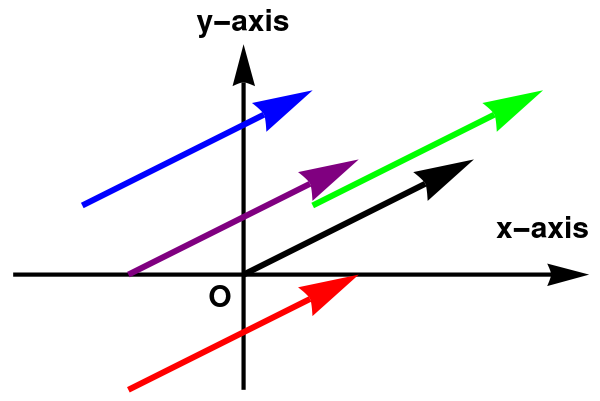
As it is seen from Figure 1, a free vector can start at any point on the plane, so it is not clear how they can be identified in computer memory. Mathematicians found a way how to marry free vectors with points---they call this new object the affine space (see a linear algebra course). Every point P(x, y) on the plane ℝ² defines uniquely a vector [x, y] started from the origin and terminated at P, so P(x, y) = O(0, 0) + [x, y]. This formula establishes a one-to-one and onto correspondence between points on the plane (ℝ²) and the set of all plane vectors starting at the origin, which is denoted by ℂ. This relation is abbreviated as ℂ ≌ ℝ². The vector [x, y] ∈ ℂ is called the affix of the point P that represents it.
Elements of ℂ, the set of vectors on the plane starting at the origin, are called complex numbers (a rigorous definition will be given shortly); they are usually denoted by lower case letters written in italic style rather than bold font as a regular notation of vectors. This set is also called the complex plane. A geometrical representation of complex numbers as plane vectors is known as an Argand diagram. Though named after Jean-Robert Argand (1768–1822), such plots were first described by Norwegian–Danish land surveyor and mathematician Caspar Wessel (1745–1818). Every complex number z = [x, y], which is actually a vector starting at the origin, can be expanded as a linear combination
The historical development of complex numbers is marked by mystery, controversy, and conceptual difficulties. Even such eminent figures as Descartes, Leibniz, Fermat, and the visionary Newton largely avoided or dismissed the subject. It is therefore unsurprising that the terminology surrounding complex numbers contains elements that appear strange or illogical. For example, the objects that function as vectors in the complex plane ℂ are conventionally referred to as “numbers.” The word "complex" means union or combination of two components (real numbers).
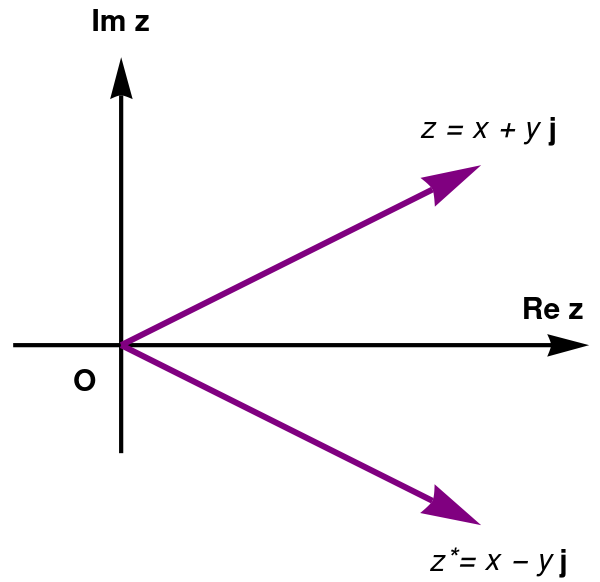
In 1777, the greatest mathematician of 18th century Leonhard Euler (1707--1783) introduced two notations: replace the unit vector along abscissa by 1 (or dropping ⅈ) and use i instead of ⅉ. This allows him to write a complex vector algebraicly as
Direct product
Now we define ℂ algebraically, posponing its rigorous definition till next subsection. Since the set of real numbers is a vector space, we define ℝ² as the direct product of two copies of ℝ that inherites the algebraic structure of ℝ as a vector space.-
Additive axioms. For every z₁, z₂, z₃ in ℝ², we have
- z₁ + z₂ = z₂ + z₁,
- (z₁ + z₂) + z₃ = z₁ + (z₂ + z₃),
- 0 + z = z + 0 = z,
- (−z) + z = z + (−z) = 0.
-
Multiplicative axioms. For every z in ℝ² and real numbers α, β, we have
- 0·z = z·0 = 0,
- 1·z = z·1 = z,
- (αβ)·z = α·(β·z).
-
Distributive axioms. For every z₁, z₂ in ℝ² and real numbers α, β, we have
- α·(z₁ + z₂) = α·z₁ + α·z₂,
- (α + β)·z = α·z + β·z.
-
For two arbitrary complex numbers z = [x, y] = x + ⅉy and w = [𝑎, b] = 𝑎 + ⅉb. we have
\[
\left[ x, y \right] + \left[ a, b \right] = \left[ a+x, b+y \right] = \left[ a, b \right] + \left[ x, y \right]
\]
because sums of reals are real and they commute.
Also, for any real number λ, \[ \lambda\left[ x, y \right] = \left[ \lambda\,x, \lambda\,y \right] . \]
- We have \begin{align*} \left( z_1 + z_2 \right) + z_3 &= \left( \left[ x_1 , y_1 \right] + \left[ x_2 , y_2 \right] \right) + \left[ x_3 , y_3 \right] \\ &= \left[ x_1 , y_1 \right] + \left( \left[ x_2 , y_2 \right] + \left[ x_3 , y_3 \right] \right) . \end{align*}
- For any complex number z = [x, y], we have \[ \left[ x, y \right] + \left[ 0, 0 \right] = \left[ 0, 0 \right] + \left[ x, y \right] = \left[ x, y \right] . \]
- For any complex number z = [x, y], its additive inverse is −z = [−x, −y] because \[ z + (-z) = \left[ x , y \right] + \left[ -x , -y \right] = \left[ 0, 0 \right] . \]
- Distributivity over vector addition: \begin{align*} \lambda \left( z_1 + z_2 \right) &= \lambda \left( \left[ x_1 , y_1 \right] + \left[ x_2 , y_2 \right] \right) = \lambda \left[ x_1 + x_2, y_1 + y_2 \right] \\ &= \lambda\,z_1 + \lambda\,z_2 . \end{align*}
- Distributivity over scalar addition: \begin{align*} \left( \lambda + \mu \right) z &= \left( \lambda + \mu \right) \left[ x , y \right] = \left[ \left( \lambda + \mu \right) x , \left( \lambda + \mu \right) y \right] \\ &= \left[ \lambda\,x , \lambda\,y \right] + \left[ \mu\,x , \mu\,y \right] . \end{align*}
- Associativity of scalar multiplication: \[ \lambda \left( \mu\,z \right) = \lambda \left[ \mu\,x , \mu\,y \right] = \left[ \lambda\mu\,x , \lambda\mu\,y \right] \]
- Multiplicative identity: 1•z = z componentwise.
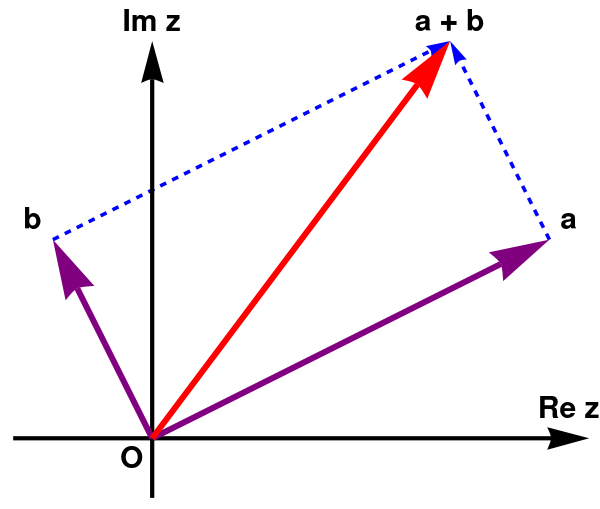
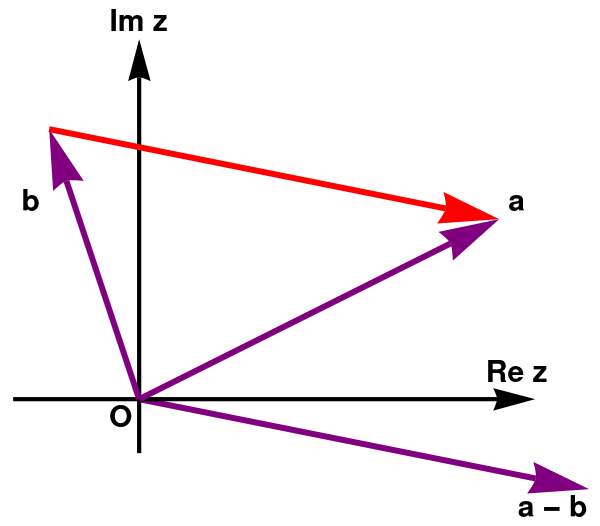
What distinguishes the complex linear space ℂ from the real linear space ℝ² is the substraction operation where the difference of two vectors is the vector which must be moved to start at the origin.
 |
 |
|
| Figure 3: Sum of two complex numbers | Figure 4: Difference of two complex numbers |
Definitioon of complex numbers
Since the set of real numbers is a field, we remind its definition.
- for all [x, y], [𝑎, b] ∈ ℂ : [x, y] + [𝑎, b] ∈ ℂ;
- for all [x, y], [𝑎, b], [c, d] ∈ ℂ : ([x, y] + [𝑎, b]) + [c, d] = [x, y] + ([𝑎, b] + [c, d]);
- for all [x, y], [𝑎, b] ∈ ℂ : [x, y] + [𝑎, b] = [𝑎, b] + [x, y];
- for all [x, y] ∈ ℂ : [x, y] + [0, 0] = [x, y];
- for all [x, y] ∈ ℂ : [x, y] + [−x, −y] = [0, 0];
- for all [x, y], [𝑎, b] ∈ ℂ : [x, y] • [𝑎, b] ∈ ℂ;
- for all [x, y], [𝑎, b], [c, d] ∈ ℂ : ([x, y] • [𝑎, b]) • [c, d] = [x, y] • ([𝑎, b] • [c, d]);
- for all [x, y], [𝑎, b] ∈ ℂ : [x, y] • [𝑎, b] = [𝑎, b] • [x, y];
- for all [x, y] ∈ ℂ : [x, y] • [1, 0] = [x, y];
- for all [x, y] ∈ ℂ ∖ {[0, 0]} : \( \displaystyle \quad \left[ x, y \right] \cdot \left[ \frac{x}{x^2 + y^2}, \ \frac{-y}{x^2 + y^2} \right] = \left[ 1, 0 \right] . \)
- distributive rule: for all [x, y], [𝑎, b], [c, d] ∈ ℂ : [x, y] • ([𝑎, b] + [c, d]) = [x, y] • [𝑎, b] + [x, y] • [c, d];
The function ϕ : ℝ → ℝ × {0} ⊂ ℂ defined by ϕ(x) = (x, 0) is an isomorphism between the above fields.
We collect some other properties of complex numbers in the follwoing statement.
- \( \displaystyle \quad \overline{z_1 z_2} = \overline{z_1}\cdot \overline{z_2} = z_1^{\ast} z_2^{\ast} = \left( z_1 z_2 \right)^{\ast} , \)
- \( \displaystyle \quad \overline{\overline{z}} = z = \left( z^{\ast} \right)^{\ast} , \)
- \( \displaystyle \quad |\overline{z} | = |z| = \left\vert z^{\ast} \right\vert , \)
- \( \displaystyle \quad z\,\overline{z} = | z |^2 = z\,z^{\ast} , \)
- \( \displaystyle \quad \frac{1}{z} = \frac{\overline{z}}{| z |^2} \quad \) for z ≠ 0,
- −|z| ≤ Re(z) ≤ |z|, \quad −|z| ≤ Im(z) ≤ |z|,
- |z₁ + z₂| ≤ |z₁| + |z₂| . where \( \displaystyle \quad \overline{z} = \overline{a + {\bf j}\,b} = a - {\bf j}\,b = \left( a + {\bf j}\,b \right)^{\ast} = z^{\ast} \quad \) is complex conjugate of complex number z.
Matrix representation
- Show that the equation of a line in complex plane \[ z = a + b\,t, \qquad \mbox{where} \quad a \in \mathbb{C}, \ b\in \mathbb{C} \setminus \{ 0 \} , \ t \in \mathbb{R}, \] can be written as \[ \mbox{Im} \frac{z-a}{b} = 0 , \qquad b\ne 0. \]
- Apostol, T.M., Calculus, Vol. 2: Multi-Variable Calculus and Linear Algebra with Applications to Differential Equations and Probability, Wiley; 2nd edition, 1991; ISBN-13: 978-0471000075.