Preface


This tutorial was made solely for the purpose of education and it was designed for students taking Applied Math 0340. It is primarily for students who have some experience using Mathematica. If you have never used Mathematica before and would like to learn more of the basics for this computer algebra system, it is strongly recommended looking at the APMA 0330 tutorial. As a friendly reminder, don't forget to clear variables in use and/or the kernel. The Mathematica commands in this tutorial are all written in bold black font, while Mathematica output is in regular fonts.

Finally, you can copy and paste all commands into your Mathematica notebook, change the parameters, and run them because the tutorial is under the terms of the GNU General Public License (GPL). You, as the user, are free to use the scripts for your needs to learn the Mathematica program, and have the right to distribute and refer to this tutorial, as long as this tutorial is accredited appropriately. The tutorial accompanies the textbook Applied Differential Equations. The Primary Course by Vladimir Dobrushkin, CRC Press, 2015; http://www.crcpress.com/product/isbn/9781439851043

Return to computing page for the first course APMA0330
Return to computing page for the second course APMA0340
Return to Mathematica tutorial for the first course APMA0330
Return to Mathematica tutorial for the second course APMA0340
Return to the main page for the first course APMA0330
Return to the main page for the second course APMA0340
Return to Part VI of the course APMA0340
Introduction to Linear Algebra

Laplace equation in a wedge


Laplace’s equation in polar coordinates can be wrriten as
\begin{equation} \label{EqCorner.1} u_{rr}+\frac{1}{r}u_r+\frac{1}{r^2}u_{\theta \theta }=0. \end{equation}
Let the wedge Wα and the sector SR be
\[ W_{\alpha} = \left\{ (r, \theta ) \ : \ 0 < r < \infty , \quad 0 < \theta < \alpha \right\} , \quad S_R = W_{\alpha} \cap \left\{ 0 < r < R \right\} . %\left\{ (r, \theta ) \ : \ 0 < r < R , \quad 0 < \theta < \alpha \right\} . \]
   
Example 1: We solve Laplace's equation by separation of variable. So we seek solutions of Eq.(1) in the form u(r, θ) = R(r) Θ(θ). Multiplying Laplace's equation by r² andstituting the product instead of u(r, θ), we obtain \[ r^2 R'' (r)\,\Theta (\theta ) + r\, R' (r)\,\Theta (\theta ) + R(r)\,\Theta'' (\theta ) = 0 . \] Division by R(r) Θ(θ) yields \[ \frac{1}{R(r)} \left[ r^2 R'' (r) + r\, R' (r) \right] + \frac{\Theta'' (\theta )}{\Theta (\theta )} = 0 . \] Separating variable, we equate both sides to a constant \[ \frac{1}{R(r)} \left[ r^2 R'' (r) + r\, R' (r) \right] = - \frac{\Theta'' (\theta )}{\Theta (\theta )} = \lambda . \] This leads to two ODEs \[ r^2 R'' (r) + r\, R' (r) - \lambda\,R(r) = 0 \] and \[ \Theta'' (\theta ) + \lambda\,\Theta (\theta ) = 0 \] Adding homogeneous boundary conditions u(r, θ = 0) = 0 and u(r, θ = α) = 0, we get the angular Sturm--Liouville problem \[ \begin{split} \Theta'' (\theta ) + \lambda\,\Theta (\theta ) &= 0 , \\ \Theta (0) = 0, \quad \Theta (\alpha ) &= 0. \end{split} \] A standard approach for this problem reveals that the angular Sturm--Liouville problem has discrete number of eigenvalues and corresponding eigenfunctions: \[ \lambda_n = \left( \frac{n\pi}{\alpha} \right)^2 , \quad \Theta_n (\theta ) = A_n \cos \left( \frac{n\pi x}{\alpha} \right) + B_n \sin \left( \frac{n\pi x}{\alpha} \right) , \qquad n=0,1,2,\ldots . \] Here Aₙ and Bₙ are arbitrary constants. Substituting instead of λ eigenvalues into the radial equation, we obtain the Euler differential equation \[ r^2 R'' (r) + r\, R' (r) - \left( \frac{n\pi}{\alpha} \right)^2 R(r) = 0 . \] When n = 0, this equation has the general solution \[ R_0 (r) = A + B\,\ln r , \qquad r> 0 . \] When n ≠ 0, the radial differential equation admits a power solution R(r) = rβ, for some real β. Since its derivatives are \[ R' (r) = \beta\, r^{\beta -1} , \qquad R'' (r) = \beta\left( \beta -1 \right) r^{\beta -2} , \] we get \[ r^2 R'' (r) + r\, R' (r) - \lambda_n R = \left[ \beta\left( \beta -1 \right) + \beta - \left( \frac{n\pi}{\alpha} \right)^2 \right] r^{\beta} = 0 . \] This equation is satisfies when \[ \beta^2 = \left( \frac{n\pi}{\alpha} \right)^2 , \qquad n=1,2,\ldots . \] Therefore, the radial differential equation has the general solution \[ R_n (r) = a_n r^{n\pi /\alpha} + b_n r^{-n\pi /\alpha} , \qquad n=1,2,\ldots. \]    ■
End of Example 1


Summary


General Separation‑of‑Variables leads to angular Sturm--Liouville problem with eigenvalues
\[ \lambda _n =\frac{n\pi }{\alpha },\qquad n=0,1,2,\dots \]
Thus, the general harmonic function in a wedge is:
\[ u(r,\theta )=A_0+B_0\ln r+\sum _{n=1}^{\infty }r^{\lambda _n}\left( A_n\sin (\lambda _n\theta )+B_n\cos (\lambda _n\theta )\right) . \]
If the boundary conditions are Dirichlet on both sides (i.e., u(r, 0) = u(r, α) =0), then only sine terms survive:
\[ u(r,\theta )=\sum _{n=1}^{\infty }a_n\, r^{n\pi /\alpha }\, \sin \! \left( \frac{n\pi \theta }{\alpha }\right) . \]
If the boundary conditions are Neumann on both sides (i.e., uθ(r, 0) = uθ(r, α) = 0), then only cosine terms survive:
\[ u(r,\theta )=a_0+b_0\ln r+\sum _{n=1}^{\infty }a_n\, r^{n\pi /\alpha }\, \cos \! \left( \frac{n\pi \theta }{\alpha }\right) . \]
These are the canonical formulas in Copson, Kellogg, and Sneddon.

Explicit Harmonic Monomials in a Wedge. The basic building blocks are:

\[ u_n(r,\theta )=r^{n\pi /\alpha }\sin \! \left( \frac{n\pi \theta }{\alpha }\right) , \]
\[ v_n (r,\theta ) = r^{n\pi /\alpha }\cos \! \left( \frac{n\pi \theta }{\alpha }\right) . \]
These are harmonic because:
\[ \Delta \left( r^{\lambda }\sin (\lambda \theta )\right) =0,\qquad \Delta \left( r^{\lambda }\cos (\lambda \theta )\right) =0. \]
This is the complete set of homogeneous harmonic functions in a wedge.    

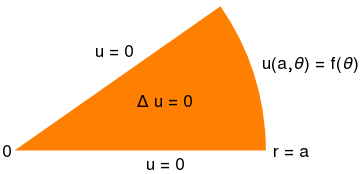
Example 2: Consider Laplace's equation in a sector:

\[ \begin{split} u_{rr} + \frac{1}{r}\,u_r + \frac{1}{r^2}\, u_{\theta\theta} &=0 , \qquad 0 < r < a, \quad 0 < \theta < \alpha , \\ u(r,0) =0 , \quad u(r, \alpha ) &=0 , \qquad u(a, \theta ) = f(\theta ) , \\ u(r, \theta ) \ \mbox{ is bounded as }\ r \to 0 &\qquad ({\bf wedge\ condition}). \end{split} \]
w = Graphics[{Orange, Disk[{0, 0}, 1, {0, 35 Degree}]}];
text1 = Graphics[ Text[Style["\[CapitalDelta] u = 0", FontSize -> 16], {0.6, 0.2}]];
text2 = Graphics[Text[Style["u = 0", FontSize -> 16], {0.4, 0.4}]]; text3 = Graphics[Text[Style["u = 0", FontSize -> 16], {0.6, -0.05}]]; text4 = Graphics[ Text[Style["u(a,\[Theta]) = f(\[Theta])", FontSize -> 16], {1.18, 0.35}]]; txt0 = Graphics[Text[Style["0", FontSize -> 16], {-0.03, 0.0}]]; txtr = Graphics[Text[Style["r = a", FontSize -> 16], {1.1, 0.0}]]; Show[w, text1, text2, text3, text4, txt0, txtr]
To solve the given boundary value problem, we apply separation of variables. So we seek partial nontrivial (not identically zero) solutions of the auxiliary problem
\[ \begin{split} u_{rr} + \frac{1}{r}\,u_r + \frac{1}{r^2}\, u_{\theta\theta} &=0 , \qquad 0 < r < a, \quad 0 < \theta < \alpha , \\ u(r,0) =0 , \quad u(r, \alpha ) &=0 , \\ u(r, \theta ) \ \mbox{ is bounded as }\ r \to 0 &\qquad ({\bf wedge\ condition}), \end{split} \]
and represented as a product: u(r,θ) = R(r) ⋅ Θ(&theta). Substitution of this product into the Laplace equation yields
\[ r^2 \frac{R'' + \frac{1}{r}\,R'}{R} = - \frac{\Theta'' (\theta )}{\Theta (\theta )} = \lambda^2 , \]
where we denote by λ² the constant of separation. From the above equations, we derive two differential equations containing a parameter λ:
\[ \begin{split} r^2 R'' (r) + r\, R' (r) - \lambda^2 R &=0 , \\ \Theta'' (\theta ) + \lambda^2 \Theta (\theta ) &=0 , \qquad \Theta (\theta ) = \Theta (\theta + 2 \pi ) . \end{split} \]
The latter is the Sturm--Liouville problem that is not hard to solve:
\[ \Theta_n (\theta ) = \sin \left( \frac{n\pi\theta}{\alpha} \right) \qquad \mbox{for} \quad \lambda_n = \frac{n\pi}{\alpha} , \quad n=1,2,\ldots . \]
Note that λ = 0 is not an eigenvalue because the corresponding eigenfunction Θ0 = a+ bθ must be identically zero to satisfy the homogeneous boundary condition.

Therefore, we get a discrete sequence of positive eigenvalues

\[ \lambda_n = \frac{n\pi}{\alpha} , \quad n=1,2,\ldots , \]
that we will use to solve the Euler differential equation for R(r). If we choose R(r) to be a power function R(r) = rk, we get
\[ R(r) = r^k , \quad r\, R' (r) = k\, r^k , \quad r^2 R'' (r) = k(k-1)\,r^k . \]
So we obtain an algebraic equation for k:
\[ k(k-1) + k - n^2 =0 \qquad \Longrightarrow \qquad k = \pm n. \]
Hence, the general solution for the Euler equation \( r^2 R'' + r\, R' - n^2 R =0 \) becomes
\[ R_n (r) = a_n r^n + b_n r^{-n} , \qquad n=1,2,3,\ldots . \]
Since this function must be bounded at the origin (wedge condition), we are forced to set bn = 0. Adding all nontrivial solution, we obtain
\[ u(r,\theta ) = \sum_{n\ge 1} R_n (t)\, \Theta_n (\theta ) = \sum_{n\ge 1} a_n r^{n\pi /\alpha} \, \sin \left( \frac{n\pi \theta}{\alpha} \right) . \]
To satisfy the boundary condition for r = a, we have to determine the values of coefficients an from the equation
\[ u(a, \theta ) = f(\theta ) = \sum_{n\ge 1} a_n a^{n\pi /\alpha} \, \sin \left( \frac{n\pi \theta}{\alpha} \right) , \]
which is actually the Fourier sine series. Therefore,
\[ a_n = a^{-n\pi/\alpha} \,\frac{2}{\alpha} \int_0^{\alpha} f(\theta )\, \sin \left( \frac{n\pi \theta}{\alpha} \right) {\text d}\theta , \qquad n=1,2,\ldots . \]
   ■
End of Example 2
   
Example 3: We want to solve the boundary value problem in half plane y > 0: \[ \begin{split} \nabla^2 u &= 0 \qquad\mbox{in} \quad \mathbb{H} = \left\{ (x,y) \in \mathbb{R}^2 \ : \ y> 0 \right\} , \\ u(x, 0) &= f(x) . \\ u , \ u_x , \ u_y \to 0& \quad \mbox{as} \quad x \to \pm \infty , \ y \to +\infty . \end{split} \tag{3.4} \] Its solution takes the form \[ u(x, y) = \int_{\partial\mathbb{H}} f\,\nabla G \bullet \hat{\bf n}\,{\text d}s = \int_{\partial\mathbb{H}} f\,\frac{\partial G}{\partial \hat{\bf n}}\,{\text d}s , \] where \[ G(x, y, \xi , \eta ) = \frac{1}{4\pi}\, \ln \left( (x-\xi )^2 + (y-\eta )^2 \right) - \frac{1}{4\pi}\, \ln \left( (x-\xi )^2 + (y+\eta )^2 \right) \] is the Green function for the half plane. Taking normal derivative, we get \[ \frac{\partial G}{\partial \hat{\bf n}} = \left. \frac{\partial G(x,y,\xi , \eta }{\partial \eta} \right\vert_{\eta = 0} = \frac{1}{\pi} \, \frac{y}{(x-\xi )^2 + y^2} . \] This function is known as the Poisson kernel for the Dirichlet problem, and it is denoted by P or Py. For ℍ, the Poisson kernel becomes \[ P_{\mathbb{H}}(x,y;\xi ) = P_y (x-\xi , y) =\frac{1}{\pi }\, \frac{y}{(x-\xi )^2+y^2} . \tag{2.5} \] So the harmonic extension of boundary data g(ξ) on ℝ is \[ U(x,y)=\int _{-\infty }^{\infty }P_{\mathbb{H}}(x,y;\xi )\, f(\xi )\, {\text d}\xi . \tag{2.6} \] We can determine the Poisson kernel (2.5) in another way by applying Fourier transformations. First, we apply the sine-Fourier transform with respect to variable y to Laplace's equation \[ \frac{{\text d} u^S}{{\text d} x^2} - k^2 u^S + k\,f(x) = 0 \tag{2.7} \] because \begin{align*} \int_0^{\infty} \frac{\partial^2 u}{\partial y^2}\,\sin (ky)\,{\text d} y &= \left. \frac{\partial u}{\partial y}\,\sin (ky) \right\vert_{y=0}^{\infty} - \int_0^{\infty} \frac{\partial u}{\partial y}\,k\,\cos (ky) \,{\text d}y \\ &= - \left. u(x,y) \,k\,\cos (ky) \right\vert_{y=0}^{\infty} - k^2 \int_0^{\infty} u(x,y)\,\sin (ky)\,{\text d} y \\ &= k\,f(x) - k^2 u^s (x,k) . \end{align*} Here \( \displaystyle \quad u^s (x,k) = \int_0^{\infty} u(x,y)\,\sin (ky)\,{\text d}y \quad \) is the sine-Fourier transform of function u. Using Mathematica, we find its solution \[ u^s (x,k) = -\frac{1}{2} \int_{-\infty}^{x} e^{-k(x -\xi )} f(\xi )\,{\text d}\xi - \frac{1}{2} \int_{x}^{\infty} e^{k(x -\xi )} f(\xi )\,{\text d}\xi . \]
DSolve[v''[x] - k^2 *v[x] + k*f[x] == 0, v[x], x]
{{v[x] -> E^(k x) C[1] + E^(-k x) C[2] + E^(-k x) (E^(2 k x) Inactive[Integrate][-(1/2) E^(-k K[1]) f[K[1]], {K[1], 1, x}] + Inactive[Integrate][ 1/2 E^(k K[2]) f[K[2]], {K[2], 1, x}])}}
Application of the inverse sine-Fourier transform yields
Integrate[Exp[-k*a]*Sin[k*x], {k, 0, Infinity}]
ConditionalExpression[x/(a^2 + x^2), Abs[Im[x]] < Re[a]]
\[ u(x,y) = \frac{2}{\pi} \int_0^{\infty} u^s (x, k)\,\sin (ky)\,{\text d}k = \frac{1}{\pi}\,\int_{-\infty}^{+\infty} \frac{y}{(x-\xi )^2 + y^2} \,f(\xi )\,{\text d}\xi . . \] The Green function for this Dirichlet problem for Laplace's equation in the upper half-plane is known as the Poisson kernel: \[ P(x,y) = \frac{1}{\pi}\cdot \frac{y}{x^2 + y^2} \quad \Longrightarrow \quad u(x,y) = \int_{-\infty}^{\infty} P(x-\xi , y)\,f(\xi )\,{\text d}\xi . \]

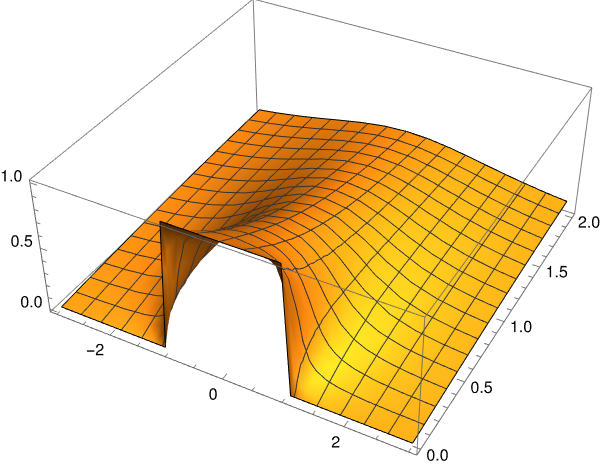
Example A (temperature distribution): Suppose the temperature along the real axis is maintained at T = 1 for −1 ≤ ξ ≤ 1 and T = 0 everywhere else on the real axis. We can use the Poisson kernel to find the temperature everywhere on the upper half-plane. We have \[ u(x,y) = \frac{y}{\pi} \int_{-1}^1 \frac{{\text d}\xi}{(x-\xi )^2 + y^2} . \] The integral can be done by substitution, though Mathematica helps

Integrate[1/((x - xi)^2 + y^2), {xi, -1, 1}]
ConditionalExpression[(ArcTan[(1 - x)/y] + ArcTan[(1 + x)/y])/y, Or[ And[Im[x] != Re[y], Or[ And[Im[x] + Re[y] != 0, Or[Re[x] + Im[x] Im[y]/Re[y] >= 1, 1 + Re[x] + Im[x] Im[y]/Re[y] <= 0]], And[Im[x]^2 Re[y]^(-2) <= 1, Or[1 + Im[y] < Re[x], Im[y] > 1 + Re[x]]]]], Im[x]^2 < Re[y]^2, And[Im[x]^2 Re[y]^(-2) <= 1, Im[x] + Re[y] != 0, Or[Im[y] + Re[x] > 1, 1 + Im[y] + Re[x] < 0]]]]
\[ u(x,y) = \frac{1}{\pi} \left[ \mbox{arctan}\left( \frac{1-x}{y} \right) + \mbox{arctan}\left( \frac{1+x}{y} \right \right) \right] . \]
Plot3D[(ArcTan[(1 - x)/y] + ArcTan[(1 + x)/y])/Pi, {x, -3, 3}, {y, 0, 2}]
Figure 3,1: Temperature distribution.

   ■
End of Example 3
   
Example 4: Let us consider the Neumann problem for Laplace's 2D equation \[ \begin{split} \nabla^2 u &= 0 , \quad y > 0, \\ \left. \frac{\partial u}{\partial \hat{\bf n}} \right\vert_{y=0} &= - \frac{\partial u}{\partial y}(x, 0) = g(x) , \quad x\in \mathbb{R} , \\ u , \ u_x , \ u_y \to 0& \quad \mbox{as} \quad x \to \pm \infty , \ y \to +\infty ; \\ \int_{-\infty}^{+\infty} g(x)\,{\text d}x &= 0 \qquad (\mbox{compatibility condition}). \end{split} \] The Neumann problem may have a solution when the compatibility condition is not valid---in this case, the solution will not stay bounded as y → +∞. We require this condition holds because we will apply Fourier transformation to the Neuman problem, and zero Fourier mode forces \( \displaystyle \quad \hat{g} (0) = \int_{\mathbb{R}} g(x)\,{\text d}x = 0 . \)

To solve this boundary value problem, we apply cosine-Fourier transform with respect to variable y. Integrating by parts twice and taking into account the regularity condition at infinity, we get \begin{align*} \int_0^{\infty} \frac{\partial^2 u}{\partial y^2}\,\cos (ky)\,{\text d}y &= \left. \frac{\partial u}{\partial y}\,\cos (ky) \right\vert_{y=0}^{\infty} + k \int_0^{\infty} \frac{\partial u}{\partial y} \,\sin (ky)\,{\text d}y \\ &= g(x) + k \,\left. u(x,y)\,\sin (ky) \right\vert_{y=0}^{\infty} - k^2 \int_0^{\infty} u(x,y)\,\cos (ky)\,{\text d}y \\ &= g(x) - k^2 u^c (x,k) , \end{align*} where \[ u^c (x,k) = \int_0^{\infty} u(x,y)\,\cos (ky)\,{\text d} y \] is the cosine Fourier transform of unknown function u. This leads to the ODE in variable x ∈ ℝ: \[ \frac{{\text d}^2 u^c}{{\text d} x^2} - k^2 u^c + g(x) = 0 , \qquad x\in \mathbb{R} . \] We ask Mathematica to solve this ODE:

DSolve[v''[x] - k^2 *v[x] == -g[x] , v[x], x]
{{v[x] -> E^(k x) C[1] + E^(-k x) C[2] + E^(-k x) (E^(2 k x) Inactive[Integrate][-((E^(-k K[1]) g[K[1]])/(2 k)), {K[1], 1, x}] + Inactive[Integrate][(E^(k K[2]) g[K[2]])/( 2 k), {K[2], 1, x}])}}
\[ u^c (x, k) = \frac{1}{2k} \int_{-\infty}^{x} e^{-k (x - \xi )} g(\xi )\,{\text d}\xi + \frac{1}{2k} \int_{x}^{\infty} e^{k (x - \xi )} g(\xi )\,{\text d}\xi . \tag{4.1} \] Its derivatives are \begin{align*} \frac{{\text d} u^c}{{\text d}x} &= - \frac{1}{2} \int_{-\infty}^{x} e^{-k (x - \xi )} g(\xi )\,{\text d}\xi + \frac{1}{2} \int_{x}^{\infty} e^{k (x - \xi )} g(\xi )\,{\text d}\xi + \frac{1}{2k}\,g(x) - \frac{1}{2k}\,g(x) , \\ \frac{{\text d}^2 u^c}{{\text d}x^2} &= \frac{k}{2} \int_{-\infty}^{x} e^{-k (x - \xi )} g(\xi )\,{\text d}\xi + \frac{k}{2} \int_{x}^{\infty} e^{k (x - \xi )} g(\xi )\,{\text d}\xi - \frac{1}{2} \, g(x) - \frac{1}{2} \, g(x) \\ &= k^2 u^c (x,k) - g(x) . \end{align*} Therefore, function (4.1) satisfies the required differential equation. Now we find the inverse cosine Fourier transform. Since uc has a singularity at k = 0, we find the inverse cosine transform of its first derivative:
Integrate[(Exp[-k*a])*Cos[k*y], {k, 0, Infinity}]
ConditionalExpression[a/(a^2 + y^2), Abs[Im[y]] < Re[a]]
\[ \frac{\partial u}{\partial x} = \frac{2}{\pi} \int_0^{\infty} \frac{{\text d} u^c}{{\text d}x}\,\cos (ky)\,{\text d}k = \frac{1}{\pi}\,\int_x^{\infty} \frac{(x-\xi )}{(x-\xi )^2 + y^2} \,g(\xi )\,{\text d}\xi - \frac{1}{\pi}\,\int_{-\infty}^x \frac{(\xi -x)}{(x-\xi )^2 + y^2} \,g(\xi )\,{\text d}\xi \] Similarly, \begin{align*} \frac{\partial u}{\partial y} &= \frac{\partial}{\partial y} \,\frac{2}{\pi} \int_0^{\infty} u^c (x, k)\,\cos (ky)\,{\text d} k \\ &= -\frac{2}{\pi} \int_0^{\infty} u^c (x, k)\,k\,\sin (ky)\,{\text d} k \\ &= -\frac{1}{\pi}\, \int_{-\infty}^{\infty} \frac{y}{(\xi -x)^2 + y^2} \,g(\xi )\,{\text d}\xi = -\int_{-\infty}^{\infty} P(x-\xi , y)\,g(\xi} \,{\text d}\xi , \end{align*} where P(x, y) is the Poisson kernel.
Integrate[Exp[-a*k]*Sin[k*y], {k, 0, Infinity}]
ConditionalExpression[y/(a^2 + y^2), Abs[Im[y]] < Re[a]]
Finally, we integrate this expression and obtain \[ u(x,y) = \frac{1}{2\pi}\,\int_x^{\infty} \ln \left( (x-\xi )^2 + y^2 \right) g(\xi )\,{\text d}\xi - \frac{1}{2\pi}\,\int_{-\infty}^x \ln \left( (x-\xi )^2 + y^2 \right) g(\xi )\,{\text d}\xi + C , \tag{4.2} \]
Integrate[a/(a^2 + y^2), a]
1/2 Log[a^2 + y^2]
where C is a constant of integration. As formula (4.2) shows, the Neumann problem has a solution up to arbitrary additive constant. We demonstrate solutions of the Neumann problem in a couple of numerical examples.

Example A (compatibility condition fails): We work in the upper half-plane \[ \mathbb{H} = \left\{ (x,y) \in \mathbb{R}^2 \ : \ y > 0 \right\} , \] with Neumann condition \[ \frac{\partial u}{\partial y}(x,0) = -g(x) . \] Let us take u(x, y) = xy. This function is harmonic because \[ \frac{\partial^2}{\partial x^2}\,u(x,y) = \frac{\partial^2}{\partial y^2}\,u(x,y) = 0. \] The Neuman boundary condition prescribes normal derivative, not the value of the function, so it reads \[ \left. \frac{\partial u}{\partial y} \right\vert_{y=0} = x \ \nexists \ 𝔏²(\mathbb{R}) . \] Formally, function uy(x,0) = x is not integrable; however, under the Cauchy principal value regularization, the compatibility condition holds: \[ \mbox{V.P.} \int_{-\infty}^{\infty} x\,{\text d}x = \lim_{R\to +\infty} \int_{-R}^R x\,{\text d}x = 0. \] On the boundary y = 0, the outward unit normal is n = (0,-1), so \[ \frac{\partial u}{\partial {\bf n}} = \nabla u\bullet \mathbf{n} =(u_x, u_y)\bullet (0,-1) = -u_y . \] Since uy(x,y) = x, we get on y = 0: \[ \frac{\partial u}{\partial {\bf n}}(x,0)=-x. \] So u(x,y) = xy solves the Neumann problem.

Example B (compatibility condition holds): In Neumann condition \[ \frac{\partial u}{\partial y}(x,0) = -g(x) , \] we choose zero-meanNeumann data to be \[ g(x) = -2x\,e^{-x^2} . \] Using formula (4.2), we find u(x,y): \[ u(x,y) = \frac{1}{\pi}\,\int_x^{\infty} \ln \left( (x-\xi )^2 + y^2 \right) \xi \,e^{-\xi^2} \,{\text d}\xi - \frac{1}{\pi}\,\int_{-\infty}^x \ln \left( (x-\xi )^2 + y^2 \right) \xi \,e^{-\xi^2} \,{\text d}\xi + C \] Integration by parts yields \begin{align*} u(x,y) &= \frac{-1}{2\pi}\,\int_x^{\infty} \ln \left( (x-\xi )^2 + y^2 \right) \frac{\text d}{{\text d}\xi} \left( e^{-\xi^2} \right) {\text d}\xi + \frac{1}{2\pi}\,\int_{-\infty}^x \ln \left( (x-\xi )^2 + y^2 \right) \frac{\text d}{{\text d}\xi} \left( e^{-\xi^2} \right) {\text d}\xi \\ &= \frac{1}{2\pi}\,\int_x^{\infty} \frac{|x-\xi |}{(x-\xi )^2 + y^2}\, e^{-\xi^2} {\text d}\xi + \frac{1}{2\pi}\,\int_{-\infty}^x \frac{|x-\xi |}{(x-\xi )^2 + y^2}\, e^{-\xi^2} {\text d}\xi \\ &= \frac{1}{2\pi}\,\int_{-\infty}^{\infty} \frac{|x-\xi |}{(x-\xi )^2 + y^2}\, e^{-\xi^2} {\text d}\xi \end{align*}

D[Log[a^2 + y^2], y]
(2 y)/(a^2 + y^2)
D[Log[a^2 + y^2], a]
(2 a)/(a^2 + y^2)
A standard trick is to write the kernel as the real part of a complex Cauchy kernel: \[ \frac{x-\xi}{(x-\xi )^2+y^2}=\Re \left( \frac{1}{x-\xi +{\bf j}y}\right) . \] So \[ \int _{-\infty }^{\infty }\frac{|x-\xi |}{(x-\xi )^2+y^2}\, e^{-\xi ^2}\, d\xi = \Re \left( \int _{-\infty }^{\infty }\frac{e^{-\xi ^2}}{x-\xi +{\bf j}y}\, d\xi \right) . \] Introduce the complex variable z = x + ⅉy. A classical Gaussian integral identity is: \[ \int _{-\infty }^{\infty }\frac{e^{-\xi ^2}}{z-\xi }\, d\xi =\pi {\bf j}\, e^{-z^2}\, \operatorname{erfc} (-{\bf j}z), \] and differentiating with respect to z gives an identity for \( \displaystyle \quad \int \frac{\xi e^{-\xi ^2}}{z-\xi }\, d\xi . \quad \) Carrying out the differentiation and simplification yields the closed form: \[ I(x,y)=\int _{-\infty }^{\infty }\frac{y}{(x-\xi )^2+y^2}\, 2\xi e^{-\xi ^2}\, d\xi = \pi \, e^{-x^2-y^2}\left[ \operatorname{erf} (x+iy)+\operatorname{erf} (x-iy)\right] . \] Thus, the solution is: \[ u(x,y)=C+\frac{1}{\pi }I(x,y)=C+e^{-x^2-y^2}\left[ \operatorname{erf} (x+{\bf j}y)+\operatorname{erf} (x-{\bf j}y)\right] . \] This is a real‑valued function because the two terms are complex conjugates.

To check this formula, we find derivatives ???? \begin{align*} \frac{\partial u}{\partial y} &= \frac{2}{\pi}\,\int_x^{\infty} \frac{y}{(x-\xi )^2 + y^2}\,\xi\,e^{-\xi^2}\,{\text d}\xi - \frac{2}{\pi}\,\int_{-\infty}^x \frac{y}{(x-\xi )^2 + y^2}\,\xi\,e^{-\xi^2}\,{\text d}\xi , \\ \frac{\partial u}{\partial x} &= \frac{2}{\pi}\,\int_{-\infty}^{\infty} \frac{|x-\xi |}{(x-\xi )^2 + y^2}\,\xi\,e^{-\xi^2}\,{\text d}\xi \end{align*}    ■

End of Example 4

Conformal Mapping Formula. The map

\[ z\mapsto w=z^{\pi /\alpha } \]
sends the wedge Wα to the upper half-plane. Thus, every harmonic function in the wedge can be written as:
\[ u(r,\theta )=\Re F\! \left( r^{\pi /\alpha }e^{i\pi \theta /\alpha }\right) = \mbox{Re}F\! \left( r^{\pi /\alpha }e^{i\pi \theta /\alpha }\right) , \]
where F is analytic in the upper half-plane. This is the most compact “explicit formula” in the literature (Nehari, Kellogg).

Explicit Poisson Kernel for a Wedge. For the wedge 0 < θ < α, the Poisson kernel is:

\[ P(r,\theta ;\phi )=\frac{1}{\alpha }\frac{\sinh \! \left( \frac{\pi }{\alpha }\ln r\right) }{\cosh \! \left( \frac{\pi }{\alpha }\ln r\right) -\cos \! \left( \frac{\pi }{\alpha }(\theta -\phi )\right) }. \]
Thus, the explicit solution of the Dirichlet problem is:
\[ u(r,\theta )=\int _0^{\alpha }P(r,\theta ;\phi )\, f(\phi )\, d\phi . \]
This is the wedge analogue of the Poisson kernel for the disk/half-plane.    
Example 5: Let the wedge be \[ W_{\alpha }=\{ (r,\theta ):r>0,\; 0<\theta <\alpha \} . \tag{2.1} \] We are looking for a harmonic function u(r, θ) in this infinite wedge domain satisfying the Dirichlet boundary conditions: \[ u(r, 0) = f_0 (r) , \qquad u(r, \alpha ) = f_{\alpha} (r) . \tag{2.2} \] We map the wedge to upper half-plane \[ w = z^{\pi /\alpha },\quad z=r\,e^{{\bf j}\theta } , \tag{2.3} \] where z = x + ⅉy and j = ⅉ is the imahinary unit on the complex plane ℂ, so ⅉ² = −1. As θ runs from 0 to α, the argument of w runs from 0 to π, so Wα maps onto the upper half-plane \[ \mathbb{H}= \{ w=x+{\bf j}\,y \ : \ y>0\} . \]

Pull back to the wedge. Let u(r, θ) be harmonic in Wα with boundary data f prescribed on the rays . Under the map w = zπ/α, the boundary of the wedge corresponds to the real axis, but the boundary parameterization changes.

Write \[ w=r^{\pi /\alpha }e^{i\pi \theta /\alpha }=x+{\bf j}y. \] On the boundary, θ = 0 or θ = α, w is real and nonzero. A convenient way to encode the boundary data is to think of f as a function of the argument ϕ ∈ (0, α) along the circular arc at some fixed radius, then use separation of variables. That route leads more cleanly to the standard closed form, so let’s switch to that. \[ P_{\alpha }(r,\theta ;\phi )=\frac{1}{\alpha }\frac{\sinh \! \left( \frac{\pi }{\alpha }\ln r\right) }{\cosh \! \left( \frac{\pi }{\alpha }\ln r\right) -\cos \! \left( \frac{\pi }{\alpha }(\theta -\phi )\right) } , \] and the harmonic extension is \[ u(r,\theta )=\int _0^{\alpha }P_{\alpha }(r,\theta ;\phi )\, f(\phi )\, d\phi . \]    ■

End of Example 5
   
Example 6: We seek a harmonic function u(r, θ) in the wedge domain Wα = { (r, θ) : 0 < r < ∞, 0 < θ < α } satisfying Neuman data of the sides \[ \frac{\partial u}{\partial n} \left( r, 0 \right) = g_0 (r) , \qquad \frac{\partial u}{\partial n} \left( r, \alpha \right) = g_{\alpha} (r) , \qquad r > 0 . \] Outward normals on the sides give \[ \frac{\partial u}{\partial n} \left( r, 0 \right) = - \frac{1}{r} \,\frac{\partial u}{\partial \theta} \left( r, 0 \right) = g_0 (r) , \qquad \frac{\partial u}{\partial n} \left( r, \alpha \right) = \frac{1}{r} \,\frac{\partial u}{\partial \theta} \left( r, \alpha \right) = g_{\alpha} (r) . \] So \[ u_{\theta} (r, 0) = -r\,g_0 (r) , \qquad u_{\theta} (r, \alpha ) = r\,g_\alpha (r) . \] Its solution is determined up to an additive constant: \[ u(r, \theta ) = C + \int_0^{\infty} N_0 (r, \theta ; \rho )\,g_0 (\rho )\,\rho\,{\text d}\rho + \int_0^{\infty} N_{\alpha} (r, \theta ; \rho )\,g_{\alpha} (\rho )\,\rho\,{\text d}\rho , \] where N₁ and Nα are the Neumann Poisson kernels associated with the sides. They are normal derivatives (in source variable) of the Neumann Green function G for the wedge Map the wedge to the upper half-plane vis \[ w = z^{\pi /\alpha} , \quad z = r\,e^{{\bf j}\theta} \qquad \Longrightarrow \qquad w = r^{\pi /\alpha}e^{{\bf j}\theta\pi /\alpha} . \] Write \[ X = r^{\pi /\alpha} \cos\frac{\pi\theta}{\alpha} , \quad Y = r^{\pi /\alpha} \sin\frac{\pi\theta}{\alpha} , \quad \xi (\rho , \phi ) = \rho^{\pi /\alpha} \cos \frac{\pi\phi}{\alpha} . \] The Neumann Poisson kernel for the upper half-plane (data on real axis) is \[ P_N (X, Y; \xi ) = \frac{1}{\pi} \left[ \frac{Y}{(X- \xi )^2 + Y^2} + \frac{Y}{(X+ \xi )^2 + Y^2} \right] . \]    ■
End of Example 6

Explicit Green Function for a Wedge. For the wedge Wα, the Green function is:

\[ G(r,\theta ;\rho ,\phi )=-\frac{1}{2\pi }\sum _{n=-\infty }^{\infty }\ln \left| re^{i\theta }-\rho e^{i(\phi +2n\alpha )}\right| . \]
This is the method of images representation (Kellogg, Jeffery). A more compact eigenfunction form is:
\[ G(r,\theta ;\rho ,\phi )=\frac{1}{\pi }\sum _{n=1}^{\infty }\frac{1}{n}\left( \frac{r_<}{r_>}\right) ^{n\pi /\alpha }\sin \! \left( \frac{n\pi \theta }{\alpha }\right) \sin \! \left( \frac{n\pi \phi }{\alpha }\right) , \]
where r< = min (r, ρ), r> = max(r, ρ).    
Example 7: The Green function for Laplace's equation in ℝ² is a solution (in distributions) of the following problem \[ \Delta G(x, y) = \delta (x)\,\delta (y) \qquad \iff \qquad \frac{\partial^2 G}{\partial x^2} + \frac{\partial^2 G}{\partial y^2} = \delta (x)\,\delta (y) , \tag{4.1} \] where δ is the Dirac delta function. Then Poisson's equation \[ \Delta u = f \] has the solution expressed via the Green function \[ u(x,y) = \iint_{\mathbb{R}^2} G(x-\xi , y-\eta )\,f(\xi , \eta )\,{\text d}\xi\,{\text d}\eta . \] Application of double Fourier transform to Eq.(4.1) yields the algebraic equation \[ - \left( \xi^2 + \eta^2 \right) G^{FF} = 1 , \] where GFF is the double Fourier transform of the Green function. Using the inverse Fourier transform, we find \[ G(x,y) = \frac{1}{\pi^2} \int_{-\infty}^{\infty} {\text d}\xi \int_{-\infty}^{\infty} {\text d}\eta\, e^{{\bf j}x\xi + {\bf j}y\eta} \] Mathematica helps:
InverseFourierTransform[1/(s^2 + t^2), {s, t}, {x, y}]
{-(1/2) (HeavisideTheta[-x1] + HeavisideTheta[x1]) (2 EulerGamma + Log[x1^2 + y^2]), -(1/ 2) (HeavisideTheta[-x2] + HeavisideTheta[x2]) (2 EulerGamma + Log[x2^2 + y^2]), -(1/ 2) (HeavisideTheta[-x3] + HeavisideTheta[x3]) (2 EulerGamma + Log[x3^2 + y^2])}
So we have \[ G(x,y) = \frac{1}{2\pi}\,\ln \sqrt{x^2 + y^2} = \frac{1}{4\pi}\,\ln \left( x^2 + y^2 \right) . \tag{4.2} \]

Next, we find the Green’s function for the half plane, { (x, y) : y > 0 }, using the Method of Images.

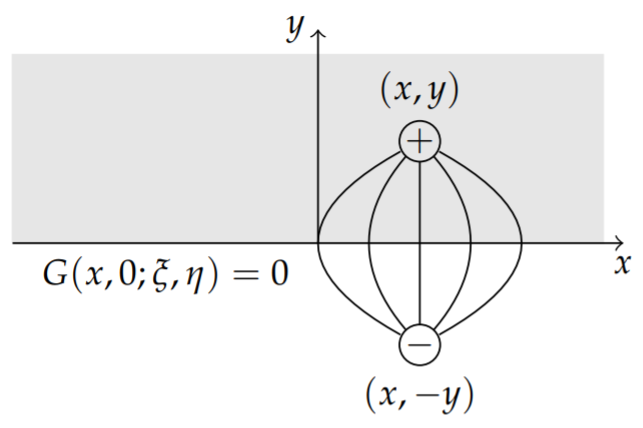
This problem can be solved using the result for the Green’s function for the infinite plane. We use the Method of Images to construct a function such that G = 0 on the boundary, y = 0. Namely, we use the image of the point (x, y) with respect to the x-axis, (x, −y).

Imagine that the Green’s function G(x, y, ξ, η) = G(x −ξ, y −η) represents a point charge at (x, y) and G(x, y, ξ, η) provides the electric potential, or response, at (ξ, η). This single charge cannot yield a zero potential along the x-axis (y = 0). One needs an additional charge to yield a zero equipotential line. This is shown in Figure 4.1.

Figure 4,1: The source and image source for the Green’s function.

The positive charge has a source of \( \displaystyle \quad \delta (\mathbf{r} - \mathbf{r}' ) \quad \) at r = (x, y) and the negative charge is represented by the source\( \displaystyle \quad \delta (\mathbf{r}^{\ast} - \mathbf{r}' ) \quad \) at r = (x, −y). We construct the Green’s functions at these two points and introduce a negative sign for the negative image source. Thus, we have \[ G(x, y,\xi, \eta ) = \frac{1}{4\pi}\,\ln \left( (x-\xi )^2 + (y-\eta )^2 \right) - \frac{1}{4\pi}\,\ln \left( (x-\xi )^2 + (y+\eta )^2 \right) . \] These functions satisfy the differential equation ΔG = δ;(x −ξ) δ;(y −η) and the boundary condition G(x, 0) = 0.    ■
End of Example 7

Special Explicit Solutions for Common Boundary Data

(a) Constant on one boundary, zero on the other. Solve:

\[ u(r,0)=0,\qquad u(r,\alpha )=1. \]
Solution:
\[ u(r,\theta )=\frac{\theta }{\alpha }. \]
(This is harmonic because it is independent of r.)

(b) Linear boundary data If

\[ u(r,0)=0,\qquad u(r,\alpha )=g(r), \]
then the solution is:
\[ u(r,\theta )=\sum _{n=1}^{\infty }a_nr^{n\pi /\alpha }\sin \! \left( \frac{n\pi \theta }{\alpha }\right) , \]
with
\[ a_n=\frac{2}{\alpha }\int _0^{\alpha }g(r)\sin \! \left( \frac{n\pi \phi }{\alpha }\right) d\phi . \]

(c) Step-function boundary data If

\[ u(r,0)=1,\qquad u(r,\alpha )=0, \]
then:
\[ u(r,\theta )=\frac{1}{2}+\frac{2}{\pi }\sum _{n=1,3,5,\dots }\frac{1}{n}\, r^{n\pi /\alpha }\, \sin \! \left( \frac{n\pi \theta }{\alpha }\right) . \]
This appears in Sneddon’s treatment of mixed problems.


Shapiro–Lopatinskiĭ condition


The Shapiro–Lopatinskiĭ condition (or Lopatinskiĭ-Shapiro condition) is a fundamental criterion in the theory of linear partial differential equations that ensures the Fredholm solvability of boundary value problems (BVPs) for elliptic operators. It requires that boundary operators are independent modulo the factor (roots in the lower half-plane) of the operator's polynomial symbo We present this condition in a simple version used in elliptic boundary value theory (Agmon–Douglis–Nirenberg, Lions–Magenes, Kozlov–Maz’ya–Rossmann).

Let us consider Laplace's equation Δu = 0 in some domain Ω with smooth boundary ∂Ω subject to the boundary condition

\[ Bu = b_1(x)\, \partial _n u +b_2(x)\, \partial _{\tau }u+b_3(x)\, u\quad \mathrm{on\ }\partial \Omega . \]
Here The Shapiro–Lopatinskiĭ condition is a local condition at each boundary point. At a boundary point, flatten the boundary so that locally: Freeze coefficients at the boundary point. Take the tangential Fourier transform in x₁:
\[ u(x_1,x_2)=e^{{\bf j}\xi x_1}v(x_2). \]
Then the PDE becomes an ODE:
\[ v''(x_2)-\xi ^2v(x_2)=0. \]
The decaying solution in the half-plane x₂ > 0 is
\[ v(x_2 ) = C\,e^{-|\xi |x_2}. \]
Apply the boundary operator to this decaying solution:
\[ B(\xi ) = b_1\, \partial _{x_2}v(0)+b_2\, ({\bf j}\xi )v(0)+b_3\, v(0). \]
Since
\[ v(0)=C,\qquad \partial _{x_2}v(0)=-|\xi |C, \]
we get the boundary symbol = -b₁| ξ | + ⅉ b₂ξ + b₃. The principal part ignores the lower‑order term bu as of lower order, so the principal boundary symbol is
\[ \mathfrak{b_{\mathrm{prin}}}(\xi )=-b_1|\xi | + {\bf j} b_2\xi , \]
and the principal SL condition is R(ξ) ≠ 0, which is equivalent to (b₁, b₂) ≠ (0,0).

Standard boundary conditions.

Shapiro–Lopatinskiĭ condition (for Laplace in 2D) says:

For every real ξ ≠ 0, the boundary symbol must not vanish:


Analytic functions


Analytic functions

Recall that both the real and imaginary parts of an analytic function satisfy Laplace’s equation in two dimensions. Suppose the region of interest is defined by the angular wedge W = 0 ≤ θ ≤ α. Consider the analytic function

\[ f(z) = z^{\pi /\alpha} = r^{\pi /\alpha} \left( \cos \frac{\pi\theta}{\alpha} + {\bf j}\,\sin \frac{\pi\theta}{\alpha} \right) , \]
of which we consider the principal branch. If α = π/m for some integer m, then f(z) is analytic everywhere. If α is an arbitrary real number, then f(z) may have a branch point at the origin, but we may choose the branch cut so that f(z) is still analytic in our region everywhere except at the origin. In fact the function \( f_n (z) = z^{n\pi /\alpha} \) for any integer n has the same nice properties. Then its real part \( u(r, \theta ) = \Re f(z) = r^{\pi /\alpha} \cos \frac{\pi\theta}{\alpha} \) and imaginary part \( v(t, \theta ) = \Im f(z) = r^{\pi /\alpha} \sin \frac{\pi\theta}{\alpha} \) are both solutions of the Laplace's equation:
\[ \Delta u =0 \qquad\mbox{and}\qquad \Delta v =0 \]
in the wedge. Thus, the potential in a wedge-shaped region W with opening angle α and conducting boundaries at potential V0 is described by the complex potential
\[ \Phi (z) = c + {\bf j}\,V_0 + \sum_n a_n z^{n\pi /\alpha} . \]
Its real part
\[ u(r, \theta ) = c + \sum_{n=-\infty}^{\infty} a_n r^{n\pi /\alpha} \cos \frac{\pi\theta}{\alpha} \]
and the imaginary part
\[ v(r, \theta ) = V_0 + \sum_{n=-\infty}^{\infty} a_n r^{n\pi /\alpha} \sin \frac{\pi\theta}{\alpha} \]
are solutions of the Laplace's equation subject to the boundary conditions:
\[ \left. \frac{\partial u}{\partial r} \right\vert_{\theta =0 \ \mbox{ or } \ \alpha} =0 \qquad\mbox{and} \qquad v(r, \theta = 0 \ \mbox{ or } \ \alpha ) = 0. \]
The coefficients an must be chosen to satisfy any remaining boundary conditions in r.

Since the origin is included within our wedge-shaped region W, the sum is over positive n only, so that the potential remains finite. Then the potential near the origin (small r) is dominated by the first (n = 1) term,and the field near the origin has components:

\[ \Delta \Phi (z) = \left( \frac{\partial^2 u}{\partial r^2} + \frac{1}{r}\, \frac{\partial u}{\partial r} + \frac{1}{r^2}\, \frac{\partial^2 u}{\partial \theta^2} \right) \Phi =0. \]
D[r^(n*Pi/a)*Cos[n*Pi/a*t] + I*r^(n*Pi/a)*Sin[n*Pi/a*t], r, r] + D[r^(n*Pi/a)*Cos[n*Pi/a*t] + I*r^(n*Pi/a)*Sin[n*Pi/a*t], r] /r + D[r^(n*Pi/a)*Cos[n*Pi/a*t] + I*r^(n*Pi/a)*Sin[n*Pi/a*t], t, t]/r^2
FullSimplify[%]
0
This is true only when \( -1 + \frac{\pi}{\alpha} > 0 \) Otherwise, π < α, the field is unbounded unless the first coefficient is zero.

As one might expect, the behavior of solution near r = 0 has to be restricted:

\[ v(r,\theta ) = c_0 + c_1 \ln r + o(1) \qquad\mbox{as} \quad r \to 0 , \]
where c0 and c1 are some constants. The constant c0 cannot be chosen arbitrary. (It is analogous to the so-called blockage coefficient in other potential flows.) The above condition on behavior of harmonic function near the corner point is called the wedge condition.

For instance, if we consider the Neumann boundary conditions on the two sides of the wedge,

\[ \begin{split} \frac{1}{r}\, \frac{\partial u}{\partial \theta} = 0 \qquad\mbox{when} \quad \theta = \alpha , \quad r> 0, \\ \frac{1}{r}\, \frac{\partial u}{\partial \theta} = f(r) \qquad\mbox{when} \quad \theta = 0 , \quad r> 0, \end{split} \]
where f is a specified function. Evidently, the solution of the problem, u, is not unique because we can always add c0 + c1 log r, where c0 and c1 are arbitrary constants.

Laplace equation in a wedge


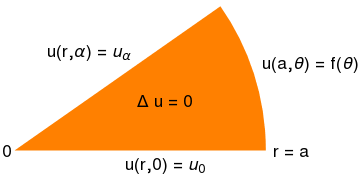
Example: Consider the Dirichlet problem for Laplace's equation in a corner:

\[ \begin{split} u_{rr} + \frac{1}{r}\,u_r + \frac{1}{r^2}\, u_{\theta\theta} =0 , \qquad 0 < r < a, \quad 0 < \theta < \alpha , \\ u(r,0) =u_0 , \quad u(r, \alpha ) = u_{\alpha} , \qquad u(a, \theta ) = f(\theta ) , \\ u(r, \theta ) \ \mbox{ is bounded as }\ r \to 0 \qquad ({\bf wedge\ condition}), \end{split} \]
where u0 and uα are given numbers.
w = Graphics[{Orange, Disk[{0, 0}, 1, {0, 35 Degree}]}];
text1 = Graphics[ Text[Style["\[CapitalDelta] u = 0", FontSize -> 16], {0.6, 0.2}]];
text2 = Graphics[ Text[Style[ "u(r,\[Alpha]) = \!\(\*SubscriptBox[\(u\), \(\[Alpha]\)]\)", FontSize -> 16], {0.3, 0.4}]]; text3 = Graphics[ Text[Style["u(r,0) = \!\(\*SubscriptBox[\(u\), \(0\)]\)0", FontSize -> 16], {0.6, -0.05}]]; text4 = Graphics[ Text[Style["u(a,\[Theta]) = f(\[Theta])", FontSize -> 16], {1.18, 0.35}]]; txt0 = Graphics[Text[Style["0", FontSize -> 16], {-0.03, 0.0}]]; txtr = Graphics[Text[Style["r = a", FontSize -> 16], {1.1, 0.0}]]; Show[w, text1, text2, text3, text4, txt0, txtr]
We reduce the given boundary value problem to the problem considered in the previous example with homogeneous boundary conditions by representing the unknown function u(r,θ) as a sum of two functions:
\[ u(r, \theta ) = w(r, \theta ) + v(r, \theta ) , \qquad\mbox{where} \quad w(r, \theta ) = \left( u_{\alpha} - u_0 \right) \frac{\theta}{\alpha} + u_0 . \]
Actually, instead of w can be used any function that satisfies the prescribed boundary conditions: \( w(r,0) = u_0 \) and \( w(r,\alpha ) = u_{\alpha} . \) Then for function v(r,θ) we get the following boundary value problem
\[ \begin{split} v_{rr} + \frac{1}{r}\,v_r + \frac{1}{r^2}\, v_{\theta\theta} =0 , \qquad 0 < r < a, \quad 0 < \theta < \alpha , \\ v(r,0) =0 , \quad v(r, \alpha ) =0 , \qquad v(a, \theta ) = f(\theta ) - w(a,\theta ), \\ v(r, \theta ) \ \mbox{ is bounded as }\ r \to 0 \qquad (\mbox{\bf wedge condition}). \end{split} \]
This is essentially the same problem that was solved in the previous example.    ■
End of Example 1
   

Example: .

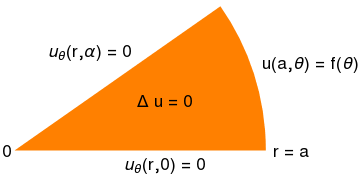
Consider the Laplace equation subject to mixed boundary conditions:
\[ \begin{split} u_{rr} + \frac{1}{r}\,u_r + \frac{1}{r^2}\, u_{\theta\theta} =0 , \qquad 0 < r < a, \quad 0 < \theta < \alpha , \\ u_{\theta} (r,0) = 0 , \quad u_{\theta} (r, \alpha ) = 0 , \qquad u(a, \theta ) = f(\theta ) , \\ u(r, \theta ) \ \mbox{ is bounded as }\ r \to 0 \qquad ({\bf wedge\ condition}). \end{split} \]
w = Graphics[{Orange, Disk[{0, 0}, 1, {0, 35 Degree}]}];
text1 = Graphics[ Text[Style["\[CapitalDelta] u = 0", FontSize -> 16], {0.6, 0.15}]];
text2 = Graphics[ Text[Style[ "\!\(\*SubscriptBox[\(u\), \(\[Theta]\)]\)(r,\[Alpha]) = 0", FontSize -> 16], {0.3, 0.4}]];
text3 = Graphics[ Text[Style["\!\(\*SubscriptBox[\(u\), \(\[Theta]\)]\)(r,0) = 0", FontSize -> 16], {0.6, -0.05}]];
text4 = Graphics[ Text[Style["u(a,\[Theta]) = f(\[Theta])", FontSize -> 16], {1.18, 0.35}]]; txt0 = Graphics[Text[Style["0", FontSize -> 16], {-0.03, 0.0}]]; txtr = Graphics[Text[Style["r = a", FontSize -> 16], {1.1, 0.0}]]; Show[w, text1, text2, text3, text4, txt0, txtr]
   ■
End of Example 1
   

Example: Consider the boundary value problem for the Laplace equation in circular domain:

\[ \begin{split} u_{rr} + \frac{1}{r}\,u_r + \frac{1}{r^2}\, u_{\theta\theta} =0 , \qquad a < r < b, \quad \alpha < \theta < \beta , \\ u_{\theta} (r,0) = 0 , \quad u_{\theta} (r, \alpha ) = 0 , \qquad u(a, \theta ) = g(\theta ) , \quad u(b, \theta ) = f(\theta ) . \end{split} \]
w = RegionPlot[ 1/2 <= x^2 + y^2 <= 2 && 0 < x && x < y , {x, 0, 2.1}, {y, 0, 2}, Frame -> False, PlotStyle -> LightOrange];
text1 = Graphics[ Text[Style["\[CapitalDelta] u = 0", FontSize -> 16, FontWeight -> "Bold"], {0.4, 1.0}]];
text2 = Graphics[ Text[Style["u(r,\[Beta]) = 0", FontSize -> 16], {-0.3, 0.74}]];
text3 = Graphics[ Text[Style["u(r,\[Alpha]) = 0", FontSize -> 16], {1.0, 0.75}]];
text4 = Graphics[ Text[Style["u(b,\[Theta]) = f(\[Theta])", FontSize -> 16], {0.8, 1.4}]];
text5 = Graphics[ Text[Style["u(a,\[Theta]) = g(\[Theta])", FontSize -> 16], {0.3, 0.45}]];
Show[w, text1, text2, text3, text4, text5]
   ■
End of Example 1
   

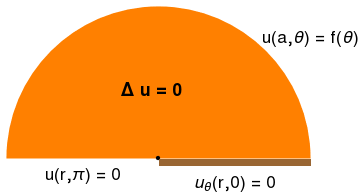
Example: Consider the boundary value problem for Laplace's equation

\[ \begin{split} u_{rr} + \frac{1}{r}\,u_r + \frac{1}{r^2}\, u_{\theta\theta} =0 , \qquad 0 < r < a, \quad 0 < \theta < \pi , \\ u_{\theta} (r,0) = 0 , \quad u (r, \pi ) = 0 , \qquad u(a, \theta ) = f(\theta ) , \end{split} \]
w = Graphics[{Orange, Disk[{0, 0}, 1, {0, Pi}]}];
text1 = Graphics[ Text[Style["\[CapitalDelta] u = 0", FontSize -> 16, FontWeight -> "Bold"], {-0.05, 0.45}]];
text2 = Graphics[ Text[Style["\!\(\*SubscriptBox[\(u\), \(\[Theta]\)]\)(r,0) = 0", FontSize -> 16], {0.5, -0.15}]];
text3 = Graphics[ Text[Style["u(r,\[Pi]) = 0", FontSize -> 16], {-0.5, -0.1}]];
text4 = Graphics[ Text[Style["u(a,\[Theta]) = f(\[Theta])", FontSize -> 16], {1.0, 0.8}]];
p = Graphics[{PointSize[Medium], Point[{0, 0}]}];
rec = Graphics[{Brown, Rectangle[{1, -0.05}, {0, 0}]}];
Show[w, text1, text2, text3, text4, p, rec]

Substituting the assumed form u(r,θ) = R(r) ⋅ Θ(&theta) into Laplace's equation, and separating variables, we obtain two differential equations

\[ \begin{split} r^2 R;; (r) + r\,R' (r) - \lambda^2 R(r) =0 , \\ \Theta'' (\theta ) + \lambda^2 \Theta (\theta ) =0 . \end{split} \]
Adding the boundary conditions at θ = 0 and θ = π, we get the Sturm--Liouville problem:
\[ \Theta'' (\theta ) + \lambda^2 \Theta (\theta ) =0 , \qquad \Theta' (0) =0, \quad \Theta (\pi ) =0. \]
So we derive the eigenvalues and corresponding eigenfunctions:
\[ \Theta_n (\theta ) = \cos \left( \frac{\theta \left( 1 + 2n \right)}{2} \right) , \qquad \lambda_n = \frac{\left( 1 + 2n \right)}{2} , \qquad n=0,1,2,\ldots . \]
Note that λ = 0 is not an eigenvalue. Then the solution to the given boundary value problem is the sum of all partial nontrivial solutions
\[ u (r,\theta ) = \sum_{n\ge 0} c_n \,r^(n+1/2) \,\cos \left( \frac{\theta \left( 1 + 2n \right)}{2} \right) . \]
To satisfy the boundary condition at r = a, we have to choose coefficients cn so that
\[ u (a,\theta ) = f(\theta ) = \sum_{n\ge 1} c_n \,a^{n+1/2} \,\cos \left( \frac{\theta \left( 1 + 2n \right)}{2} \right) . \]
Since this is just Fourier series over orthogonal set of eigenfunctions, we determine its coefficients as
\[ c_n = a^{-n-1/2} \,\frac{2}{\pi} \int_0^{\pi} f(\theta )\,\cos \left( \frac{\theta \left( 1 + 2n \right)}{2} \right) {\text d}\theta , \quad n=0,1,2, \ldots . \]
   

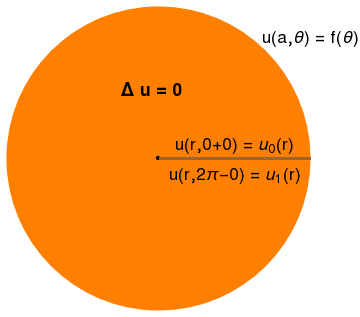
Example: Consider the boundary value problem for Laplace's equation

\[ \begin{split} u_{rr} + \frac{1}{r}\,u_r + \frac{1}{r^2}\, u_{\theta\theta} =0 , \qquad 0 < r < a, \quad 0 < \theta < 2\pi , \\ u_{\theta} (r,0+0) = u_0 , \quad u (r, 2\pi -0 ) = u_1 , \qquad u(a, \theta ) = f(\theta ) , \end{split} \]

w = Graphics[{Orange, Disk[{0, 0}, 1, {0.01, 2*Pi - 0.01}]}];
p = Graphics[{PointSize[Medium], Point[{0, 0}]}];
text1 = Graphics[ Text[Style["\[CapitalDelta] u = 0", FontSize -> 16, FontWeight -> "Bold"], {-0.05, 0.45}]];
text2 = Graphics[ Text[Style["u(r,0+0) = \!\(\*SubscriptBox[\(u\), \(0\)]\)(r)", FontSize -> 16], {0.5, 0.1}]];
text3 = Graphics[ Text[Style["u(r,2\[Pi]-0) = \!\(\*SubscriptBox[\(u\), \(1\)]\)(r)", FontSize -> 16], {0.5, -0.1}]];
text4 = Graphics[ Text[Style["u(a,\[Theta]) = f(\[Theta])", FontSize -> 16], {1.0, 0.8}]];
Show[w, text1, text2, text3, text4, p, rec]

If the boundary conditions on the crack are the same, u0 = u1, the solution can be obtained from our first two examples by taking the limit \( \lim_{\alpha \to 2\pi} u(r, \theta ) . \) When they are not the same, the problem becomes very hard to solve.    ■

End of Example 1


  1. Copson, E.T., An Introduction to the Theory of Functions of a Complex Variable, Oxford University Press, London, 1935.
  2. Kellogg, O.D., Foundations of potential theory, ‎ Dover Publications, 2010.
  3. Sneddon, I.N., Mixed Boundary Value Problems in Potential Theory, North-Holland Publishing Company, 1966.


Return to Mathematica page

Return to the main page (APMA0340)
Return to the Part 1 Matrix Algebra
Return to the Part 2 Linear Systems of Ordinary Differential Equations
Return to the Part 3 Non-linear Systems of Ordinary Differential Equations
Return to the Part 4 Numerical Methods
Return to the Part 5 Fourier Series
Return to the Part 6 Partial Differential Equations
Return to the Part 7 Special Functions