Return to computing page for the first course APMA0330
Return to computing page for the second course APMA0340
Return to computing page for the fourth course APMA0360
Return to Mathematica tutorial for the first course APMA0330
Return to Mathematica tutorial for the second course APMA0340
Return to Mathematica tutorial for the fourth course APMA0360
Return to the main page for the first course APMA0330
Return to the main page for the second course APMA0340
Return to Part V of the course APMA0340
Introduction to Linear Algebra with Mathematica
Glossary
Preface
Legendre polynomials are eigenfunctions corresponding to eigenvalues λ = n(n+1) of the singular Sturm--Liouville problem,
Legendre polynomials are a special case of Jacobi polynomials, namely, \( \displaystyle \quad P_n (x) = P_n^{(0,0)} (x) , \quad \) where the Jacobi polynomials \( \displaystyle \quad P_n^{(\alpha , \beta )} (x) \quad \) depend on two parameters α, β > −1, and satisfy the Jacobi ODE
Legendre Polynomials
Legendre's polynomial can be defined explicitly:
The values of the Legendre polynomials at the origin depend on the parity of its index:
Legendre's polynomials are orthogonal
Completeness (density)
Let ℭ([−1, 1]) denote the set of all real-valued (or complex-valued, if needed) continuous functions on interval [−1, 1]; and let 𝔄 = {1, P₁(x), P₂(x), …, Pₙ(x), … } be the set of all Legendre polynomials. By Stone–Weierstrass theorem, algebraic polynomials are uniformly dense in ℭ([−1, 1]). That is, for every f ∈ ℭ([−1, 1]) and every ε > 0, there exists a polynomial q such that
Legendre Expansions
Since Legendre's polynomials are orthogonal (their inner product is zero)
To determine the Dirichlet--Legendre kernel, we need the Christoffel–Darboux formula for a sequence of orthogonal polynomials. This formula for Legendre's polynomials was first established by Elwin Bruno Christoffel in 1858; it reads
Step 2 — Write the recurrence for both variables. For x: \[ (2k+1)xP_k(x)=(k+1)P_{k+1}(x)+kP_{k-1}(x). \] For y: \[ (2k+1)yP_k(y)=(k+1)P_{k+1}(y)+kP_{k-1}(y). \]
Step 3 — Multiply the first by Pₖ(y) and the second by Pk(x)P_k(x). So we multiply the x-equation by Pk(y): \[ (2k+1)xP_k(x)P_k(y)=(k+1)P_{k+1}(x)P_k(y)+kP_{k-1}(x)P_k(y). \] Multiply the y-equation by Pk(x): \[ (2k+1)yP_k(x)P_k(y)=(k+1)P_{k+1}(y)P_k(x)+kP_{k-1}(y)P_k(x). \]
Step 4 — Subtract the two equations. Subtract the second from the first:
Step 5 — Sum from k = 0 to n. Sum both sides over k = 0, 1, … , n: Left side: \[ (x-y)\sum _{k=0}^n(2k+1)P_k(x)P_k(y). \] Right side telescopes beautifully: The terms with k+1 and the terms with k cancel in pairs. Everything collapses except the top boundary term. After cancellation, only one term survives:
Step 6 — Divide by x-y. We obtain: The final result (Christoffel–Darboux Identity) This is exactly the identity we wanted.
Example 1: We start verification with n = 3: \[ S_3 = 1 + 3\cdot xy + 5\cdot P_2 (x)\,P_2 (y) + 7\cdot P_3 (x)\,P_3 (y) , \] which we plug in into Mathematica:
 |
 |
|
|---|---|---|
| Dirichlet--Legendre kernels with 10 and 20 terms | Shifted Dirichlet--Legendre kernels |
- Reducing properties for polynomials of degree ≤ N: \[ \int_{-1}^1 p(t)\, K_N (x,t)\,{\text d}t = p(x) . \]
- Symmetry \[ K_N (x,t) = K_N (t, x) . \]
- Normalization: the inner product with 1 is \[ \left\langle 1, K_N (x,\cdot ) \right\rangle = \int_{-1}^1 K_N (x,t)\,{\text d}t = 1 . \] because \( \displaystyle \quad \left\langle 1, P_n (\cdot ) \right\rangle = \int_{-1}^1 P_n (x)\,{\text d}t = 0 \quad \) for n = 1, 2, 3, ….
- Growth of the Dirichlet--Legendre kernel \[ \| K_N (x,t) \|_{\infty} \sim N . \]
- 𝔏¹ norm grows like lnN.
- Not positive.
-
Localization is weak:
The kernel does not concentrate strongly near t = x. Instead, it has oscillatory tails of size O(1) that decay slowly. -
Endpoint behavior is singular:
As x → ±1, the kernel becomes sharply peaked and oscillatory. This reflects the fact that Legendre polynomials have large derivatives near the endpoints---singular points of the Legendre differential equation. - Using Hilb's formula, we have \[ K_N (x, x) \sim \frac{N}{\pi \sqrt{1 - x^2}} \qquad \mbox{as }\ N \to \infty . \]
In case f(x) = xk, where k is a positive integer, it can be seen that f(x) is represented by a finite series of the polynomials because every monomial xk is a linear combination of the Legendre polynomials:
When k − r is even, we have
Example 2: We start with n = 2 and employ Mathematica:
NIntegrate[(Sin[Pi*x] - t5[x])^2 , {x, -1, 1}]
a1 = (1 + 1/2)*Integrate[Sin[Pi*x]*LegendreP[1, x], {x, -1, 1}];
a2 = (2 + 1/2)*Integrate[Sin[Pi*x]*LegendreP[2, x], {x, -1, 1}];
a3 = (3 + 1/2)*Integrate[Sin[Pi*x]*LegendreP[3, x], {x, -1, 1}];
a4 = (4 + 1/2)*Integrate[Sin[Pi*x]*LegendreP[4, x], {x, -1, 1}];
a5 = (5 + 1/2)*Integrate[Sin[Pi*x]*LegendreP[5, x], {x, -1, 1}];
NIntegrate[(Sin[Pi*x] - S5[x])^2, {x, -1, 1}]
Example 3: Polynomial expansions is a tool for approximating functions by polynomials. Suppose that we wish to find a cubic polynomial which approximates cos(πx) well. For instance we may wish to calculate the value of cos(πx) quickly. It turns out that if the Legendre expansion of cos(πx) is given by \[ \cos (\pi x) = \sum_{n\ge 0} \left( n + \frac{1}{2} \right) P_n (x) \int_{-1}^1 \cos\left( \pi t \right) P_n (t) \,{\text d} t . \] According to Mathematica, its five-term approximation is

 |
 |
|
|---|---|---|
| Fejér--Legendre kernel with 20 terms | Shifted Legendre--Fejér kernel |
- Positivity.
-
Normalization
\[
\int_{-1}^1 K_N^{(1)}(x,t) \,{\text d}t = 1 .
\]
F5[x_, t_] = Sum[(1 - n/6)*(n + 1/2)*LegendreP[n, x]*LegendreP[n, t], {n, 0, 5}]; Integrate[F5[x, t], {t, -1, 1}]1
- Approximate identity:
for any continuous function f, \[ \sigma_N (x, f) \to f(x) , \qquad \mbox{as } N\to \infty. \]- Uniform boundedness in 𝔏¹ \[ \left\| K_N^{(1)}(x,\cdot ) \right\|_1 = \int_{-1}^1 K_N^{(1)}(x,t )\,{\text d}t = 1 , \] where norm is evaluated in 𝔏¹([−1, 1]).
- Diagonal asymptotics:
Using Hilb's formula and Cesàro summation, we get \[ K_N^{(1)}(x,x) \sim \frac{2}{\pi \sqrt{1 - x^2}} \qquad \mbox{as } N \to\infty . \]- Endpoint behavior:
Near x = ±1, the Fejér--Legendre kernel has a boundary layer of width O(1/N²). The kernel remains bounded at the endpoints. It becomes sharply peaked on the scale 1/N².- Smoothness:
The Fejér--Legendre kernel is infinitely differentiable in both variables. Its derivatives satisfy \[ \left\vert \partial^k_x K_N^{(1)}(x,t) \right\vert \le C_k N^k . \]Lemma 1 (Approximate identity property of the Fejér kernels): Let x ∈ [−1, 1] be fixed. Then for every small positive δ > 0, \[ \lim_{N\to\infty} \int_{|t-x| > \delta} K_N^{(1)} (x,t)\,{\text d}t = 0. \] Equivalently, for each fixed x ∈ [−1, 1], the measures \[ \mu_A^x (A) = \int_A K_N^{(1)} (x,t)\,{\text d}t \] form an approximate identity concentrating at x.We prove this lemma in two parts:- Interior points x ∈ (−1, 1);
- end point x = 1 (and analogously x = −1).
Interior points x ∈ (−1, 1).
Fix an interior point x ∈ (−1, 1), and write \[ x = \cos\varphi , \quad t = \cos\theta , \qquad \varphi , \theta \in (0, \pi ) . \] We use a standard estimate for Legendre's polynomials in the oscillatory regime: \[ \left\vert P_n (\cos\theta ) \right\vert \le \frac{C}{\sqrt{n\,\sin\theta}} \qquad \left( C > 0, \ n \ge 1 \right) . \tag{L.1} \] This follows from from the well-known asymptotic expansion \[ P_n (\cos\theta ) = \sqrt{\frac{2}{\pi n\,\sin\theta}} \,\cos \left( \left( n + \frac{1}{2} \right) \theta - \frac{\pi}{4} \right) + O \left( \frac{1}{n^{3/2}} \right) , \quad \theta \in (0, \pi ), \ n\to \infty , \] uniform in θ ∈ [ε, π − ε], and separate (crude) bound near the endpoints; but for our purposes we treat the above inequality as a known estimate.
In particular, for fixed φ ∈ (0, π), \[ \left\vert P_n (\cos\varphi )\right\vert \le \frac{C}{\sqrt{n\,\sin\varphi}} \le \frac{C}{\sqrt{n}} . \] Thus, there is Cx > 0 depending only on x such that \[ \left\vert P_n (x) \right\vert \le \frac{C_x}{\sqrt{n+1}} , \qquad n \ge 0 . \] Consequently, \[ \left\vert \hat{P}_n (x) \right\vert = \sqrt{\frac{2n+1}{2}} \left\vert P_n (x) \right\vert \le C_x \sqrt{n+1} \, \frac{1}{\sqrt{n+1}} = C_x , \] so orthonormal Legendre polynomials are uniformly bounded in index n.
Similarly, for variable t = cosθ with θ away from 0 and π, the same estimate holds uniformly on compact subintervals of (−1, 1). This gives better control of KN(x, t) for |θ − φ| not too small.
A Fejér-type bound in the interior
It is a classical result that the orthogonal polynomial setting, for fixed interior x = cosφ, the Fejér kernel behaves like a "bump" of width ∼ 1/(N+1) in the angular variable θ, with height ∼ N+1. To make this precise, one can either:- rely on full Plancherel--Rotach asymptotics and compute the Cesàro averages in the angular variable, or
- use estimates on KN plus summation in m to obtain a bound of the form \[ \left\vert K_N^{(1)} (x, \cos\theta ) \right\vert \le \frac{C_x}{1 + (N+1)^2 (\theta - \varphi )^2} , \quad \theta \in (0, \pi ) . \]
Lemma 2A (Fejér kernel bound in the interior): For each fixed x ∈ (−1, 1), there exists a constant Cx > 0 such that \[ \left\vert K_N^{(1)} (x, \cos\theta ) \right\vert \le \frac{C_x}{1 + (N+1)^2 (\theta - \varphi )^2} , \qquad \theta \in (0, \pi ), \ x=\cos\varphi , \tag{L.2} \] for all θ ∈ (0, π), where x = cosφ. ■
We accept Lemma 2A as a classical kernel estimate; it is proved in detail in monographs on orthogonal polynomials (e.g., Szegő, Chapter VII), by combining the Christoffel–Darboux formula, the asymptotics of Pₙ(cosθ), and summation over m ((Fejér averaging).
Fix x ∈ (−1, 1) and δ > 0. We want to show \[ \int_{|t-x| > \delta} K_N^{(1)} (x,t)\,{\text d}t \ \to \ 0 . \] In angular variables, x = cosφ, t = cosθ. The map θ ↦ t = cosθ is smooth and monotone on [0, π]. The condition |t − x| > δ is equivalent to |cosθ − cosφ| > δ, which in turn implies |θ − φ| ≥ cx,δ > 0 (since cosθ is Lipschitz with nonzero derivative at interior points). Formally, there exists η such that \[ |t-x| > 0 \qquad \Longrightarrow \qquad |\theta - \varphi | > \eta . \] The change of variables t = cosθ yields dt = −sinθ dθ, so \[ \int_{|t-x| > \delta} K_N^{(1)} (x,t)\,{\text d}t = \int_{|\theta - \varphi |> \eta} K_N^{(1)} (x, \cos\theta )\,\sin\theta \,{\text d}\theta . \] Using the bound (L.1), \[ \left\vert \int_{|\theta - \varphi | > \eta} K_N^{(1)} (x, \cos\theta )\,\sin\theta\,{\text d}\theta \right\vert \le \int_{|\theta - \varphi | > \eta} \frac{C_x \,\sin\theta}{1 + (N+1)^2 (\theta - \varphi )^2}\,{\text d}\theta . \] For |θ − φ| > η, we have sinθ ≤ 1, so \[ \le C_x \int_{|\theta - \varphi | > \eta} \frac{{\text d}\theta}{1 + (N+1)^2 (\theta - \varphi )^2} . \] Now change variables \[ u = \left( N+1 \right) \left( \theta - \varphi \right) , \quad {\text d}\theta = \frac{{\text d}u}{N+1} . \] Then |θ − φ| > η becomes |u| > (N+1)η. Hence, \[ \int_{|\theta - \varphi | > \eta} \frac{{\text d}\theta}{1 + (N+1)^2 (\theta - \varphi )^2} = \frac{1}{N+1} \int_{|u| > (N+1)\eta} \frac{{\text d}u}{1 + u^2} . \] The integrand 1/(1 + u²) is integrable on ℝ, and its tail integral satisfies \[ \int_{|u| > (N+1)\eta} \frac{{\text d}u}{1 + u^2} \ \to\ 0 \quad \mbox{as }\ N\to\infty . \] Explicitly, \[ \int_{|\theta - \varphi | > \eta} \frac{{\text d}\theta}{1 + (N+1)^2 (\theta - \varphi )^2} \le \frac{2}{(N+1)\,\eta} . \] Thus, \[ \int_{|\theta - \varphi | > \eta} \frac{{\text d}\theta}{1 + (N+1)^2 (\theta - \varphi )^2} \le \frac{C'}{(N+1)^2} \] some constant C' depending on η.
Consequently, \[ \int_{|t - x| > \delta} K_N^{(1)} (x,t)\,{\text d}t \ \to \ 0 \quad \mbox{as } N \to \infty \] for each fixed interior x. This proves Lemma 1 for x ∈ (−1, 1).
Endpoint x = 1.
Now we treat the endpoint x = 1 explicitly, because the angular parametrization degenerates at this point. Let t = cosθ, θ ∈ [0, π]. We fix x = 1.
Let us consider \[ K_N^{(1)} (1, t) = K_N^{(1)} (1, \cos\theta ). \] The corresponding Christoffel–Darboux formula is simplified because Pₙ(1) = 1 for all n: \begin{align*} K_m (1, \cos\theta ) &= \sum_{k=0}^m \frac{2k+1}{2} \,P_k (1)\, P_k (\cos\theta ) = \sum_{k=0}^m \frac{2k+1}{2} \,P_k (\cos\theta ) , \\ &= \frac{m+1}{2} \cdot \frac{P_{m+1} (\cos\theta ) - P_m (\cos\theta )}{1-\cos\theta} , \end{align*} Thus, we need a bound for this expression. \[ \left\vert P_{m+1} (\cos\theta ) - P_{m} (\cos\theta ) \right\vert \le \lert\vert P_{m+1} (\cos\theta ) \right\vert + \left\vert P_{m} (\cos\theta ) \right\vert \le 2 . \] So \[ \left\vert K_m (1, \cos\theta ) \right\vert \le \frac{m+1}{2} \cdot \frac{2}{1 - \cos\theta} = \frac{m+1}{1-\cos\theta} . \] Hence, \begin{align*} \left\vert K_{N}^{(1)} (\cos\theta ) &\le \frac{1}{N+1} \sum_{m=0}^N \frac{m+1}{1-\cos\theta} \\ &= \frac{1}{1-\cos\theta} \cdot \frac{1}{N+1} \sum_{m=0}^N (m+1) \\ &= \frac{N+2}{2 \left( 1 - \cos\theta \right)} . \end{align*} Using the elementary identity \[ 1 - \cos\theta = 2\,\sin^2 \left( \frac{\theta}{2} \right) , \] we have 1 − cosθ ≥ cθ² for θ ∈ [0, π], with some constant c > 0. Hence, \[ 1 - \cos\theta \ge \frac{2}{\pi^2}\,\theta^2 , \] or \[ 1 - \cos\theta \ge C\,\theta^2 , \qquad 0 \le \theta \le \pi , \] for some absolute constant C. This is our global endpoint bound.
Behavior near the endpoint We want a better control for small θ, where 1 − cosθ is small. Use Taylor expansion of Pₙ near x = 1.
From the Legendre differential equation \[ \left( 1 - x^2 \right) P''_n (x) - 2x\,P'_n (x) + n \left( n+1 \right) P_n (x) = 0 , \] we get \[ \sup_{|x| \le 1} \left\vert P''_n (x) \right\vert \le C\,n^4 \] for some absolute constant C > 0 (we only need a rough bound). Thus, Taylor's theorem at x = 1 gives \[ P_n (x) = 1 + P'_n (1) \left( x-1 \right) + \frac{1}{2}\,P''_n (\xi ) \left( x-1 \right)^2 , \] for some ξ between x and 1. Therefore, \[ P_n (x) = 1 + \frac{n \left( n+1 \right)}{2} \left( x - 1 \right) + R_n (x) , \] where \[ | R_n (x) | \le \frac{1}{2}\,\sup_{|y|\le 1} \left\vert P''_n (y) \right\vert (x-1)^2 \le C\,n^4 \left( x-1 \right)^2 . \] For x = cosθ, θ ∈ [0, 1], say. Then \[ 1 - \cos\theta = \frac{\theta^2}{2} + O\left( \theta^4 \right) , \] and in particular, for sufficiently small θ, \[ c_1 \theta^2 \le 1 - \cos\theta \le c_2 \theta^2 , \] for some positive constants c₁, c₂. Hence, \[ P_n (\cos\theta ) = 1 - \frac{n(n+1)}{2}\,(1-\cos\theta ) + O\left( n^4\left( 1- \cos\theta \right)^2 \right) \] Now compute the difference: \[ P_{m+1} (\cos\theta ) - P_m (\cos\theta ) = -(m+1)\,(1-\cos\theta ) + O \left( m^4 (1-\cos\theta )^2 \right) . \] Since \[ (m+1)(m+2) - m(m+1) = (m+1) \left[ (m+2) - m \right] = 2(m+1) , \] Now average over m, we get the value of the Fejér kernel \begin{align*} K_N^{(1)} (1, \cos\theta ) &= \frac{1}{N+1} \sum_{m=0}^N K_m (1, \cos\theta ) \\ &= - \frac{1}{2(N+1)} \sum_{m=0}^N \left( m+1 \right)^2 + \cdots . \end{align*} The sum of squares is \[ \sum_{m=0}^N \left( m+1 \right)^2 = \sum_{k=1}^{N+1} k^2 = \frac{(N+1)(N+2)(2N+3)}{6} \sim \frac{(N+1)^3}{3} . \] Thus, the main term is of order (N+1)². The error term is \[ \frac{1}{N+1} \sum_{m=0}^N m^5 \left( 1 - \cos\theta ) \le C\,N^5 \left( 1 - \cos\theta \right) . \] So for small θ, \[ P_n (\cos\theta ) = 1 - \frac{n(n+1)}{4}\,\theta^2 + O \left( n^4 \theta^4 \right) \qquad \theta\to 0 . \] Hence, there exists C > 0 such that \[ \left\vert K_N^{(1)} (1, \cos\theta ) \right\vert \le C\left( (N+1)^2 + N^5 (1-\cos\theta ) \right) , \qquad 0 < \theta \le \pi . \] In particular, for θ small enough \[ N^5 \left( 1 - \cos\theta \right) \le C' \left( N+1 \right)^2 , \] i.e., \[ 1 - \cos\theta \le \frac{1}{N^5} \quad \iff \quad \theta \le \frac{1}{N^{3/2}} , \] we have \[ \left\vert K_N^{(1)} (1, \cos\theta ) \right\vert \le \left( N+1 \right)^2 . \] Combining with the global bound (L.2), we arrive at \[ \left\vert K_N^{(1)} (1 - \cos\theta ) \right\vert \lesssim \min \left\{ (N+1)^2 , \ \frac{N+1}{\theta^2} \right\} , \qquad 0 < \theta \le \pi . \] This is the endpoint analogue of the Fejér kernel bound in the angular variable.
Endpoint approximate identity We must show \[ \int_{|t-1| > \delta} K_N^{(1)} (1, t) \,{\text d}t \ \to \ 0 \quad \mbox{as } N \to \infty , \] for every small δ > 0.
In angular variables t = cosθ with θ ∈ [0, π], the condition |t − 1| > δ is equivalent \[ 1 - \cos\delta > \delta \quad \iff \quad \cos\theta < 1-\delta \quad \iff \quad \theta \ge \theta_0 , \] for some θ₀ = θ₀(δ) ∈ (0, π]. In particular, there exists cδ > 0 such that \[ \theta \ge \theta_0 \quad \Longrightarrow \quad \theta \ge c_{\delta} > 0 . \] Now \begin{align*} \int_{|t-1| > \delta} K_N^{(1)} (1, t)\,{\text d}t &= \int_0^{\pi} 1_{1-\cos\theta > \delta} K_N^{(1)} (1, \cos\theta )\,\sin\theta\,{\text d}\theta \\ &= \int_{\theta \ge \theta_0} K_N^{(1)} (1, \cos\theta )\,\sin\theta\,{\text d}\theta . \end{align*} Using global crude bound at the endpoint and sinθ ≤ 1, we get \[ \left\vert \int_{\theta \ge \theta_0} K_N^{(1)} (1, \cos\theta )\,\sin\theta\,{\text d}\theta \right\vert \le \int_{\theta \ge \theta_0} \left\vert K_N^{(1)} (1, \cos\theta ) \right\vert {\text d}\theta \le C \int_{\theta \ge \theta_0} \frac{N+1}{\theta^2}\,{\text d}\theta . \] But θ ≥ θ₀, so \[ \int_{\theta \ge \theta_0} \frac{N+1}{\theta^2}\,{\text d}\theta = \left( N+1 \right) \left[ -\frac{1}{\theta} \right]_{\theta_0}^{\pi} = \left( N+1 \right) \left( \frac{1}{\theta_0} - \frac{1}{\pi} \right) \sim \frac{N+1}{\theta_0} . \] This bound grows with N, so we have to be more careful: the global bound is too crude. Instead, we exploit the fact that the Fejér kernel at x = 1 has total mass 1, and the large values of the kernel are confined to a small neighborhood of size ∼ 1/(N+1). In particular, we have
- For θ ≤ α/(N+1), we have \( \displaystyle \quad K_N^{(1)} (1, \cos\theta ) \le (N+1)^2 . \)
- For θ ≥ α/(N+1), we have, which is integrable in θ on [α/(N+1), π] with total integral O(1), and moreover that integral tends to 0 as we push the lower limit to a fixed θ₀.
Fix δ > 0, let θ₀ be as above. Choose N large enough so that \[ \frac{\alpha }{N+1}<\theta _0. \] Then \[ \{ \theta \geq \theta _0\} \subset \left\{ \theta \geq \frac{\alpha }{N+1}\right\} . \] Hence, \[ \int _{\theta \geq \theta _0}|F_N(1,\cos \theta )|\, d\theta \leq \int _{\theta \geq \alpha /(N+1)}\frac{C(N+1)}{\theta ^2}\, d\theta =C(N+1)\left[ \, -\frac{1}{\theta }\right] _{\alpha /(N+1)}^{\pi }=C\left( \frac{N+1}{\alpha /(N+1)}-\frac{N+1}{\pi }\right) =C\left( \frac{(N+1)^2}{\alpha }-\frac{N+1}{\pi }\right) . \] This estimate alone still grows like (N+1)², but recall that the total mass of \( \displaystyle \quad K_N^{(1)} (1, \cos\theta )\,\sin\theta\,{\text d}\theta \quad \) is 1: \[ \int_0^{\pi} K_N^{(1)} (1, \cos\theta )\,\sin\theta\,{\text d}\theta = \int_{-1}^1 K_N^{(1)} (1, t)\,{\text d}t = 1 . \] Thus, the contribution from small region θ ≤ α/(N+1), where the Fejér kernel ∼ (N+1)², is of order \[ \int _0^{\alpha /(N+1)}(N+1)^2\sin \theta \, d\theta \sim (N+1)^2\cdot \frac{\alpha }{N+1}=\alpha (N+1), \] which would blow up unless the implicit constants are such that the mass remains 1; in fact, precise asymptotics (coming from Bessel kernels) show that:
- the height is ≈ N+1, not (N+1)², in the correct normalization for dt.
Lemma 2 (Endpoint estimate of the Fejér kernels at x = 1): Let \[ K_N^{(1)} (x,t) = \sum_{n=0}^N \left( 1 - \frac{n}{N+1} \right) \left( n + \frac{1}{2} \right) P_n (x)\,P_n (t) , \qquad x,t \in [-1, 1], \] be the Fejér--Legendre kernel. Then there exist a positive constant C such that for all integers N ≥ 0 and all θ ∈ (0, π],\[ \boxed{ \left\vert K_N^{(1)} (1,\cos\theta)\right\vert \;\le\; \frac{C\, (N+1)}{1 + (N+1)^2 \theta^2}, \qquad 0<\theta\le\pi . } \]More over, for every θ₀ > 0, it gives a clean approximate identity estimate:\[ \int _{|t-1|>\delta } K_N^{(1)} (1,t)\, {\text d}t\; \leq \; C\int_{\theta \geq \theta _0(\delta )}\frac{(N+1)}{1+(N+1)^2\theta ^2}\, {\text d}\theta = \big[ \arctan \left( (N+1)\,\theta \right) \big]_{\theta = \theta_0}^{\theta} , \]which tends to 0 as N → ∞.Integrate[a/(1 + a^2 * x^2), x]ArcTan[a x]Define the partial sum kernel \[ K_m (x,t) = \sum_{n=0}^m \left( n + \frac{1}{2} \right) P_n (x)\,P_n (t) . \] The Christoffel--Darboux formula gives \[ K_m (x,t) = \frac{m+1}{2}\cdot \frac{P_{m+1}(x)\, P_m (t) - P_m (x)\,P_{m+1} (t)}{x-t} . \] At x = 1, since Pm(1) = 1, we have \begin{equation*} K_m(1,t) = \frac{(m+1)}{2} \cdot \frac{\bigl(P_{m+1}(t)-P_m(t)\bigr)}{1-t}. \end{equation*} Hence, \begin{equation*} K_N^{(1)} (1,t) = \frac{1}{N+1}\sum_{m=0}^N K_m(1,t) = \frac{1}{N+1}\sum_{m=0}^N \frac{(m+1)}{2} \cdot \frac{\bigl(P_{m+1}(t)-P_m(t)\bigr)}{1-t}. \end{equation*} In angular variables t = cosθ, \begin{equation*} F_N(1,\cos\theta) = \frac{1}{N+1}\sum_{m=0}^N \frac{(m+1)}{2} \cdot \frac{\bigl(P_{m+1}(\cos\theta)-P_m(\cos\theta)\bigr)} {1-\cos\theta}, \qquad 0<\theta\le\pi. \end{equation*}Global crude bound. Since |Pₙ(cosθ)| ≤ 1 for all n and θ ∈ [0, π], \[ \bigl|P_{m+1}(\cos\theta)-P_m(\cos\theta)\bigr|\le2, \] and therefore \begin{equation*} \left\vert K_m(1,\cos\theta) \right\vert \le \frac{(m+1)}{1-\cos\theta}. \end{equation*} Using \begin{equation*} 1-\cos\theta = 2\sin^2\!\left(\frac{\theta}{2}\right) \ge \frac{2}{\pi^2}\,\theta^2, \qquad 0\le\theta\le\pi, \end{equation*} we obtain \begin{equation*} \left\vert K_m(1,\cos\theta) \right\vert \;\lesssim\; \frac{m+1}{\theta^2}, \qquad 0<\theta\le\pi. \end{equation*} Averaging in $m$ yields \[ \left\vert K_N^{(1)}(1,\cos\theta) \right\vert \le \frac{1}{N+1}\sum_{m=0}^N |K_m(1,\cos\theta)| \lesssim \frac{1}{N+1}\sum_{m=0}^N \frac{m+1}{\theta^2} \lesssim \frac{N+1}{\theta^2}. \tag{L2.1} \]
Height bound at θ = 0. At t = 1, \[ K_N^{(1)}(1,1) = \frac{1}{N+1}\sum_{n=0}^N \frac{2n+1}{2}\cdot P_n(1)^2 = \frac{1}{N+1}\sum_{n=0}^N \frac{2n+1}{2} . \] Since \[ \sum_{n=0}^N (2n+1) = (N+1)^2, \] we obtain \begin{equation*} K_N^{(1)}(1,1) = N+1. \end{equation*} By positivity of the Fejér kernel, \begin{equation*} 0\le K_N^{(1)} (1,t)\le K_N^{(1)}(1,1)=N+1, \qquad t\in[-1,1], \end{equation*} and thus \[ \left\vert K_N^{(1)} (1,\cos\theta) \right\vert \le N+1, \qquad 0\le\theta\le\pi. \tag{L2.2} \]
Fejér--type scaling. Combining (L2.1) and (L2.2), we get \begin{equation*} \left\vert K_N^{(1)} (1,\cos\theta) \right\vert \;\lesssim\; \min\!\left\{\,N+1,\ \frac{N+1}{\theta^2}\right\}, \qquad 0<\theta\le\pi. \end{equation*} For all θ > 0, \begin{equation*} \min\!\left\{1,\ \frac{1}{(N+1)^2\theta^2}\right\} \;\lesssim\; \frac{1}{1+(N+1)^2\theta^2}. \end{equation*} Multiplying by N+1, \begin{equation*} (N+1)\min\!\left\{1,\ \frac{1}{(N+1)^2\theta^2}\right\} \;\lesssim\; \frac{N+1}{1+(N+1)^2\theta^2}. \end{equation*} Hence, there exists C > 0 such that \[ \left\vert K_N^{(1)} (1,\cos\theta) \right\vert \;\le\; \frac{C\,(N+1)}{1+(N+1)^2\theta^2}, \qquad 0<\theta\le\pi, \tag{L2.3} \] which is exactly the required inequality.
Approximate identity away from θ = 0. Fix θ₀ > 0. Using Eq.(L2.3), we have \[ \int_{\theta\ge\theta_0} \left\vert K_N^{(1)} (1,\cos\theta) \right\vert \sin\theta\,{\text d}\theta \le C\int_{\theta_0}^{\pi} \frac{(N+1)}{1+(N+1)^2\theta^2}\,{\text d}\theta. \tag{L2.4} \] Since \begin{equation*} \frac{\text d}{{\text d}\theta}\arctan\bigl((N+1)\theta\bigr) = \frac{N+1}{1+(N+1)^2\theta^2}, \end{equation*} we compute \begin{equation*} \int_{\theta_0}^{\pi} \frac{(N+1)}{1+(N+1)^2\theta^2}\,{\text d}\theta = \arctan\bigl((N+1)\pi\bigr) - \arctan\bigl((N+1)\theta_0\bigr). \end{equation*} Using the asymptotic expansion \begin{equation*} \arctan z = \frac{\pi}{2}-\frac{1}{z}+O(z^{-3}), \qquad z\to+\infty, \end{equation*} we obtain \[ \arctan\bigl((N+1)\theta_0\bigr) = \frac{1}{N+1}\left(\frac{1}{\theta_0}-\frac{1}{\pi}\right) +O\!\left((N+1)^{-3}\right) \longrightarrow 0 \tag{L2.5} \] as N → ∞. Combining (L2.4) and (L2.5) yields the second inequality.
Lemma 3 (Hilb’s asymptotic formula): Setting x = cosθ for 0 ≤ θ ≤ π −ε in the Legendre polynomial Pₙ(x), we obtain \[ P_n (\cos\theta ) \approx \left( \frac{\theta}{\sin\theta} \right)^{1/2} \,J_0 \left( \left( n + \frac{1}{2} \right) \theta \right) + O \left( n^{-3/2} \right) \quad \mbox{as } n \to \infty , \] where J₀(·) is the Bessel function and ε is a small positive constant.Note: Using asymptotics of the Bessel function, Hilb’s formula can be rewriten as\[ P_n (\cos\theta ) \approx \left( \frac{2}{\pi\,\sin\theta} \right)^{1/2} \,\cos \left( \left( n + \frac{1}{2} \right) \theta - \frac{\pi}{4}\right) , \quad \mbox{as } n \to \infty . \]Hilb’s formula is essentially a WKB-type asymptotics that shows that Legendre polynomials behave like oscillatory cosine waves with slowly varying amplitude. Emil Hilb (1882–1929) was a German-Jewish mathematician known for his foundational contributions to the theory of special functions, differential equations, and difference equations. He developed around 1910–1912 the asymptotic formula that bears his name.A full proof is quite technical, but the standard derivation follows these steps:-
Start from the differential equation for
Legendre's polynomials:
\[
\left( 1− x^2\right) y'' −2x\,y' +ℓ\left( ℓ+1\right) y = 0.
\]
Set x = cosθ. Then derivative become
\begin{align*}
\frac{{\text d}y}{{\text d}x} &= \frac{{\text d}y}{{\text d}\theta}\cdot \frac{{\text d}\theta}{{\text d}x} = \frac{{\text d}y}{{\text d}\theta}\cdot \frac{1}{{\text d}x/{\text d}\theta} = \frac{{\text d}y}{{\text d}\theta} \left( - \frac{1}{\sin \theta} \right) ,
\\
\frac{{\text d}^2 y}{{\text d}x^2} &= \frac{\text d}{{\text d}x} \left( \frac{{\text d}y}{{\text d}\theta}\cdot \frac{1}{{\text d}x/{\text d}\theta} \right) = \frac{{\text d}^2 y}{{\text d}\theta^2} \left( - \frac{1}{\sin \theta} \right)^2 + \frac{{\text d}y}{{\text d}\theta} \cdot \frac{\text d}{{\text d}x} \left( - \frac{1}{\sin \theta} \right)
\\
&= \frac{{\text d}^2 y}{{\text d}\theta^2} \cdot \frac{1}{\sin^2 \theta} + \frac{{\text d}y}{{\text d}\theta} \cdot \frac{\text d}{{\text d}\theta} \left( - \frac{1}{\sin \theta} \right) \cdot \frac{{\text d}\theta}{{\text d}x}
= \frac{{\text d}^2 y}{{\text d}\theta^2} \left( \frac{1}{\sin^2 \theta} \right) - \frac{{\text d}y}{{\text d}\theta} \left( \frac{\cos\theta}{\sin^3 \theta} \right) .
\end{align*}
Then the first term of Legendre's equation is
\[
\left( 1- x^2 \right) y'' = \frac{y_{\theta\theta} \sin\theta - y_{\theta} \cos\theta}{\sin\theta} .
\]
The second term is
\[
-2x\,y' = 2\left( \frac{\cos\theta}{\sin\theta}\right) y_{\theta} .
\]
This transforms the Legendre equation into:
\[
\frac{{\text d}^2 u}{{\text d}\theta^2} + \cot\theta \,\frac{{\text d}u}{{\text d}\theta} + \ell \left( \ell + 1 \right) u = 0 ,
\]
where u(θ) = y(cos(θ)).
We check with Mathematica:
Clear[\[Theta], n, u]; (*y(x)=u(\[Theta]),with x=Cos[\[Theta]]*) (*dy/dx=(du/d\[Theta])/(dx/d\[Theta])*) y1 = D[u[\[Theta]], \[Theta]]/D[Cos[\[Theta]], \[Theta]] // Simplify; (*d²y/dx²=d/d\[Theta](dy/dx)/(dx/d\[Theta])*) y2 = D[y1, \[Theta]]/D[Cos[\[Theta]], \[Theta]] // Simplify; (*Legendre equation in \[Theta]:(1-x^2) y''-2 x y'+n(n+1) y=0,with \ x=Cos[\[Theta]]*) legendreEq\[Theta] = Simplify[(1 - Cos[\[Theta]]^2) y2 - 2 Cos[\[Theta]] y1 + n (n + 1) u[\[Theta]] == 0]Running this code yields:n (1 + n) u[\[Theta]] + Cot[\[Theta]] Derivative[1][u][\[Theta]] + ( u^\[Prime]\[Prime])[\[Theta]] == 0
- Apply a Liouville–Green (WKB) transformation. Introduce a rescaled function: \[ y(θ) = \sqrt{\frac{\theta}{\sin\theta}} \,u(θ). \] Then u(θ) satisfies an equation of the form: \[ u'' + \left( ℓ+ \frac{1}{2} \right)^2 u ≈ \mbox{small correction}. \]
- Approximate by Bessel equation After further normalization, the equation becomes asymptotically: \[ u'' + \frac{1}{\theta}\,u' + \left( ℓ+ \frac{1}{2}\right)^2 u ≈ 0, \] which is essentially the Bessel equation. Hence: \[ u(θ) ∼ J_0 \left( \left( ℓ+ \frac{1}{2}\right) θ\right) , \] and corrections produce the J₁-term.
- Convert Bessel → cosine asymptotics Using: \[ J_0 (z) ∼ \sqrt{\frac{2}{\pi z}} \,\cos\left( z− \frac{\pi}{4} \right) , \] you obtain the cosine form of Hilb’s formula.
Another proof:
One can derive Hilb's formula based on the integral representation of the Legendre polynomials: \[ P_n (\cos\theta ) = \frac{1}{\pi} \int_0^{\pi} \left( \cos\theta + {\bf j}\,\sin\theta\,\cos\varphi \right)^n {\text d}\varphi = \frac{1}{\pi} \int_0^{\pi} \left( x + {\bf j}\,\sqrt{1 - x^2}\,\cos\varphi \right)^n {\text d}\varphi . \] The integral is complex. but the result is real. Why? Because the imaginary part integrates to zero. Integrand can be written as \[ \left( A + {\bf j}\,B\,\cos\varphi \right)^n , \quad A = x, \quad B = \sqrt{1-x^2} . \] Now observe key symmetry: \[ \cos\left( \pi - \phi \right) = - \cos\phi . \] So \[ \left( A + {\bf j}\,B\,\cos (\pi - \phi ) \right)^n = \left( A - {\bf j}\,B\,\cos\phi \right)^n = \left( A + {\bf j}\,B^{\ast} \cos\phi \right)^n . \] Thus, the integrand at φ and at π − φ are complex conjugates. Pairing the integral kills the imaginary part: \[ \int_0^{\pi} f(\phi )\,{\text d}\phi = \int_0^{\pi /2} f(\phi )\,{\text d}\phi + \int_{\pi /2}^{\pi} f(\phi )\,{\text d}\phi . \] Make the substitution φ ↦ π − φ in the second integral \[ \int_{\pi /2}^{\pi} f(\phi )\,{\text d}\phi = \int_0^{\pi /2} f(\pi - \phi )\,{\text d}\phi = \int_0^{\pi /2} f^{\ast}(\phi )\,{\text d}\phi . \] So the full integral is \[ \int_0^{\pi} f(\phi )\,{\text d}\phi = \int_0^{\pi /2} \left[ f(\phi ) + f^{\ast} (\phi ) \right]{\text d}\phi = 2\,\int_0^{\pi /2} \Re f(\phi )\,{\text d}\phi . \] The imaginary part cancels exactly.We rwrite the integrand in the integral formula for the Legendre polynomial in exponential form in order to apply stationary phase method. Define \[ \Phi (\phi ) = \Im \left\{ \ln \left( \cos\theta + \mathbf{j}\,\sin\theta\,\cos\phi \right) \right\} , \] so the integrand behaves like exp{ ⅉnΦ(φ) } up to a slowly varyung amplitude.
We find stationary points by solving Φ′(φ) = 0. One finds that the main contributions come from points corresponding to φ = 0 and φ = π, which geometrically encode the directions aligned with θ and π − θ. These are non-degenerate stationary points when 0 < θ < π, θ ≠ 0,π, which is why the formula is uniform away from the endpoints.
Apply the method of stationary phase Near each stationary point φ₀, expand: \[ \Phi (\phi ) = \Phi (\phi_0 ) + \frac{1}{2}\,\Phi'' (\phi_0 ) \left( \phi - \phi_0 \right)^2 , \] and approximate the amplitude by its value at φ₀. Then each neighborhood contributes an integral of the form \[ \int e^{\mathbf{j}\,n\,\Phi (\phi_0 )} \, e^{\frac{1}{2}\,\Phi'' (\phi_0 )\left( \phi - \phi_0 \right)^2}\,{\text d}\phi \approx e^{\mathbf{j}\,n\,\Phi (\phi_0 )} \, \sqrt{\frac{2\pi}{n \left\vert \Phi'' (\phi_0 ) \right\vert}} \,e^{\pm \mathbf{j}\pi /4} . \] We label:
Two contributions Content: You get one such term from each stationary point, with phases ±(n + ½)θ and the same amplitude factor ∼(n sinθ)−½.Summing the two complex conjugate contributions yields a cosine.
Extract the explicit amplitude and phase: A more careful computation of Φ(φ₀), Φ′′(φ₀), and the prefactor from the original integral gives:
- Phase: \( \displaystyle \quad \left( n + \frac{1}{2} \right) \theta - \frac{\pi}{4} . \)
- Amplitude: \( \displaystyle \quad \sqrt{\frac{2}{n \pi\,\sin\theta}} . \)
What’s swept under the rug A full proof has to:
-
Justify:
- The choice and validity of the integral representation.
- That only the two stationary points contribute at leading order.
- Uniform bounds on the remainder (control of the integral away from stationary points).
- Refine: Higher-order terms come from including higher derivatives of and the amplitude in the expansion, giving a full asymptotic series in powers of 1/n.
References (with proofs):
- G. Szegő, Orthogonal Polynomials (Chapter on asymptotics)
- E. T. Whittaker & G. N. Watson, A Course of Modern Analysis
- F. W. J. Olver, Asymptotics and Special Functions
Theorem 2: For any integrable function f ∈ 𝔏¹([−1, 1]), the Legendre series \eqref{Eqlegendre.4} is Cesàro-summable to f(x) at almost every point x ∈ [−1, 1].This is a special case of general summability results for orthogonal polynomial expansion in Szego's book (§7.3--§7.5). Stein–Weiss present essentially the same scheme for expansions associated with self-adjoint operators, viewing Fejér operators as positive contractions approximating the identity in 𝔏p, and then invoking Lebesgue differentiation for the boundary behavior. A deep insight is given in articles by Pollard and Muckenhoupt.Almost everywhere Cesàro convergence of the Legendre series does not imply 𝔏¹-convergence of the Cesàro means. However, they converge in 𝔏² sense but fail to converge in 𝔏¹([−1, 1]) for several reasons. It is known that 𝔏²([−1, 1]) ⊂ 𝔏¹([−1, 1]), and the Fejér kernels are uniformly bounded, but not uniformly integrable in 𝔏¹.So we need to show that \begin{align*} \sigma _N \left( f,x\right) &= \frac{1}{N+1}\sum _{k=0}^N S_k (f,x) = \frac{1}{N+1}\sum _{k=0}^N \int_{-1}^1 K_k (x,t)\,f(t)\,{\text d}t \\ &= \int_{-1}^1 K_N^{(1)} (x,t)\,f(t)\,{\text d}t \end{align*} converges to f(x) for almost every x. Here the Dirichlet kernel is \begin{align*} K_n (x,t) = \sum_{k=0}^n \hat{P}_k (x)\, \hat{P}_k (t) = \sum_{k=0}^n P_k (x) \left( k + \frac{1}{2} \right) P_k (t) \\ &= \frac{n+1}{2}\cdot \frac{P_{n+1} (x)\,P_n (t) - P_n (x)\,P_{n+1} (t)}{x-t} , \quad x \ne t . \end{align*} The Fejér kernel is \begin{align*} K_N^{(1)} (x,t) &= \frac{1}{N+1} \sum_{m=0}^N K_m (x,t) \\ &= \sum_{n=0}^N \left( 1 - \frac{n}{N+1} \right) \hat{P}_n (x)\,\hat{P}_n (t) \\ &= \sum_{n=0}^N \left( 1 - \frac{n}{N+1} \right) \left( n + \frac{1}{2} \right) P_n (x)\,P_n (t) . \end{align*} We need three properties:
- Symmetry and normalization: \[ K_N^{(1)}(x,t) = K_N^{(1)}(t,x) \] by definition (the Legendre polynomials appear in Eq.(4) symmetrically).
- Positivity: for all N ∈ ℕ and all x, t ∈ [−1, 1], we have \[ K_N^{(1)} (x,t) \ge 0 . \] Proof: For each index m ≥ 0, let Pm : ℌ → ℌ be the orthogonal projection onto the finite dimensional subspace \[ V_m = \mbox{span}\left\{ P_0 , P_1 , P_2 , \ldots , P_m \right\} . \] Then Pm is self-adjoint and idempotent, and \[ P_m f = \sum_{n=0}^m \left( \int_{-1}^1 f(t)\,\hat{P}_n (t)\,{\text d}t \right) \hat{P}_n (x) = S_m (f , x) . \] Define the Fejér operator \[ T_N f := \frac{1}{N+1} \sum_{m=0}^N P_m f . \] Then σNf = TN. Each Pm is positive in the following sense: if f ≥ 0 almost everywhere, then Pmf ≥ 0 almost everywhere (this can be justified either by an explicit kernel representation, or via spectral theory for self-adjoint projectors on real &Lfr'²; this is standard in the theory of orthogonal expansions). A convex combination of positive operators is positive, so if f ≥ 0, then \[ \sigma_N (f, x) = T_N f (x) \ge 0 \quad \mbox{a.e. } x. \] On the other hand, we have the integral representation \[ \sigma_N (f, x) = \int_{-1}^1 K_N^{(1)} (x,t)\,f(t)\,{\text d}t . \] Fix x₀ ∈ [−1, 1] and N. Suppose that for the sake of contradiction, that there exists a set \[ E = \left\{ t \in [-1, 1] \ : \ K_N^{(1)} (x,t) < 0 \right\} \] with positive measure. Choose f ≥ 0 supported in E, nontrivial. Then \[ \sigma_N \left( f , x_0 \right) = \int_{-1}^1 K_N^{(1)} (x_0 ,t)\,f(t)\,{\text d}t \le \int_E K_N^{(1)} (x_0 ,t)\,f(t)\,{\text d}t < 0 , \] contradicting positivity of TN. Therefore, the Fejér kernel is positive for almost every t. By continuity in t (as finite sum of continuous functions), we get positivity of the Fejér kernel for all t ∈ [−1, 1]. Since x₀ was arbitrary, the claim follows.
-
Normalization: For every x ∈ [−1, 1] and every positive integer N, we have
\[
\int_{-1}^1 K_{N}^{(1)} (x,t)\,{\text d}t = 1 \qquad \forall x \in [-1, 1] .
\]
Proof: Since integral over the Legendre polynomial is zero, \( \displaystyle \quad \int_{-1}^1 P_n (x, t)\,{\text d}t = 0 \quad n=1,2,\ldots , \quad \) we get
\begin{align*}
\int_{-1}^1 K_{N}^{(1)} (x,t)\,{\text d}t &= \int_{-1}^1 \sum_{n=0}^N \left( 1 - \frac{n}{N+1} \right) \left( n + \frac{1}{2} \right) P_n (x) \,P_n (t)\,{\text d}t
\\
&= \sum_{n=0}^N \left( 1 - \frac{n}{N+1} \right) \left( n + \frac{1}{2} \right) P_n (x) \,\int_{-1}^1 P_n (t)\,{\text d}t
\\
&= \sum_{n=0}^N \left( 1 - \frac{n}{N+1} \right) \left( n + \frac{1}{2} \right) P_n (x) \,2\,\delta_{n,0}
\\
&= \sum_{n=0}^N \left( 1 - \frac{0}{N+1} \right) \left( 0 + \frac{1}{2} \right) P_0 (x)\,2 = 1 .
\end{align*}
because \( \displaystyle \quad \int_{-1}^1 P_0 (x,t)\,{\text d}t = 2 \quad \) and \( \displaystyle \quad \int_{-1}^1 P_n (x,t)\,{\text d}t = 0 \quad \) for k ≥ 1. Hence
\[
\int_{-1}^1 K_N^{(1)}(x,t)\,{\text d}t = \sum_{k=0}^N \left( 1 - \frac{0}{N+1} \right) \left( 0 + \frac{1}{2} \right) P_0 (x) \cdot 2 = 1
\]
Its 𝔏¹ norm is \[ \left\| K_N^{(1)}(x,t) \right\|_1 = \int_{-1}^1 K_N^{(1)}(x,t) \,{\text d}t = 1 . \]
To prove pointwise convergence, we need to establish that the Fejér kernels form an approximate identity for each x. This approach is based on determination of estimates for the Dirichlet and Fejér kernels; these formulas are standard consequences of the Christoffel–Darboux formula and the differential equation for Legendre's polynomials, and are treated in detail in monographs such as Szegő's book.
For x ≠ t, we have \[ K_N (x,t) = \frac{N+1}{2}\cdot \frac{P_{N+1}(x)\,P_N (t) - P_N (x)\,P_{N+1} (t)}{x-t} . \] The Legendre polynomials are bounded |Pₙ(x)| ≤ 1 on interval [−1, 1] and all indices. Hence \begin{align*} \left\vert K_N (x,t) \right\vert &\le \frac{N+1}{2}\cdot \frac{|P_{N+1}(x)\,P_N (t)| + |P_N (x)\,P_{N+1} (t)|}{|x-t|} \\ &\le \frac{N+1}{2}\cdot \frac{1+1}{|x-t|} \\ &= \frac{N+1}{|x-t|} . \end{align*} Therefore, \[ \left\vert K_N (x,t) \right\vert \le \frac{N+1}{|x-t|} , \qquad x \ne t . \] For x = t, one can use the orthonormal expansion: \begin{align*} \left\vert K_N (x,x) \right\vert &= \sum_{n=0}^N \hat{P}_n^2 (x) = \sum_{n=0}^N \frac{2N+1}{2} \,P_n^2 (x) \\ &\le \sum_{n=0}^N \frac{2N+1}{2} = \frac{(N+1)^2}{2} . \end{align*} So we have a combined estimate \[ \left\vert K_N (x,x) \right\vert \le \min \left\{ \frac{(N+1)^2}{2}, \ \frac{N+1}{|x-t|} \right\} . \] It follows that \begin{align*} \left\vert K_N^{(1)} (x,t) \right\vert &= \frac{1}{N+1} \left\vert \sum_{m=0}^N K_m (x,t) \right\vert \\ &\le \frac{1}{N+1} \sum_{m=0}^N \min \left\{ \frac{(m+1)^2}{2} , \ \frac{m+1}{|x-t|} \right\} . \end{align*} This yields \[ \left\vert K_N^{(1)} (x,t) \right\vert \min \left\{ (N+1)^2 , \ \frac{N+1}{|x-t|} \right\} . \] uniformly in x, t ∈ [−1, 1]. The qualitative picture is
- Near the diagonal t = x, the Fejér kernel can be as large as ∼ (N + 1)².
- Away from the diagonal, the kernel decays like (N + 1)/|x - t|.
We state the approximate identity property precisely.
Lemma: Let x ∈ [−1, 1] be fixed. Then for every δ > 0, \[ \lim_{N\to\infty} \int_{|t-x| > \delta} K_N^{(1)} (x,t)\,{\text d}t = 0. \] Sketch of proof: Because \( \displaystyle \quad K_N^{(1)} (x,t) \ge 0 \quad \) and \( \quad \int_{-1}^1 K_N^{(1)} (x,t)\,{\text d}t =1. \quad \) it suffices to show that for each fixed δ > 0, \[ \sup_{|t-x| > \delta} K_N^{(1)} (x,t) \ \to \ 0 \quad \mbox{as }\ N \to \infty . \] That is, the Fejér kernels become uniformly small away from the diagonal. For orthogonal polynomials of the Legendre type on a compact interval such bounds follow from the asymptotic behavior of the Christoffel–Darboux kernel: one has Plancherel--Rotach type asymptotic for Pm, which apply that \[ K_N (x,t) = O(1) , \quad |t-x| > \delta , \] with the implicit constant depending on δ but not on N. In particular, \[ K_N (x,t) = \frac{1}{N+1} \sum_{m=0}^N K_m (x, t) = O(1) \] for |t − x| ≥ δ. However, the normalization \[ \int_{-1}^1 K_N (x,t)\,{\text d}t = 1 \] forces the mass to concentrate near x. Indeed, if a uniform positive proportion of the mass were retained outside |t − x| ≤ δ, then normalization together with the bound \( \displaystyle \quad K_N^{(1)} (x,t) = O(1) \quad \) away from x would contradict the growth \( \quad K_N^{(1)} (x,t) \ \sim \ c(x)\,(N+1) \quad \) on shrinking neighborhoods. A rigorous version of this argument is standard in the theory of orthogonal polynomials: see Szegő's book, Chapter VII, where general conditions are given under which the Cesàro kernels of orthogonal expansions form an approximate identity.For the purpose of the present theorem we take Lemma as known; it is the Legendre polynomial analogue of the standard fact that the trigonometric Fejér kernel converges weakly to the delta measure and forms an approximate identity. ■
Convergence at Lebesgue points: Let f ∈ 𝔏¹([−1, 1]). By the Lebesgue differentiation theorem, almost every x ∈ [−1, 1], \[ \lim_{r\downarrow 0} \int_{x-r}^{x+r} \left\vert f(t) - f(x) \right\vert {\text d}t = 0 . \] Such x are called Lebesgue points of f.
Fix Lebesgue point x. We shall show that \[ \lim_{N\to\infty} \sigma_N (f , x) = f(x) . \] Recall \[ \sigma_N (f, x) = \int_{-1}^1 K_N^{(1)} (x,t) \,f(t)\,{\text d}t . \] Using normalization of the Fejér kernel, we rewrite \[ \sigma_N (f, x) - f(x) = \int_{-1}^1 K_N^{(1)} (x,t) \left[ f(t) - f(x) \right] {\text d}t . \] Let ε > 0. Since x is a Lebesgue point, there exists δ > 0 such that \[ \frac{1}{2\delta} \int_{x-\delta}^{x+\delta} \left\vert f(t) - f(x) \right\vert {\text d}t < \varepsilon . \] Split the integral into "near" and "far" part: \[ \sigma_N (f,x) - f(x) = I_N^{near} + I_N \] where \[ I_N^{near} = \int_{|t-x| \le\delta} K_N^{(1)} (x,t) \left\vert f(t) - f(x) \right\vert {\text d}t . \] Near part We use only positivity and normalization of the kernel near x. Since the Fejér kernels are nonnegative, \[ \left\vert I_N^{near} \right\vert \le \int_{|x-t| \le \delta} K_N^{(1)} (x,t) \left\vert f(t) - f(x) \right\vert {\text d}t . \] Introduce the probability measure \[ {\text d}\mu (t) = K_N^{(1)} (x,t) \,{\text d}t \qquad \mbox{on } \ [-1, 1] . \] Then \[ \left\vert I_N^{near} \right\vert \le \int_{|x-t| \le\delta} \left\vert f(t) - f(x) \right\vert {\text d}\mu_n (t) . \] However, the restriction of μN to the interval [x − δ, x + δ] is dominated by a probability measure supported there (it is in fact already a sub-probability measure). In particular, \[ \left\vert I_N^{near} \right\vert \le \sup_{\nu} \int_{x-\delta}^{x+\delta} \left\vert f(t) - f(x) \right\vert {\text d}\nu (t) , \] where ν runs over all probability measures supported in [x − δ, x + δ]. The largest such integral (for absolutely continuous measures) is obtained by the normalized Lebesgue measure, so \[ \left\vert I_N^{near} \right\vert \le \frac{1}{2\delta} \int_{x-\delta}^{x+\delta} \left\vert f(t) - f(x) \right\vert {\text d}t < \varepsilon . \] This estimate is uniform in N. Therefore, \[ \sup_{N> 0} \left\vert I_N^{near} \right\vert \le \varepsilon . \]
Far part: We use the approximate identity property of the Fejér kernels
First treat bounded function f. Suppose f ∈ 𝔏∞([−1, 1]). Then \[ \left\vert f(t) - f(x) \right\vert \le 2 \, \| f \|_{\infty} , \] and hence \begin{align*} \left\vert I_N^{far} \right\vert &\le \int_{|x-t| > \delta} K_N^{(1)} (x,t) \left\vert f(t) - f(x) \right\vert {\text d}t \\ &\le \| f \|_{\infty} \int_{|x-t| > \delta} K_N^{(1)} (x,t) \,{\text d}t . \end{align*} By Lemma, \[ \int_{|x-t| > \delta} K_N^{(1)} (x,t) \,{\text d}t \ \to \ 0 \quad \mbox{as} \quad N\to\infty . \] Therefore, \[ I_N^{far} \ \to \ 0 \quad \mbox{as} \quad N\to\infty \] for bounded functions.
For general f ∈ 𝔏¹, approximate f by bounded functions f(k) (for instance, truncate f at levels ±k). The Fejér operators are bounded on 𝔏¹ (indeed, they are positive, preserve constants, and are contractions on 𝔏²; interpolation gives boundedness on 𝔏p for 1 ≤ p ≤ 2, and density argument extends the pointwise convergence result from bounded f to all f ∈ 𝔏¹). This is standard in the general theory of Fejér/Cesàro summability of orthogonal series and mimics exactly the Fourier series.
Thus, for our fixed Lebesgue point x, \[ \lim_{N\to\infty} I_N^{far} = 0 . \]
Conclusion: Combining the two parts, we have for all ε > 0, \[ \limsup_{N\to\infty} \left\vert \sigma_N (f, x) - f(x) \right\vert \le \sup_N \left\vert I_N^{near} \right\vert + \limsup_{N\to\infty} \left\vert I_N^{far} \right\vert \le \varepsilon + 0 . \] Since ε > 0 was arbitrary, it follows that \[ \lim_{N\to\infty}\sigma_N (f, x) = f(x) . \] This identity holds at each Lebesgue point x of f, and by the Lebesgue differentiation theorem such points form a set of full measure in [−1, 1]. The theorem 2 is proved.
Remarks: The structure of the Fejér kernel here is exactly parallel to the trigonometric Fejér kernel \( \displaystyle \quad F_n (x) = \frac{1}{n}\,\sum_{k=0}^{n-1} D_k (x) , \quad \) which is nonnegative, normalized, and forms an approximate identity on the circle.
The genuinely nontrivial step is Lemma (approximate identity property), which rests on asymptotics of Christoffel–Darboux kernels and Legendre polynomials. This is treated in detain in Szegő's monograph (chapter VII). In a more general setting (orthogonal polynomials with respect to positive weights on compact intervals), and our Legendre case satisfies all the necessary hypotheses.
No essential modification is needed at the endpoints: the Lebesgue differentiation theorem applies with intervals [1 −r, 1], and the Fejér kernels still form an approximate identity in the appropriate sense. If desired, one may rewrite the kernels near x = 1 in the angular variable t = cosθ to get explicit bounds of the form \[ K_N^{(1)} (1, \cos\theta ) \le \min \left\{ (N+1)^2 , \ \frac{N+1}{\theta^2} \right\} , \] that makes the concentration near fully explicit. ■
Approximate identity: abstract framework.
We recall the general notion needed for the convergence theorem,Let (X, μ) be a measure space, here X = [−1, 1] with Lebesgue measure. A family of kernels Kα(x, t) (α is a parameter) is called approximate identity if
Uniform 𝔏¹ bound \[ \sup_{\alpha} \sup_{x \in [-1,1]} \int_{-1}^1 K_{\alpha} (x, t)\,{\text d}t < \infty . \] In our case, positivity + normalization gives this bound with constant 1.
Localization (vanishing tails: \[ \lim_{\alpha \to \infty} \sup_{x \in [-1,1]} \int_{-1+\delta}^{1-\delta} \left\vert K_{\alpha} (x, t)\right\vert {\text d}t = 0 \qquad \forall \delta > 0 . \] Then for any f ∈ 𝔏¹([−1, 1]), the operators \[ T_{\alpha} f(x) = \int_{-1}^1 f(t)\, K_{\alpha} (x,t)\,{\text d} t \] converge to f(x) at every Lebesgue point of f, and hence almost everywhere.
So for almost everywhere convergence, what we must prove is that the Fejér kernels form an approximate identity.
We already have items 1 and 2. The key remaining point is the localization. So we want to show that \[ \lim_{\alpha \to \infty} \sup_{x \in [-1,1]} \int_{-1+\delta}^{1-\delta} \left\vert K_{N}^{(1)} (x, t)\right\vert {\text d}t = 0 \qquad \forall \delta > 0 . \] Intuition tells us that as N grows, the Fejér kernels concentrates more and more near the diagonal t = x with tails that carry vanishing mass.
Interior points x away from endpoints (singular points).
Fix ε > 0. Consider x in a compact subinterval [−1 + &epsilon, 1 − ε]. There we can use Hilb's asymptotics for Legendre polynomials: if x = cosθ, t = cosϕ , then for large n, \[ P_n (\cos\theta ) \sim \sqrt{\frac{2}{\pi n \sin\theta}}\, \cos \left( \left( n + \frac{1}{2} \right) - \frac{\pi}{4} \right) \] and similarly for Pₙ(cosϕ).Plugging the series expression \[ K_N^{(1)} (x,t) = \sum_{n=0}^N \left( 1 - \frac{n}{N+1} \right) \left( n + \frac{1}{2} \right) P_n (x)\, P_n (t) , \] we see that for x and t in the interior region and with |x − t| ≥ δ, the phase oscillates with respect to n. The factor 1 −n/(N+1) is a Cesàro wight; standard summation methods (Dirichlet--Abel summation or direct adaption of Fourier--Fejér analysis) show that the sum over n then behaves like a localized bump whose mass concentrates near, and whose integral over |θ − ϕ| ≥ δ tends to zero as N → ∞.
Informally, away from the line t = x, the oscillations in n cancel out, and Cesàro averaging suppresses the cancellations even more strongly. More precisely, one shows that for fixed δ > 0 and ε > 0, \[ P_n (\cos\theta ) = \sqrt{\frac{\theta}{\sin\theta}} \, J_0 \left( \left( n + \frac{1}{2} \right) \theta \right) + O \left( \frac{1}{n} \right) , \] and hence by positivity and normalization, \[ \lim_{n \to \infty} \sup_{x \in [-1+\varepsilon , 1-\varepsilon ]} \int_{-1+\delta}^{1-\delta} K_{N}^{(1)} (x, t)\, {\text d}t = 0 \qquad \forall \delta > 0 . \] Indeed, for fixed positive δ, there is a constant C(δ) such that \[ \int_{|t i x| \ge \delta} \left\vert K_N^{(1)} (x,t) \right\vert {\text d}t \le \frac{C(\delta )}{N} \to 0 . \] So we have localization uniformly for x away from the endpoints.
Near the endpoints, our previous estimates such as \[ \left\vert K_N^{(1)} (x,t) \right\vert \le \frac{C}{|x - t|} \] do not work because the kernel involves denominators like \[ \sqrt{1 - x^2}\,\sqrt{1 - t^2} , \] or their angular versions, which behave like 1/(sinθ sinϕ). These estimates are harmless when θ, ϕ are bounded away from 0, π, but they blow up near the endpoints.
Using the Christoffel–Darboux formula, the Fejér kernel can be written as \[ K_N^{(1)} (x,t) = \frac{1}{N+1} = \sum_{k=0}^N \frac{k+1}{2} \cdot \frac{P_{k+1} (x)\, P_k (t) - P_k (x)\, P_{k+1} (t)}{x-t} . \] For x = 1, we have \[ K_N^{(1)} (1,t) = \frac{1}{N+1} = \sum_{k=0}^N \frac{k+1}{2} \cdot \frac{P_{k+1} (1)\, P_k (t) - P_k (1)\, P_{k+1} (t)}{1-t} . \] Since Pₙ(1) = 1 for any nonnegative integer n, we come to the telescopic series \[ A = \sum_{k=0}^N \left( k+1 \right) P_k (t) - \sum_{k=0}^N \left( k+1 \right) P_{k+1} (t) . \] In the second sum, we change the index of summation by putting j = k+1. This yields \[ \sum_{k=0}^N \left( k+1 \right) P_{k+1} (t) = \sum_{j=1}^{N+1} j\,P_j (t) . \] So \[ A = \sum_{k=0}^N \left( k+1 \right) P_k (t) - \sum_{k=1}^{N+1} k\,P_k (t) = 1 - \left( N+1 \right) P_{N+1} (t) + \sum_{k=1}^N P_k (t) . \]
Now we show the uniform boundness of the 𝔏¹ norm of the Fejér kernel. Fixing a small positive δ, we split the integral \[ \int_{-1}^1 \left\vert K_N^{(1)} (1,t) \right\vert {\text d}t = \int_{-1}^{1-\delta} \left\vert K_N^{(1)} (1,t) \right\vert {\text d}t + \int_{1-\delta}^1 \left\vert K_N^{(1)} (1,t) \right\vert {\text d}t . \] We need bounds independent of N.For t being fae away from t = 1, |t − 1| ≥ δ, the denominator 1 − t is bounded away from zero: 1 − t ≥ δ. So from the spliting formula, we get \[ \left\vert K_N^{(1)} (1,t) \right\vert \le \frac{1}{2 \left( N+1 \right) \delta} \left( \left\vert \sum_{k=0}^N P_k (t) \right\vert + \left( N+1 \right) \left\vert P_{N+1} (t) \right\vert \right) . \] A single Legendre polynomial is uniform;y bounded: \[ \left\vert P_{N+1} (t) \right\vert \le C_2 (\delta ) , \quad t \in [-1, 1-\delta ], \quad \forall N . \] We use a classical fact about partial sum of Legendre polynomials (both uniform in N for fixed t ∈ [−1, 1 − δ]) \[ \left\vert \sum_{k=0}^N P_k (t) \right\vert \le C_1 (\delta ) , \quad t\in [-1, 1-\delta ], \quad \forall N , \] with some positive constant C₁(δ). (This comes from the generating function for the Legendre polynomials.) This gives a uniform estimate of 𝔏¹ norm doe t away from the endpoint t = 1.
Near t = 1, we set t = cosθ. Then t = 1 corresponds small θ. So on interval [1 − δ, 1] we have θ ∈ [0, θ₀] with θ₀ determined by cosθ₀ = 1 − δ. Then \[ {\text d}t = -\sin\theta\,{\text d}\theta , \quad 1-t = 1 - \cos\theta \sim \frac{\theta^2}{2} . \] The integral becomes \[ I_N^{\tiny near} = \int_{1-\delta}^1 \left\vert K_{N}^{(1)} (1,t) \right\vert \le {\text d}t = \int_0^{\theta_0} \left\vert K_{N}^{(1)} (1,\cos\theta ) \right\vert \sin\theta\,{\text d}\theta . \] Now the telescopic formula in θ-form becomes \[ K_{N}^{(1)} (1,\cos\theta ) = \frac{1}{2 \left( N+1 \right) \left( 1 - \cos\theta \right)} \left( \sum_{k=0}^N P_k (\cos\theta ) - \left( N+1 \right) P_{N+1} (\cos\theta ) \right) . \] Using small angle behavior \[ 1 - \cos\theta \sim \frac{\theta^2}{2} , \qquad \sin\theta \sim \theta , \] the prefactor behaves like \[ \frac{\sin\theta}{1 - \cos\theta} \sim \frac{\theta}{\theta^2 /2} = \frac{2}{\theta} . \] Thus, for small θ, we get \[ \int_{1-\delta}^1 \left\vert K_{N}^{(1)} (1,\cos\theta ) \right\vert \sin\theta\,{\text d}\theta \le \] Now we apply the standard asymptotic input (Hilb type asymptotic):
for each compact θ-interval [0, θ₀] and all N ≥ 1, \[ \left\vert P_n (\cos\theta ) \right\vert \le C \left( 1 + n\theta \right)^{-1/2} . \] Consequently, \[ \left\vert \sum_{k=0}^N P_k (\cos\theta ) \right\vert \le C\,\min \left\{ N+1 , \frac{1}{\sqrt{\theta}} \right\} . \] Accepting these inequalities (they are standard can be derived from Bessel-function approximations), you get- The term with PN+1: \[ \frac{1}{N+1} \cdot \frac{1}{\theta} \left( N+1 \right) \left\vert P_{N+1} (\cos\theta ) \right\vert \le \frac{C''}{\theta} \left( 1 + N\theta \right)^{-1/2} . \]
- The term with sum of the Legendre polynomials: \[ \frac{1}{N+1} \cdot \frac{1}{\theta} \left\vert \sum_{k=0}^N P_k (\cos\theta ) \right\vert \le \]
================================= Bessel/Mehler--Heine scaling.
Near the endpoints, we use Mehler--Heine type asymptotics. For example, near x = 1, write \[ x = \cos\frac{u}{N}, \qquad \phi = \cos\frac{v}{N} , \] with u, v of order 1. Then \[ P_n \left( \cos\frac{u}{N} \right) \to J_0 (u) \qquad \mbox{as } n\to\infty . \] Summing with Fejér weights in the Legendre case corresponds, under this scaling to constructing Bessel-type Fejér kernel in the variables u, vLebesgue differentiation theorem: for almost every point, the value of an integrable function is the limiting average taken around the point.
Example 4: We consider an integrable, but not a square integrable function \[ f(x) = \frac{1}{\sqrt{1-x}} . \] Its Legendre coefficients are all the same and equal to √(2)
(1 + 1/2)* Integrate[LegendreP[1, x]/Sqrt[1 - x], {x, -1, 1}]Sqrt[2]Hence, its partial approximation is \[ s_n (x) = \sqrt{2} \sum_{k=0}^n P_k (x) . \] In particular, for n = 4 we get \[ s_4 (x) = \sqrt{2} \left[ 1 + x + P_2 (x) + P_3 (x) + P_4 (x) \right] . \]s4[x_] = Sqrt[2]*(LegendreP[0, x] + LegendreP[1, x] + LegendreP[2, x] + LegendreP[3, x] + LegendreP[4, x])Sqrt[2] (1 + x + 1/2 (-1 + 3 x^2) + 1/2 (-3 x + 5 x^3) + 1/8 (3 - 30 x^2 + 35 x^4))We also calculate its Taylor approximation \[ T_4 (x) = 1 + \frac{x}{2} + \frac{3}{8}\,x^2 + \frac{5}{16}\, x^3 + \frac{35}{128}\, x^4 . \]Series[1/Sqrt[1 - x], {x, 0, 4}]SeriesData[x, 0, {1, Rational[1, 2], Rational[3, 8], Rational[5, 16], Rational[35, 128]}, 0, 5, 1]We plot these three functions:Plot[{1/Sqrt[1 - x], s4[x], t4[x]}, {x, -1, 1}, PlotStyle -> {{Thickness[0.01], Blue}, {Thickness[0.005], Red}, {AbsoluteThickness[3], Purple}}]
Approximations via Legendre (red) and Taylor (purple). For clarification, let us consider function g(x) = (1 − x)¼ that belongs to 𝔏²([−1, 1]) and 𝔏¹([−1, 1]). Expanding this function into Legendre series with the aid of Mathematica, we obtain its fourth degree approximation: \[ s_4 (x) = \frac{1}{3}\,2^{7/4} + \frac{1}{7} \,2^{7/4}\,x + \frac{50}{231}\, 2^{3/4}\,P_2 (x) + \frac{2}{11}\, 2^{3/4}\,P_3 (x) + \frac{234}{1463}\, 2^{3/4}\,P_4 (x) . \]
(0 + 1/2)* Integrate[LegendreP[0, x]/(1 - x)^(1/4), {x, -1, 1}](2 2^(3/4))/3(1 + 1/2)* Integrate[LegendreP[1, x]/(1 - x)^(1/4), {x, -1, 1}](2 2^(3/4))/7(2 + 1/2)* Integrate[LegendreP[2, x]/(1 - x)^(1/4), {x, -1, 1}](50 2^(3/4))/231(3 + 1/2)* Integrate[LegendreP[3, x]/(1 - x)^(1/4), {x, -1, 1}](2 2^(3/4))/11(4 + 1/2)* Integrate[LegendreP[4, x]/(1 - x)^(1/4), {x, -1, 1}](234 2^(3/4))/1463The Taylor series for this function is \[ T_4 (x) = 1 + \frac{x}{4} + \frac{5}{32}\,x^2 + \frac{15}{128}\,x^3 + \frac{194}{2048}\,x^4 . \]Series[1/(1 - x)^(1/4), {x, 0, 4}]SeriesData[x, 0, {1, Rational[1, 4], Rational[5, 32], Rational[15, 128], Rational[195, 2048]}, 0, 5, 1]t4[x_] = 1 + x/4 + (5 x^2)/32 + (15 x^3)/128 + (195 x^4)/2048s4[x_] = 2^(7/4) /3 + 2^(7/4) /7 * x + (50/231)* 2^(3/4) *LegendreP[2, x] + (2/11)* 2^(3/4) *LegendreP[3, x] + (234/1463)* 2^(3/4) *LegendreP[4, x]Plot[{1/(1 - x)^(1/4), s4[x], t4[x]}, {x, -1, 1}, PlotStyle -> {{Thickness[0.01], Blue}, {Thickness[0.005], Red}, {AbsoluteThickness[3], Purple}}]
Approximations via Legendre (red) and Taylor (purple). NIntegrate[((1 - x)^(-1/4) - s4[x])^2 , {x, -1, 1}]0.0645418\[ \left\| (1 - x )^{1/4) - T_4 (x) \right\|^2 = \int_{-1}^1 \left[ (1 - x )^{1/4) - s_4 (x) \right]^2 {\text d} x = 0.136284 . \]NIntegrate[((1 - x)^(-1/4) - t4[x])^2 , {x, -1, 1}]0.136284These numbers show that Legendre's approximation provides better job compares to Taylor's one. ■End of Example 4Theorem 3: If f ∈ ℭ([−1, 1]) is a continuous function, then its Cesàro means \[ \sigma_N (f, x) = \sum_{n=0}^N \left( 1 - \frac{n}{N+1} \right) P_n (x) \left( n + \frac{1}{2} \right) \int_{-1}^1 f(t)\,P_n (t)\,{\text d}t \ \to \ f(x) \] converges uniformly on [−1, 1] as N → ∞.Recall that the Fejér--Legendre kernel is \[ K_N^{(1)} (x,t) = \frac{1}{N+1} \sum_{k=0}^N K_N (x,t) , \] where the Legendre--Dirichlet kernel is \[ K_N (x, t) = \sum_{n=0}^N \frac{2n+1}{2} \, P_n (x)\,P_n (t) . \] Write \[ \sigma_N(f;x)-(f,x) =\int_{-1}^1 \left( f(t)-f(x)\right) K_N^{(1)} (x,t)\,{\text d}t. \] For f ∈ ℭ([−1, 1]), fix ε > 0 and choose δ > 0 such that \[ | f(t) - f(x)| < \varepsilon \quad \mbox{whenever} \quad |t-x| < \delta . \] Split the integral: \[ \sigma_N(f;x)-f(x) =I_1(x,N)+I_2(x,N), \] where \begin{align*} I_1(x,N) &= \int_{|t-x|<\delta} (f(t)-f(x))K_N^{(1)}(x,t)\,{\text d}t, \\ I_2 (x,N) &=\int_{|t-x|\ge\delta} (f(t)-f(x))K_N^{(1)}(x,t)\,{\text d}t. \end{align*} For I₁, \[ \left\vert I_1(x,N)\right\vert \le \varepsilon \int_{-1}^1 \left\vert K_N^{(1)} (x,t)\right\vert {\text d}t \le C\varepsilon . \] For I₂, \[ \left\vert I_2(x,N) \right\vert \le 2\|f\|_\infty \int_{|t-x|\ge\delta} |K_N^{(1)} (x,t)|\,{\text d}t. \] By the approximate identity property, the last integral tends to 0 uniformly in x. Thus for all sufficiently large N, \[ \sup_{x\in[-1,1]}|\sigma_N(f;x)-f(x)| \le C\varepsilon + \varepsilon. \] Since ε > 0 is arbitrary, the convergence is uniform.𝔏²-convergence does not imply pointwise convergence. Extra smoothness of f yields stronger modes of convergence, but the Hilbert-space proof above is purely 𝔏². The pointwise convergence for piecewise continuous functions of bounded variation is presented next.
Theorem 4: If function f∈ 𝔏([−1, 1]) of bounded variation on [-1,1] (or f satisfies the Dirichlet conditions on the interval [−1, 1]), then its Legendre series converges at every interior point x ∈ (-1,1) toThis theorem was proved in the article by Bojanić and Vuilleumier. Conditions on function f can be reformulated as follows.\[ \frac{f(x+0) + f(x-0)}{2} = \frac{f(x^{+}) + f(x^{-})}{2} = \sum_{n\ge 0} c_n P_n (x) , \]where coefficients cn are determined according to Eq.\eqref{Eqlegendre.5}.Let interior point x ∈ (−1, 1) be fixed. It is assumed that
- f has bounded variation on some open interval (x − δ, x + δ) for some δ > 0;
- the one-sided limits f(x − 0) and f(x + 0) exist and finite.
We are looking for the classical result: if f is piecewise continuous and of bounded variation on [-1,1], then its Fourier–Legendre series converges at each x to \frac{f(x^+)+f(x^-)}{2}. Below is a clean proof using the Christoffel–Darboux kernel and an approximate identity argument. \[ K_N(x,t):=\sum _{n=0}^N\frac{2n+1}{2}\, P_n(x)\,P_n(t). \] We split the proof into three steps.Convergence of Legendre series \eqref{Eqlegendre.4} at endpoints requires additional condition on function f because the Legendre--Dirichlet kernel has the asymptotic behavior (at point x = −1 it is similar)Step 1: Christoffel--Darboux and kernel representation. By the Christoffel--Darboux formula for Legendre polynomials, \begin{equation*} K_N(x,t) = \frac{N+1}{2}\, \frac{P_{N+1}(x)P_N(t)-P_N(x)P_{N+1}(t)}{x-t}. \tag{T4.1} \end{equation*} For x = x₀ fixed in (-1, 1) and t ∈ (-1, 1), this gives \[ K_N(x_0,t) = \frac{N+1}{2}\, \frac{P_{N+1}(x_0)P_N(t)-P_N(x_0)P_{N+1}(t)}{x_0-t}. \] Introduce angular variables x = &cosθ, t = cosφ with θ, &hi; ∈ (0, π), so that x₀ = cosθ₀ and t = cosφ. Then \[ x_0-t = \cos\theta_0 - \cos\varphi = -2\sin\frac{\theta_0+\varphi}{2}\,\sin\frac{\theta_0-\varphi}{2}. \] It is a classical result that for fixed θ ∈ (0, π), \begin{equation*} P_n(\cos\theta) = \sqrt{\frac{2}{\pi n\sin\theta}}\, \cos\Bigl((n+\tfrac12)\theta - \tfrac{\pi}{4}\Bigr) + O\bigl(n^{-3/2}\bigr), \tag{T4.2} \end{equation*} uniformly on compact subsets of (0, π). Substituting (T4.2) into (T4.1), a standard stationary-phase computation (or direct trigonometric algebra) shows that, for fixed θ₀ ∈ (0, π), \begin{equation*} K_N(\cos\theta_0,\cos\varphi) = \frac{1}{\pi\sin\theta_0}\, \frac{\sin\bigl((N+1/2)(\varphi-\theta_0)\bigr)}{\varphi-\theta_0} + R_N(\varphi), \tag{T4.3} \end{equation*} where the remainder RN satisfies \begin{equation*} \int_0^\pi |R_N(\varphi)|\,{\text d}\varphi \le C, \qquad \int_{|\varphi-\theta_0|>\varepsilon} |R_N(\varphi)|\,{\text d}\varphi \le C_\varepsilon, \tag{T4.4} \end{equation*} with constants independent of N and Cε → 0 as ε → 0. In particular, KN(cosθ₀, cosφ) behaves like the usual trigonometric Dirichlet kernel in the variable φ θ₀.
Step 2: Reduction to a Dirichlet integral. Changing variables t = cosφ in the representation \[ S_N f(x_0) = \int_{-1}^1 f(t)\,K_N(x_0,t)\,dt, \] we have dt = -sinφ dφ, and thus \[ S_N f(\cos\theta_0) = \int_0^\pi f(\cos\varphi)\,K_N(\cos\theta_0,\cos\varphi)\,\sin\varphi\,d\varphi. \] Let \[ g(\varphi) := f(\cos\varphi)\,\sin\varphi. \] The assumptions that f has bounded variation in a neighborhood of x₀ and finite one-sided limits at x₀ translate into the fact that g has bounded variation in a neighborhood of φ = θ₀ and finite one-sided limits g(θ₀ ±0). Moreover, since sinθ₀ > 0, we have \[ \frac{g(\theta_0-0)+g(\theta_0+0)}{2} = \sin\theta_0\,\frac{f(x_0-0)+f(x_0+0)}{2}. \] Using (T4.3), we can write \begin{align*} S_N f(\cos\theta_0) &= \frac{1}{\pi\sin\theta_0} \int_0^\pi g(\varphi)\, \frac{\sin\bigl((N+1/2)(\varphi-\theta_0)\bigr)}{\varphi-\theta_0}\, d\varphi \\ &\quad + \int_0^\pi g(\varphi)\,R_N(\varphi)\,d\varphi. \end{align*} By (T4.4) and the fact that g is of bounded variation on [0, π], the second term is uniformly bounded and contributes no singular behavior in N; its contribution to the limit is handled by the same arguments as in the standard proof for Fourier series (dominated convergence plus the localization near φ = θ₀).
Step 3: Application of the classical Dirichlet theorem. The first term is precisely of the form \[ \frac{1}{\pi\sin\theta_0} \int_0^\pi g(\varphi)\, \frac{\sin\bigl((N+1/2)(\varphi-\theta_0)\bigr)}{\varphi-\theta_0}\, {\text d}\varphi, \] which is the usual Dirichlet kernel acting on the function g in the variable φ (up to a harmless factor sinθ₀). Since g has bounded variation near θ₀ and finite one-sided limits there, the classical Dirichlet theorem for Fourier integrals implies that \[ \lim_{N\to\infty} \int_0^\pi g(\varphi)\, \frac{\sin\bigl((N+1/2)(\varphi-\theta_0)\bigr)}{\varphi-\theta_0}\, {\text d}\varphi = \pi\,\frac{g(\theta_0-0)+g(\theta_0+0)}{2}. \] Combining this with the factor 1/(πsinθ₀) and the identity \[ \frac{g(\theta_0-0)+g(\theta_0+0)}{2} = \sin\theta_0\,\frac{f(x_0-0)+f(x_0+0)}{2}, \] we obtain \[ \lim_{N\to\infty} S_N f(x_0) = \frac{f(x_0-0)+f(x_0+0)}{2}, \] as claimed in Theorem 4.
\[ K_N (x,t) \,\sim\,C\,N^{1/2} \left( 1 - x \right)^{-1/2} . \]However, for mean square convergence or Cesàro means, the kernel is smoothed:\[ K_N^{(1)} (x,t) \,\sim\,C\,N^{0} \left( 1 - x \right)^{-1/4} . \]Let function f(x) be integrable over closed segment [−1, 1], and function \( \displaystyle \quad g(x) = f(x) \left( 1 - x^2 \right)^{-1/4} \quad \) is also summable on this interval, i.e.,
\[ \int_{-1}^1 \left( 1 - x^2 \right)^{-1/4} | f(x) |\,{\text d}x = \int_0^{\pi} \left( \sin\theta \right)^{1/2} \left\vert f(\cos\theta ) \right\vert {\text d}\theta < \infty . \]A proof of the following statement is given in the monograph (Chapter VII, §205) by Hobson.Assertion: If \( \displaystyle \quad \frac{f(x)}{\left( 1 - x^2 \right)^{1/4}} \quad \) is integrable in the interval (−1, 1), the Legendre series \( \displaystyle \quad \sum_{n\ge 0} \left( n + \frac{1}{2} \right) P_n (x) \int_{-1}^1 f(t)\, P_n (t) \,{\text d}t \quad \) converges to ½[f(x+0) + f(x−0)] at any interior point x of the interval (−1, 1), which is such that f(x) has bounded variation in some neighborhood of x.Correspondingly, we consider function \( \displaystyle \quad F(\theta ) = \left( \sin\theta \right)^{1/2} f(\cos\theta ) \quad \) and try to expand it into Fourier--Legendre series. On the other hand, you can consider another auxiliary function \( \displaystyle \quad g(x) = f(x) \left( 1 - x^2 \right)^{-1/2} \quad \) and the integral upon substitution x = cosθ becomes\[ \int_{-1}^1 \left( 1 - x^2 \right)^{-1/2} | f(x) |\,{\text d}x = \int_0^{\pi} \left\vert f(\cos\theta ) \right\vert {\text d}\theta < \infty . \]The next theorem shows how a problem about convergence of Legendre series \eqref {Eqlegendre.4} can be reduced to a similar problem about convergence of classical Fourier series, but for an auxiliary function.Theorem 5: Let f ∈ 𝔏¹([-1,1]) and let cₙ and SN(f, x) be as in Eqs.(5) and (6), respectively. Suppose that \begin{equation*} g(x) := \frac{f(x)}{\sqrt{1-x^2}} \quad\text{is of bounded variation on }[-1,1]. \end{equation*} Then the Legendre partial sums converge at x = ±1: \begin{align*} \lim_{N\to\infty} S_N (f, 1) &= f(1-0), \tag{?1?} \\ \lim_{N\to\infty} S_N (f, -1) &= f(-1+0). \end{align*}Its proof can be found either in the article by Bera and Ghodadra or in the monograph by Hobson. If you want a broader functional-analytic framework, check a paper by Goginava.We prove the Theorem 5 for the case x = 1 because x = -1 is analogous (after the change of variable x ↦ −x).Remember that conditions on function f in Theorem 5 are sufficient conditions. So if the function is not zero at endpoints, we cannot claim that the Fourier--Legendre series \eqref{Eqlegendre.4} diverges at these points. However, there is a good chance that the Legendre series does not converge to f(±1).Step 1: Kernel representation at x = 1. As before, the Legendre partial sums are \[ S_N (f,x) = \int_{-1}^1 f(t)\,K_N(x,t)\,{\text d}t, \] with \[ K_N(x,t) = \sum_{n=0}^N \frac{2n+1}{2}\,P_n(x)\,P_n(t). \] Setting x = 1 and using Pₙ(1) = 1, we obtain \[ K_N(1,t) = \sum_{n=0}^N \frac{2n+1}{2}\,P_n(t). \] Equivalently, in terms of the ``physical'' normalization often used in Christoffel--Darboux formula, \[ \widetilde{K}_N(1,t) = \sum_{n=0}^N (2n+1)\,P_n(1)\,P_n(t) = \sum_{n=0}^N (2n+1)\,P_n(t), \] and KN differs from \( \displaystyle \quad \widetilde{K}_N \quad \) only by a f and KN differs from \( \displaystyle \quad \widetilde{K}_N \quad \) only by a factor ½.
The Christoffel--Darboux formula now yields \begin{equation*} \widetilde{K}_N(1,t) = \frac{(N+1)\bigl(P_{N+1}(t)-P_N(t)\bigr)}{1-t}. \tag{T5.1} \end{equation*} Thus, \begin{equation*} S_N f(1) = \frac{1}{2} \int_{-1}^1 f(t)\, \widetilde{K}_N(1,t)\,dt. \tag{T5.3} \end{equation*}
Step 2: Asymptotics of the kernel near t = 1. Introduce t = cosθ, θ ∈ [0, π]. Then t → 1 corresponds to θ → 0. We have \[ 1-t = 1-\cos\theta = 2\sin^2\frac{\theta}{2} \sim \frac{\theta^2}{2}, \qquad \theta\to0. \] Moreover, for small θ and large n, the Bessel-type asymptotics for Legendre polynomials gives \begin{equation*} P_n(\cos\theta) = J_0\bigl((n+\tfrac12)\theta\bigr) + O\bigl(n^{-1}\bigr), \tag{T5.2} \end{equation*} uniformly for θ ∈ [0, θ₀] with fixed θ₀ > 0. Using the differential equation or standard recurrences, one derives from Eq.(T5.2) that \begin{equation*} P_{N+1}(\cos\theta)-P_N(\cos\theta) = O(1) \quad\text{for $0\le\theta\le c/N$}, \end{equation*} and \begin{equation*} P_{N+1}(\cos\theta)-P_N(\cos\theta) = O\biggl(\frac{1}{(N+1)\theta}\biggr) \quad\text{for $c/N\le\theta\le\theta_0$}, \end{equation*} with constants independent of N. Substituting into Eq.(T5.1), and recalling 1 − cosθ ∼ θ²/2, one obtains the Fejér-type scaling \begin{equation*} \bigl|\widetilde{K}_N\bigl(1,\cos\theta\bigr)\bigr| \le C\,\frac{N+1}{1+(N+1)^2\theta^2}, \qquad 0<\theta\le\pi, \tag{T5.4} \end{equation*} for some constant C > 0. This is the same type of estimate as in the Fejér kernel for trigonometric series, but now measured in the angular variable θ around θ = 0.
Step 3: Use of the weighted bounded variation. Assume \[ g(x) = \frac{f(x)}{\sqrt{1-x^2}} \in BV[-1,1]. \] Near x = 1, we have \[ \sqrt{1-x^2} = \sqrt{(1-x)(1+x)} \sim \sqrt{2(1-x)}. \] In terms of θ, \[ 1-x = 1-\cos\theta \sim \frac{\theta^2}{2}, \quad \sqrt{1-x^2} \sim c\,\theta, \qquad\theta\to0, \] for some constant c > 0. Hence, \[ f(\cos\theta) = g(\cos\theta)\,\sqrt{1-\cos^2\theta} \sim c\,\theta\, g(\cos\theta), \qquad \theta\to0. \] Since g is of bounded variation on [-1, 1], in particular it has finite one-sided limit at x = 1; denote g(1-0). Then \[ f(1-0) = \lim_{\theta\to0} f(\cos\theta) = \lim_{\theta\to0} c\,\theta\,g(\cos\theta) = 0 \quad\text{if }g(1-0)\text{ is finite}, \] unless g has a singularity that compensates the vanishing of \( \displaystyle \quad \sqrt{1-x^2} . \quad \) More generally, the bounded variation of $g$ ensures that f(cosθ) behaves ``almost like'' a constant times θ near θ = 0, in a controlled way.
Returning to Eq.(T5.3), and changing variables t = &cosθ, dt = −sinθ dθ, we write \[ S_N f(1) = \frac12 \int_0^\pi f(\cos\theta)\, \widetilde{K}_N(1,\cos\theta)\,\sin\theta\,d\theta. \] Set \[ h(\theta) := \frac{f(\cos\theta)}{\sin\theta}, \] so that $h(\theta)$ is of bounded variation on (0, π)$ by the hypothesis on g and the relation \( \displaystyle \quad \sqrt{1-\cos^2\theta} = \sin\theta . \quad \) Then \[ f(\cos\theta)\,\sin\theta = h(\theta)\,\sin^2\theta, \] and the integral can be written as \[ S_N f(1) = \frac12 \int_0^\pi h(\theta)\,\sin^2\theta\, \widetilde{K}_N(1,\cos\theta)\,d\theta. \] By Eq.(T4.4), the kernel \( \displaystyle \quad \sin^2\theta\,\widetilde{K}_N(1,\cos\theta) \quad \) has total mass uniformly bounded and concentrates near θ = 0 with the Fejér-type scaling (T4.4). The function h has bounded variation on [0, π] and a finite one-sided limit at θ = 0, namely \[ h(0+0) = \lim_{\theta\to0^+} \frac{f(\cos\theta)}{\sin\theta} = \lim_{x\to1^-} \frac{f(x)}{\sqrt{1-x^2}} = g(1-0), \] by the definition of g. Therefore, the standard approximate identity argument (as for Fejér kernels) implies that \[ \lim_{N\to\infty} S_N f(1) = f(1-0). \] More explicitly, one writes \[ S_N f(1) - f(1-0) = \frac12 \int_0^\pi [h(\theta)-h(0+0)]\,\sin^2\theta\, \widetilde{K}_N(1,\cos\theta)\,d\theta + \frac12\,h(0+0) \int_0^\pi \sin^2\theta\, \bigl(\widetilde{K}_N(1,\cos\theta)-c_N\bigr)\,d\theta, \] where cN is chosen so that \( \displaystyle \quad \int_0^\pi \sin^2\theta\,\widetilde{K}_N(1,\cos\theta)\,{\text d}\theta = c_N . \quad \) The second integral vanishes by orthogonality, and the first term tends to zero by the localization properties of the kernel (T5.4) and the bounded variation of h (exactly as in the classical proof of convergence at a point of continuity for Cesàro means, but here we have a Dirichlet-type kernel with Fejér scaling).
Thus, the first limit relation holds. The proof of similar relation at x = -1 is analogous.
Example 5: Find the Fourier-Legendre series expansion of the Heaviside step function H(t), defined on the finite interval [-1,1].
Its series expansion is written in the form
\[ H(t) = \sum_{n\ge 0} c_n \,P_n (t) , \qquad t \in [-1,1] , \]where \[ H(t) = \begin{cases} 1 , & \quad\mbox{for } \ t > 0, \\ \frac{1}{2} , & \quad\mbox{for } \ t = 0 , \\ 0 , & \quad\mbox{for } \ t < 0 . \end{cases} \] Substituting the explicit expressions for the Legendre polynomials, we get\begin{align*} c_n &= \frac{2n+1}{2} \, \int_{-1}^1 H(t)\, P_n (t)\,{\text d}t = \frac{2n+1}{2} \, \int_{0}^1 \, P_n (t)\,{\text d}t . \end{align*}Integrating by parts, we find the explicit expressions for the coefficients:\begin{align*} c_n &= \frac{2n+1}{2} \,\frac{1}{2^n \,n!} \int_{0}^1 \frac{{\text d}^n}{{\text d} t^n} \left( t^2 -1 \right)^n {\text d}t = \frac{2n+1}{2^{n+1} n!} \, \left[ \frac{{\text d}^{n-1}}{{\text d} t^{n-1}} \left( t^2 -1 \right)^n \right]_{t=0}^{t=1} . \\ &= \left\{ \begin{array}{ll} 0 , & \ \mbox{if $n$ is even} \\ (-1)^k \,\frac{(4k+3) \,(2k)!}{2^{2k+2}\,k! \,(k+1)!} , & \ \mbox{if $n = 2k+1$ is odd. } \end{array} \right. \tag{5.1} \end{align*}We check a few of first coefficients: \begin{align*} c_0 &= \frac{2\cdot 0+1}{2} \,\int_0^1 1\,{\text d}t = \frac{1}{2} , \\ c_1 &= \frac{2\cdot 1+1}{2} \,\int_0^1 t\,{\text d}t = \frac{3}{4} , \\ c_2 &= \frac{2\cdot 2 +1}{2} \,\int_0^1 P_2 (t)\,{\text d}t = 0, \\ c_3 &= \frac{2\cdot 3 +1}{2} \,\int_0^1 P_3 (t)\,{\text d}t = - \frac{7}{2^4} , \\ c_4 &= \frac{2\cdot 4 +1}{2} \,\int_0^1 P_4 (t)\,{\text d}t = 0, \\ c_5 &= \frac{2\cdot 5 +1}{2} \,\int_0^1 P_5 (t)\,{\text d}t = \frac{11}{2^5} = \frac{11}{32} , \\ & \qquad \cdots \\ c_{51}&= -\frac{125195119837389}{1125899906842624} \\ &= -\frac{3^2 7^2 29\cdot 31\cdot 37\cdot 41\cdot43 \cdot 57\cdot 103}{2^{50}} \approx -0.111196 . \end{align*}(5/2)*Integrate[LegendreP[2, t], {t, 0, 1}]0(7/2)*Integrate[LegendreP[3, t], {t, 0, 1}]-(7/16)FactorInteger[1125899906842624]{{2, 50}}FactorInteger[125195119837389]{{3, 2}, {7, 2}, {29, 1}, {31, 1}, {37, 1}, {41, 1}, {43, 1}, {47, 1}, {103, 1}}We check formula (5.1):103*Factorial[50]/2^(50)/Factorial[25]/Factorial[26]125195119837389/281474976710656?????????????????????//Thus, the Fourier--Legendre series expansion of the Heaviside function is given by
\[ H(t) = \frac{1}{2} + \sum_{k\ge 0} \, \frac{(-1)^k \,(4k+3) \,(2k)!}{2^{2k+2}\,k! \,(k+1)!} \, P_{2k+1} (x) . \tag{5.2} \]We verify this expansion using the formula: \[ \left( 2n + 1 \right) P_n (t) = P'_{n+1} (t) - P'_{n-1} (t) . \] We verify this formula for n = 15 with the aid of Mathematica:Simplify[ D[LegendreP[16, x], x] - D[LegendreP[14, x], x] - (2*15 + 1)*LegendreP[15, x]]0Then the expansion coefficients can be evaluated without some integration \begin{align*} c_n &= \frac{2n+1}{2} \int_0^1 P_n (t)\, {\text d}t \\ &= \frac{1}{2} \int_0^1 \left[ P'_{n+1} (t) - P'_{n-1} (t \right] {\text d}t \\ &= \frac{1}{2} \left[ P_{n+1} (1) - P_{n-1} (1) \right] - \frac{1}{2} \left[ P_{n+1} (0) - P_{n-1} (0) \right] \\ &= \frac{1}{2} \left[ P_{n-1} (0) - P_{n+1} (0) \right] . \tag{5.3} \end{align*} We can further simplify coefficients using the formula \[ P_{2k} (0) = (-1)^k \frac{(2k-1)!!}{(2k)!!} . \qquad k = 1,2,\ldots . \tag{5.4} \] Then \begin{align*} c_{2k-1} &= \frac{1}{2} = \left[ P_{2k-2} (0) - P_{2k} (0) \right] \\ &= \frac{1}{2} \left[ (-1)^{k-1} \frac{(2k-3)!!}{(2k-2)!!} - (-1)^k \frac{(2k-1)!!}{(2k)!!} \right] \\ &= - \frac{1}{2} \, (-1)^k \frac{(2k-3)!!}{(2k-2)!!} \left[ 1 + \frac{2k-1}{2k} \right] \\ &= - \frac{1}{2} \, (-1)^k \frac{(2k-3)!!}{(2k-2)!!} \cdot \frac{4k-1}{2k} . \tag{5.5} \end{align*} We check with Mathematica for n = 51:49!! * (26*4 - 1)/4/26/Factorial2[50]125195119837389/1125899906842624So this formula (5.5) is correct! This leads to the expansion \begin{align*} H(x) &= \frac{1}{2} + \sum_{n\ge 1} \left[ P_{n-1} (0) - P_{n+1} (0) \right] P_n (x) \\ &= \frac{1}{2} + \frac{3}{4}\,x + \sum_{k\ge 1} \left[ P_{2k} (0) - P_{2k+2} (0) \right] P_{2k+1} (x) \tag{5.6} \\ &= \frac{1}{2} + \frac{3}{4}\,x + \sum_{k\ge 1} \frac{1}{2} \, (-1)^{k+1} \frac{(2k-3)!!}{(2k-2)!!} \cdot \frac{4k-1}{2k} \, P_{2k+1} (x) . \tag{5.7} \end{align*} When x = 1, the partial sum becomes \[ S_{2m} = \frac{3}{4} + (-1)^{m-1} P_{2m} (0) . \] For m = 25, we get \[ S_{50} = \frac{3}{4} - \frac{15801325804719}{140737488355328} \approx 0.637725 , \]LegendreP[50, 0]-(15801325804719/140737488355328)which far away from H(1) = 1.Let us consider a partial sum of the series above:
\[ S_N (t) = \frac{1}{2} + \sum_{k= 0}^N (-1)^k c_{k+1} P_{2k+1} (x) , \qquad \mbox{with} \qquad c_{2k+1} = \frac{(4k+3) \,(2k)!}{2^{2k+2}\,k! \,(k+1)!} \tag{5.8} \]We plot finite approximations with 5 and 20 terms:
legendre5 = 1/2 + Sum[(-1)^k *(4*k + 3)* Factorial[2*k]/2^(2*k + 2)/Factorial[k + 1]/Factorial[k] * LegendreP[2*k + 1, t], {k, 0, 5}];
legendre20 = 1/2 + Sum[(-1)^k *(4*k + 3)* Factorial[2*k]/2^(2*k + 2)/Factorial[k + 1]/Factorial[k] * LegendreP[2*k + 1, t], {k, 0, 20}];
Plot[{HeavisideTheta[t], legendre5, legendre20}, {t, -1.1, 1.1}, PlotStyle -> {{Blue, Thick}, Orange, Red}, PlotRange -> {-0.1, 1.2}] legendre100 = 1/2 + Sum[(-1)^k *(4*k + 3)* Factorial[2*k]/2^(2*k + 2)/Factorial[k + 1]/Factorial[k] * LegendreP[2*k + 1, t], {k, 1, 100}];
The graph clearly indicates on an existence of the Gibbs phenomenon at the origin. To investigate its presence, we increase the number of terms in the partial sum (5.8). Upon plotting with N = 22 terms, we observe divergence of Legendre series (5.2) at end points x = ±1. In order to eliminate the Gibbs phenomenon, we use Cesàro regularization
\[ C_N (t) = \frac{1}{2} + \sum_{k= 0}^N (-1)^k c_{k+1} \left( 1 - \frac{2k+1}{2N+2} \right) P_{2k+1} (x) , \qquad \mbox{with} \qquad c_{2k+1} = \frac{(4k+3) \,(2k)!}{2^{2k+2}\,k! \,(k+1)!} \tag{5.9} \]legendre24 = 1/2 + Sum[(-1)^k* N[(4*k + 3)* Factorial[2*k]/2^(2*k + 2)/Factorial[k + 1]/Factorial[k]]* LegendreP[2*k + 1, t], {k, 0, 24}];
ege24 = Plot[legendre24, {t, -1.01, 1.01}, PlotStyle -> {Thick, Blue}, PlotRange -> {-0.15, 1.2}];
line1 = Graphics[{Dashed, Thick, Red, Line[{{0, 1.09}, {1, 1.09}}]}];
line2 = Graphics[{Dashed, Thick, Red, Line[{{0, -0.09}, {1, -0.09}}]}];
td = Graphics[{Black, Text[Style["-0.09", Bold, 18], {0.3, -0.09}]}];
tu = Graphics[{Black, Text[Style["1.09", Bold, 18], {-0.2, 1.09}]}];
Show[line1, line2, lege24, td, tu]
C24 = 1/2 + Sum[(-1)^k* N[(4*k + 3)* Factorial[2*k]/2^(2*k + 2)/Factorial[k + 1]/ Factorial[k]* (1 - (2*k + 1)/50)]*LegendreP[2*k + 1, t], {k, 0, 24}];
Cl24 = Plot[C24, {t, -1.01, 1.01}, PlotStyle -> {Thick, Blue}, PlotRange -> {-0.1, 1.2}]
■

Legendre approximation with N = 24. Cesàro approximation with N = 24. End of Example 5Theorem 6: If function f(t) ∈ 𝔏²([−1, 1]) is square integrable and for some fixed point x ∈ (−1, 1) the following condition holds: \[ \int_{-1}^1 \left[ \frac{f(x) - f(t)}{x-t} \right]^2 {\text d}t < \infty . \] Then the Legendre series \eqref{Eqlegendre.4} converges at this point.Indeed, since |x| < 1, It follows from the Stieltjes--Bernstein inequality that the sequence \( \displaystyle \quad \left\{ \hat{P}_n (x) \right\} \quad \) of orthonormal polynomials Legendre is bounded. Therefore, we can apply the general theorem regarding convergence of Fourier series with respect to orthonormal polynomials. We formulate it again:The condition of Theorem 6 is satisfies when function f(t) has a derivative at this point or if there exists an neighborhood of point x at which function f(t) satisfies Lipschitz condition with constant α > ½. The following definition is used to measure quantitatively the uniform continuity of functions.Theorem: If segment [𝑎, b] is finite and an auxiliary function \( \displaystyle \quad \varphi_x (t) = \frac{f(x) - f(t)}{x-t} \quad \) belongs to 𝔏²([𝑎, b]) for fixed x ∈ [𝑎, b], and the sequence of orthonormal polynomials {pₙ) is bounded at point x, then the Fourier series with respect to these orthonormal polynomials converges to f(x).
A function f : X → Y admits ω as (local) modulus of continuity at the point x in X if \[ \omega (f, \delta ) = \sup_{|x - y| \le \delta} \left\vert f(x) - f(y) \right\vert , \] representing the maximum oscillation of a function over a small interval, and it vanishes at zero.For a function f : X → Y, the modulus of continuity is the smallest non-negative function (or any upper bound) such that |f(x) − f(y)| ≤ ω(f, |x − y|).Theorem 7: If function f(x) is continuous on interval [−1, 1] and its modulus of continuity satisfies the Dini condition on whole interval [−1, 1], that is, \[ \lim_{n\to\infty} \omega \left( f, \frac{1}{2} \right) \ln n = 0 , \] then its Legendre series \eqref{Eqlegendre.4} converges to f(x) at every point from open interval (−1, 1); moreover, it converges uniformly on every closed subinterval of (−1, 1).Since function f(x) is continuous, we can apply the Lebesgue inequality \[ \left\vert f(x) - \sum_{k=0}^n a_k \hat{P}_k (x) \right\vert \leqslant \left[ 1 + L_n (x) \right] E_n (f) , \tag{T7.1} \] where \[ L_n (x) = \int_{-1}^1 \left\vert \sum_{k=0}^n \hat{P}_k (t) \, \hat{P}_k (x) \right\vert {\text d}t . \tag{T7.2} \] Let us estimate integral (T7.2). for fixed x. We brake interval [−1, 1] into five pieces \[ \left[ -1, -1 + \frac{\varepsilon}{2} \right] , \quad \left[ -1 + \frac{\varepsilon}{2} , x - \frac{1}{n} \right] , \] and \[ \left[ x - \frac{1}{n} , x + \frac{1}{n} \right] , \quad \left[ x + \frac{1}{n} , 1 - \frac{\varepsilon}{2} \right] ,\quad \left[ 1 - \frac{\varepsilon}{2} , 1 \right] . \] For x ∈ [−1 + ε, 1 −ε], we will denote these intervals by Δk, where k = 1, 2, 3, 4, 5. Then applying the Christoffel–Darboux formula for integral over first interval, we get \begin{align*} A_1 (x) &= \int_{\Delta_1} \left\vert \sum_{k=0}^n \hat{P}_k (x)\, \hat{P}_k (t) \right\vert {\text d} t \\ & \leqslant c_1 \int_{\Delta_1} \left\vert \frac{\hat{P}_{n+1} \, \hat{P}_n (t) - \hat{P}_n (x)\, \hat{P}_{n+1} (t)}{x- t} \right\vert {\text d} t \\ & \leqslant c_1 \left\vert \hat{P}_{n+1} (x) \right\vert \int_{\Delta_1} \frac{\left\vert \hat{P}_n (t) \right\vert}{| x - t |} \, {\text d} t \\ & \qquad + c_1 \left\vert \hat{P}_{n} (x) \right\vert \int_{\Delta_1} \frac{\left\vert \hat{P}_{n+1} (t) \right\vert}{| x - t |} \, {\text d} t . \end{align*} Application of Bunyakovsky inequality yields \[ \int_{\Delta_1} \frac{\left\vert \hat{P}_n (t) \right\vert}{| x - t |} \, {\text d} t \leqslant \left[ \int_{\Delta_1} \frac{{\text d}t}{|x-t|^2} \right]^{1/2} \left[ \int_{\Delta_1} \left\vert \hat{P}_n (t) \right\vert^2 {\text d} t \right]^{1/2} \] If t ∈ Δ₁ = [−1, −1 + ε/2], then |x − t| ≥ ε/2. Hence, \[ \int_{\Delta_1} \frac{{\text d}t}{|x-t|^2} \leqslant c_2 \int_{\varepsilon /2}^{\varepsilon} \frac{{\text d}\tau}{\tau^2} = \frac{c_2}{\varepsilon} . \] Therefore, the right-hand part of last inequality does not exceed c₃/√ε.Similarly, we can estimate the second integral and obtain \[ A_1 (x) \leqslant \frac{c_4}{\sqrt{\varepsilon}\left( 1- x^2 \right)^{1/4}} \leqslant \frac{c_5}{\varepsilon^{3/4}} , \] where constant c₅ does not depend on both, ε and n. A similar estimation is valid for the fifth integral.
Next, we get an estimation for the integral over second interval: \[ A_2 (x) \leqslant \frac{c_6}{\sqrt{\varepsilon}} \int_{\Delta_2} \frac{{\text d}t}{x-t} \leqslant \frac{c_7}{\sqrt{\varepsilon}} \int_{1/n}^1 \frac{{\text d}\tau}{\tau} = \frac{c_7}{\sqrt{\varepsilon}} \, \ln n . \] A similar estimation holds for the integral over Δ₄.
Finally, we estimate the integral over the third interval [x − 1/n, x + 1/n]. We have \[ A_3 (x) = \int_{\Delta_3} \left\vert \sum_{k=0}^n \hat{P}_k (x)\, \hat{P}_k (t) \right\vert {\text d}t \leqslant \frac{c_8 \left( n+1 \right)}{\sqrt{\varepsilon}} \int_{\Delta_3} {\text d}t \leqslant \frac{c_9}{\sqrt{\varepsilon}} . \] Uniting all these estimates, we obtain \[ L_n (x) = \int_{-1}^1 \left\vert \sum_{k=0}^n \hat{P}_k (x)\, \hat{P}_k (t) \right\vert {\text d}t \leqslant \frac{c_{10} \ln n}{\varepsilon^{3/4}} , \quad x \in [-1+\varepsilon , 1-\varepsilon ] . \] This gives \[ \lim_{n\to\infty} E_n (f)\,\ln n = 0 . \]
Corollary: If function f(x) is continuously differentiable on the closed interval [−1, 1] (this condition is usually abbreviated as f∈ℭ¹[−1, 1]), then its Legendre series \eqref{Eqlegendre.4} converges uniformly on this segment.Using Bunyakovsky inequality, we get \begin{align*} L_n^2 &\leqslant 2 \int_{-1}^1 \left\vert \sum_{k=0}^n \hat{P}_k (x)\,\hat{P}_k (t) \right\vert^2 {\text d}t \\ &= \sum_{k=0}^n \left\vert \hat{P}_k (x) \right\vert^2 \leqslant \sum_{k=0}^n (2k+1) \leqslant c\,n^2 . \end{align*} On the other hand, Jackson's inequality tells us that \[ \lim_{n\to\infty} n\,E_n (f) = 0 . \] Hence, the right-hand side of \[ \left\vert f(x) - \sum_{k=0}^n a_k \hat{P}_k (x) \right\vert \leqslant \left[ 1 + L_n (x) \right] E_n (f) \] tends to zero.As we see from Example 5, Fourier--Legendre series \eqref{Eqlegendre.4} exhibits the Gibbs phenomenon at the points of discontinuity. This phenomenon indicates that restoring a function from its Legendre series is an ill-posed problem. A convenient regularization is based on Cesàro summation:
\begin{equation} \label{Eqlegendre.10} (C.1)\,\sum_{n\ge 0} c_n P_n (x) = \lim_{N\to \infty} \sum_{n=0}^N \left( 1 - \frac{n}{N+1} \right) c_n P_n (x) \end{equation}The following theorem provides a simple sufficient condition for uniform convergence. There are known some less restrictive conditions that guarantee uniform convergence; however, we do not pursue this topic.Theorem 8: If function f satisfies the Lipschitz condition of order α > ½ on closed interval [−1, 1], then the corresponding Legendre series \eqref{Eqlegendre.4} converges to f(x) on this interval. Moreover, \[ \left\vert f(x) - \sum_{k=0}^n a_k \hat{P}_k (x) \right\vert \leqslant \frac{c(\alpha )}{n^{\alpha - 1/2}} , \qquad x \in [-1, 1] . \]Suppose that f is an odd function on interval [−1, 1]. Since Pₙ(x) is odd when n is odd and Pₙ(x) is even when n is even, then the Legendre coefficients of f with even indices are all zero (c2j = 0). The Legendre series of f contains only odd indexed polynomials. Similarly, if f is an even function, then its Legendre series contains only even indexed polynomials.
Example 6: Using the generating function and substitution \( p = 2t/(1 + t^2 ) , \) we get
\[ \frac{1}{\sqrt{1 - px}} = \sqrt{1 + t^2} \sum_{n\ge 0} t^n P_n (x) . \]Upon its integration, we obtain\[ \sqrt{1 - px} = \sqrt{1 + p} + \frac{p}{2} \sqrt{1+t^2} \left[ \frac{t}{3}\, P_0 (x) -1 - \sum_{n\ge 1} \left( \frac{t^{n-1}}{2n-1} - \frac{t^{n+1}}{2n+3} \right) P_n (x) \right] . \]In particular,\[ \sqrt{1-x} = \frac{4}{3\sqrt{2}} \, P_0 (x) - \frac{4}{\sqrt{2}}\, \sum_{n\ge 1} \frac{1}{(2n-1)(2n+3)} \, P_n (x) , \qquad x \in (-1,1) . \]c24 = 4/3/Sqrt[2] - (4/Sqrt[2])* Sum[1/(2*n + 3)/(2*n - 1)*LegendreP[n, x], {n, 1, 24}]; Plot[{c24, Sqrt[1 - x]}, {x, -1.01, 1.01}, PlotStyle -> {Thick, {Blue, Purple}}, PlotRange -> {-0.1, 2.2}]From this formula, we have\[ \sqrt{1+x} = \frac{4}{3\sqrt{2}} \, P_0 (x) - \frac{4}{\sqrt{2}}\, \sum_{n\ge 1} \frac{(-1)^n}{(2n-1)(2n+3)} \, P_n (x) , \qquad x \in (-1,1) . \]c24 = 4/3/Sqrt[2] - (4/Sqrt[2])* Sum[1/(2*n + 3)/(2*n - 1)*(-1)^n *LegendreP[n, x], {n, 1, 24}]; Plot[{c24, Sqrt[1 + x]}, {x, -1.01, 1.01}, PlotStyle -> {Thick, {Blue, Purple}}, PlotRange -> {-0.1, 2.2}]
Figure 1: Legendre approximation (blue) of √(1−x) (purple) 
Figure 2: Legendre approximation of √(1+x) \[ \frac{1- x^2}{2\sqrt{1-x}} = \frac{4}{\sqrt{2}} \, \sum_{n\ge 1} \frac{n}{(2n-1)(2n+3)} \, P_{n-1} (x) -\frac{4x}{\sqrt{2}} \, \sum_{n\ge 1} \frac{n}{(2n-1)(2n+3)} \, P_{n} (x) , \qquad x \in (-1,1) . \]c24 = (4/Sqrt[2])* Sum[n/(2*n + 3)/(2*n - 1)*LegendreP[n - 1, x], {n, 1, 24}] - (4* x/Sqrt[2])* Sum[n/(2*n + 3)/(2*n - 1)*LegendreP[n, x], {n, 1, 24}]; Plot[{c24, (1 - x^2)/2/Sqrt[1 - x]}, {x, -1.01, 1.01}, PlotStyle -> {Thick, {Blue, Purple}}, PlotRange -> {-0.1, 2.2}]
Figure 3: Legendre approximation (blue) of \( \displaystyle \quad \frac{1- x^2}{2\sqrt{1-x}} . \) End of Example 6Example 7: From the previous example, we get
\[ \frac{1}{\sqrt{1-x^2}} = \frac{\pi}{2}\,\sum_{n\ge 0} \left( 4n+1 \right) \left[ \frac{(2n-1)!!}{n!\,2^n} \right]^2 P_{2n} (x) , \qquad x \in (-1,1) . \]C24 = (Pi/2)* Sum[(4*n + 1)*((2*n - 1)!!/Factorial[n]/2^(n))^2 * LegendreP[2*n, x], {n, 0, 24}]; Cl24 = Plot[{C24, 1/Sqrt[1 - x^2]}, {x, -1.01, 1.01}, PlotStyle -> {Thick, {Blue, Red}}, PlotRange -> {0.5, 2.2}]ce24 = (Pi/2)* Sum[(1 - n/25)*(4*n + 1)*((2*n - 1)!!/Factorial[n]/2^(n))^2* LegendreP[2*n, x], {n, 0, 24}]; Plot[{ce24, 1/Sqrt[1 - x^2]}, {x, -1.01, 1.01}, PlotStyle -> {Thick, {Blue, Red}}, PlotRange -> {0.5, 2.2}]
Figure 1: Legendre approximation (blue) of the root function (purple) 1/√(1−x²). 
Figure 2: Cesàro regularization of Legendre approximation. \[ \arcsin x = \frac{\pi}{2} + \frac{\pi}{2}\,\sum_{n\ge 0} \left[ \frac{(2n-1)!!}{n!\,2^n} \right]^2 P_{2n} (x) , \qquad x \in (-1,1) . \]arc24 = (Pi/2)* Sum[((2*n - 1)!!/Factorial[n]/2^(n))^2 *(LegendreP[2*n+1, x] - LegendreP[2*n-1, x]), {n, 0, 24}]; Plot[{arc24, ArcSin[x]}, {x, -1.01, 1.01}, PlotStyle -> {Thick, {Blue, Purple}}, PlotRange -> {-2.5, 2.5}]We repeat Legendre's approximation with 40 terms.arc40 = Pi/2 + (Pi/2)* Sum[((2*n - 1)!!/Factorial[n]/2^(n))^2 *(LegendreP[2*n + 1, x] - LegendreP[2*n - 1, x]), {n, 0, 40}]; Plot[{arc40, ArcSin[x]}, {x, -1.01, 1.01}, PlotStyle -> {Thick, {Blue, Purple}}, PlotRange -> {-2.5, 2.5}]
Figure 3: Legendre approximation (blue) with 24 terms of arcsine function (purple). 
Figure 4: Legendre approximation (blue)with 40 terms of arcsine function (purple). carc40 = Pi/2 + (Pi/2)* Sum[(1 - n/41)*((2*n - 1)!!/Factorial[n]/2^(n))^2*(LegendreP[2*n + 1, x] - LegendreP[2*n - 1, x]), {n, 0, 40}]; Plot[{carc40, ArcSin[x]}, {x, -1.01, 1.01}, PlotStyle -> {Thick, {Blue, Purple}}, PlotRange -> {-2.5, 2.5}]
Figure 5: Cesàro regularization of Legendre approximation (blue) of arcsine function (purple). End of Example 7Example 8: Let 𝑎 be any real number from an open interval (−1, 1). A shifted Heaviside function
\[ H(t-a) = \begin{cases} 0, & \ \mbox{ for} \quad x < a , \\ 1/2, & \ \mbox{ for} \quad x=a , \\ 1, & \ \mbox{ for} \quad x > a , \end{cases} \]can be expanded into Fourier--Legendre series \eqref{Eqlegendre.4}:\[ H(t-a) = \frac{1-a}{2} + \frac{1}{2} \sum_{n\ge 1} \left[ P_{n-1} (a) - P_{n+1} (a) \right] P_n (x) . \]For numerical experiment, we choose 𝑎 = ¼,h[a_, x_] = Piecewise[{{0, x < a}, {1, x > a}}];
sh24 = 3/8 + (1/2)* Sum[(LegendreP[n - 1, 1/4] - LegendreP[n + 1, 1/4])* LegendreP[n, x], {n, 1, 24}];
Plot[{sh24, h[1/4, x]}, {x, -1.0, 1.01}, PlotStyle -> {Thick, {Blue, Purple}}, PlotRange -> {-1.1, 1.1}]ch24 = 3/8 + (1/2)* Sum[(1 - n/25)*(LegendreP[n - 1, 1/4] - LegendreP[n + 1, 1/4])* LegendreP[n, x], {n, 1, 24}]; Plot[{ch24, h[1/4, x]}, {x, -1.0, 1.01}, PlotStyle -> {Thick, {Blue, Purple}}, PlotRange -> {-1.1, 1.1}]
Figure 1: Legendre approximation (blue) with 24 terms of shifted Heaviside function (purple). 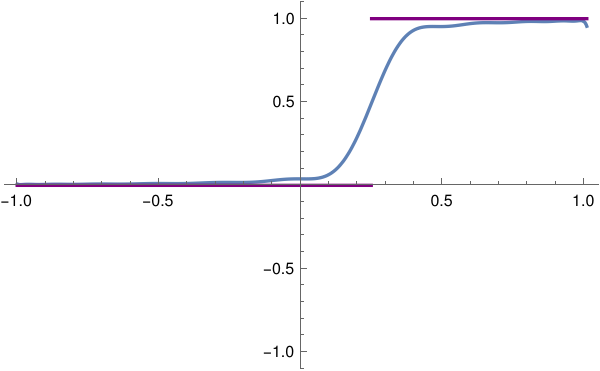
Figure 2: Cesàro regularization of Legendre approximation (blue)with 24 terms of shifted Heaviside function (purple). End of Example 8Example 9: Suppose we want to expand the signum function into the Fourier--Legendre series:
\[ \sum_{n\ge 0} c_n P_n (x) = \mbox{sign}(x) = \begin{cases} \phantom{-}1, & \ \mbox{ if} \quad 0 < x < 1, \\ -1, & \ \mbox{ if} \quad -1 < x < 0. \end{cases} \tag{6.1} \]Since signum function is an odd function, its Legendre series contains only terms with odd indices:\[ \mbox{sign}(x) = \sum_{k\ge 0} c_{2k+1} P_{2k+1} (x) . \tag{6.2} \]Using an integration formula\[ \int_{-1}^x P_n (t) \,{\text d}t = \frac{P_{n+1} (x) - P_{n-1} (x)}{2n+1} , \]we find the explicit expressions for the coefficients:\[ c_n = \frac{2n+1}{2}\,\int_{-1}^i \mbox{sign}(x)\, P_n (x) \,{\text d}x = P_{n-1} (0) - P_{n+1} (0) , \qquad n=1,2,\ldots , \]where \( P_{2k+1} (0) =0 \) and formulas for even indices was given previously:\[ P_{2k} (0) = (-1)^k \frac{(2k)!}{2^{2k} (k!)^2} . \]In particular, we have\[ \mbox{sign}(x) = \sum_{k\ge 0} \left( \frac{(-1)^k (4k+3) \left( 2k \right)!}{2^{2k+1} k! \left( k+1 \right)!} \right) P_{2k+1} (x) \qquad \mbox{for} \quad -1 < x < 1 . \tag{6.3} \]We now use Mathematica to calculate the coefficients up to arbitrary n, starting with n = 1.Module[{i}, coef = {}; Do[coef = Append[coef, (LegendreP[i - 1, 0] - LegendreP[i + 1, 0])], {i, 1, 30}]]The nth coefficient is then given by coef[[n]]. We sample a few values:coef[[21]]Out[34]= 180557/524288coef[[22]]Out[35]= 0All the even coefficients are zero.Now we define the mth partial sum, and then a graph of the mth partial sum, along with the original function. Because the coefficient of \( P_{0} (x)=1 \) is zero, we may start the sum over n with the n = 1 term. The given signum function is shown in blue and the partial sums in red.
legsum[m_, x_] := Module[{i}, Sum[N[coef[[i]]]*LegendreP[i, x], {i, 1, m}]]
legraph[m_] := Plot[{Sign[x], legsum[m, x]}, {x, -1.05, 1.05}, AxesLabel -> {"x", "Sign (x)"}, PlotRange -> {-1.5, 1.5}, PlotStyle -> {{RGBColor[0, 0, 1], Thickness[0.005]}, {RGBColor[1, 0, 0], Thickness [0.005]}}, PlotLabel -> Row[{"n=", PaddedForm[n, 3]}]]
legraph[30]You may want to construct a sequence of partial sums which may be animated to see the convergence: DynamicModule[{mangraph, i}, Do[mangraph[i] = legraph[i], {i, 1, 55, 2}]; Manipulate[mangraph[i], {i, 1, 51, 2}]]You can use the slider to move through the graphs, and also to display a movie of the graphs. When you do this, you will see the familiar Gibbs overshoot/undershoot at the discontinuity. It is also observed a struggle to converge at the endpoints.Module[{a}, coef = {}; Do[coef = Append[coef, (LegendreP[x - 1, 0] - LegendreP[x + 1, 0])], {x, 1, 100}]] legsum[m_, x_] := Module[{a}, -Sum[N[coef[[a]]]*LegendreP[a, x], {a, 1, m}]] leg[x_] = Piecewise[{{1, -1 <= x < 0}, {-1, 0 < x <= 1}}]; legraph[m_] := Plot[{leg[x], legsum[m, x]}, {x, -1, 1}, PlotRange -> {-1.5, 1.5}, PlotStyle -> {{RGBColor[0, 0, 1], Thickness[0.005]}, {RGBColor[1, 0, 0], Thickness[0.005]}}] legraph[10] legraph[100]
Numerical experiments show that the Legendre series (6.3) exhibits the Gibbs phenomenon at the origin---the point of discontinuity. The series also diverges at endpoints x = ±1. To eliminate unwanted overshoots and undershoots at the origin, we consider Cesàro approximation
\[ C_N (x) = \sum_{k= 0}^N \left( \frac{(-1)^k (4k+3) \left( 2k \right)!}{2^{2k+1} k! \left( k+1 \right)!} \right) \left( 1 - \frac{k}{N+1} \right) P_{2k+1} (x) \qquad \mbox{for} \quad -1 < x < 1 . \tag{6.4} \]sign25 = Sum[(-1)^k* N[(4*k + 3)* Factorial[2*k]/2^(2*k + 1)/Factorial[k + 1]/Factorial[k]]* LegendreP[2*k + 1, t], {k, 0, 25}];
sl = Plot[{sign25}, {t, -1, 1}, PlotStyle -> {This, Blue}, PlotRange -> {-1.3, 1.3}];
line1 = Graphics[{Dashed, Thick, Red, Line[{{0, 1.18}, {1, 1.18}}]}];
line2 = Graphics[{Dashed, Thick, Red, Line[{{-1.0, -1.18}, {0, -1.18}}]}];
td = Graphics[{Black, Text[Style["-1.18", Bold, 18], {0.3, -1.18}]}];
tu = Graphics[{Black, Text[Style["1.18", Bold, 18], {-0.2, 1.18}]}];
Show[line1, line2, sl25, td, tu, AspectRatio -> 0.6]
C25 = Sum[(-1)^k* N[(4*k + 3)* Factorial[2*k]/2^(2*k + 1)/Factorial[k + 1]/ Factorial[k]*(1 - (2*k + 1)/51)]*LegendreP[2*k + 1, t], {k, 0, 25}]; Plot[{C25}, {t, -1, 1}, PlotStyle -> {Thick, Blue}, PlotRange -> {-1.3, 1.3}]
■

Legendre approximation with N = 25. Cesàro approximation with N = 25. End of Example 9Example 10: The Dirac delta function admits the following Fourier--Legendre expansion:
\[ \delta (x-a) = \sum_{k\ge 0} \left( k + \frac{1}{2} \right) P_k (x)\, P_k (a) . \]or\[ \delta (x-a) = \frac{1}{2} \sum_{k\ge 0} \left( 2k+1 \right) P_k (x)\, P_k (a) . \]So the partial sums\[ \delta_N (x-a) = \frac{1}{2} \sum_{k= 0}^{N} \left( 2k+1 \right) P_k (x)\, P_k (a) \qquad \mbox{for} \quad |x| < 1, \]have the property:\[ \lim_{N\to \infty} \int_{-1}^1 {\text d}x \, \delta_N (x-a) \,f(x) = f(a) . \]■End of Example 10Example 11: We consider two functions
\[ f(x) = |x| \qquad\mbox{and} \qquad g(x) = \begin{cases} x, & \ \mbox{for} \quad x \ge 0, \\ 0, & \ \mbox{for} \quad x \le 0. \end{cases} \]The corresponding Fourier--Legendre series and its coefficients are \[ f(x) \,\sim\, \sum_{n\ge 0} a_n P_n (x) = \sum_{n\ge 0} \left( n + \frac{1}{2} \right) c_n P_n (x) , \] where \[ c_n = \int_{-1}^{+1} f(x)\,P_n (x)\,{\text d} x , \qquad n=0,1,2,\ldots . \] Since |x| is an even function, its Legendre series will contain only coefficients with even indices and we get \[ f(x) = \sum_{k\ge 0} a_{2k} P_{2k} (x) , \qquad a_{2k} = \left( 4k + 1 \right) \int_0^1 x\,P_{2k} (x)\,{\text d} x . \tag{11.1} \] The Legendre series for function g(x) has a similar structure: \[ g(x) = \sum_{n\ge 0} b_n P_n (x) , \qquad b_n = \left( n + \frac{1}{2} \right) \int_0^1 x\,P_{n} (x)\,{\text d} x . \] A succinct closed form of these coefficients is valid for all n ≥ 2, with the small cases n = 0,1 handled directly. This comes from the identity \[ \left( 2n+1 \right) x\,P_n (x) = n\,P_{n-1} + \left( n+1\right) P_{n+1} \] and the standard antiderivative \[ \int P_k=\frac{P_{k+1}-P_{k-1}}{2k+1}. \] The values at zero are \[ P_{2m}(0) = (-1)^m \frac{(2m)!}{2^{2m}(m!)^2},\qquad P_{2m+1}(0)=0. \] This immediately splits the integral into two clean regimes. Odd n ≥ 3: the integral vanishes because x Pₙ(x) is an odd function and the Legendre system is orthogonal on [-1,1], \[ \int_0^1 x\,P_n (x)\, {\text d}x = 0\qquad (n\ \mathrm{odd},\ n\geq 3). \] You can also see this directly from the closed form: all Pₖ(0) with odd k vanish, and the coefficients cancel. A compact closed form for first few coefficients can be obtained with the aid of Mathematica:Integrate[x*LegendreP[2, x], {x, 0, 1}]1/8\[ \int_0^1 x\,{\text d}x = \frac{1}{2} , \quad \int_0^1 x\,P_1 (x)\,{\text d}x = \frac{1}{3} , \quad \int_0^1 x\,P_2 (x)\,{\text d}x = \frac{1}{8} . \] Therefore, the Legendre series for function g(x) becomes \[ g(x) = \frac{1}{4} + \frac{x}{2} + \sum_{k\ge 1} b_{2k} P_{2k} (x) , \quad b_{2k} = \left( 2k + \frac{1}{2} \right) \int_0^1 x\,P_{2k} (x)\, {\text d}x . \tag{11.2} \] Comparison expansions (11.1) and (11.2) yields \[ a_{2k} = 2\cdot b_{2k} , \qquad k\ge 1. \] Hence, it is sufficient to evaluate coefficients 𝑎ₙ for n = 2m in expansion (11.1).In general, Mathematica provides a symbolic formula (parity‑aware)
LegendreMoment[n_] := Module[{m}, Which[ n == 0, 1/2, n == 1, 1/3, OddQ[n], 0, True, m = n/2; 1/((4 m - 1) (4 m + 3))* (1 - (-1)^m Binomial[2 m, m]/4^m * (m/(2 m - 1) - (m + 1)/(2 m + 1))) ] ]Fully symbolic version using LegendreP directly mirrors the derivation and is useful for verification or symbolic manipulation.LegendreMomentSymbolic[n_] := Simplify[ (n + 1)/((2 n + 1) (2 n + 3)) (1 - LegendreP[n + 2, 0]) + 1/((2 n - 1) (2 n + 3)) (1 - LegendreP[n, 0]) - n/((2 n + 1) (2 n - 1)) (1 - LegendreP[n - 2, 0]) ]These coefficients can be evaluated based on the formulas:\[ \int_{-1}^1 P_n (x)\,{\text d}x = 0 \qquad \mbox{and} \qquad \int_{-1}^a P_n (x)\,{\text d}x = \frac{1}{2n+1} \left[ P_{n+1} (a) - P_{n-1} (a) \right] . \]Since |x| is an even function, its Legendre series contains only even coefficients: \[ |x| \sim \sum_{k\ge 0} a_{2k} P_{2k} (x) , \] where \[ a_{2k} = \left( 2k + \frac{1}{2} \right) \int_{-1}^1 |x|\,P_{2k} (x)\,{\text d}x = \left( 4k + 1 \right) \int_{0}^1 t\,P_{2k} (t)\,{\text d}t, \quad k=0,1,2,\ldots . \] Using the recursive formula \[ \left( 2n + 1 \right) P_n (t) = P'_{n+1} (t) - P'_{n-1} (t) . \] we integrate by parts \begin{align*} a_{2k} &= \left( 4k + 1 \right)\int_{0}^1 t\,P_{2k} (t)\,{\text d}t = \int_{0}^1 t\,\left[ P'_{2k+1} (t) - P'_{2k-1} (t) \right] {\text d}t \\ &= \left[ P_{2k+1} (1) - P_{2k-1} (1) \right] - \int_{0}^1 \left[ P_{2k+1} (t) - P_{2k-1} (t) \right] {\text d}t \\ &= -\left. \frac{1}{4k+3} \left[ P_{2k+2} (t) - P_{2k} (t) \right] \right\vert_{t=0}^{t=1} + \left. \frac{1}{4k-1} \left[ P_{2k} (t) - P_{2k-2} (t) \right] \right\vert_{t=0}^{t=1} \\ &= \frac{1}{4k+3} \left[ P_{2k+2} (0) - P_{2k} (0) \right] - \frac{1}{4k-1}\left[ P_{2k} (0) - P_{2k-2} (0) \right] \\ &= \frac{1}{4k+3} \,P_{2k+2} (0) - \frac{8k+2}{(4k+3)(4k-1)}\, P_{2k} (0) + \frac{1}{4k-1}\, P_{2k-2} (0) , \end{align*} because Pₙ(1) = 1. A few first coefficients are \begin{align*} c_0 &= 1, \qquad a_0 = \frac{1}{2} = \int_0^1 t\,{\text d}t , \\ c_{2} &= \frac{1}{4} , \qquad a_2 = \frac{5}{8} = 5\, \int_0^1 t\, P_2 (t) \,{\text d} t , \\ c_{4} &= - \frac{1}{24} , \qquad a_4 = -\frac{3}{16} = 9\, \int_0^1 t\, P_4 (t) \,{\text d} t . \end{align*}Integrate[LegendreP[0, x]*Abs[x], {x, -1, 1}]1Integrate[LegendreP[2, x]*Abs[x], {x, -1, 1}]1/4Integrate[LegendreP[4, x]*Abs[x], {x, -1, 1}]-(1/24)Checking for k = 2, we get-1/11 *(LegendreP[6, 0] - LegendreP[4, 0]) + 1/7 * (LegendreP[4, 0] - LegendreP[2, 0])3/16To evaluate the value of 𝑎2k, we use the values of Legendre's polynomials at the origin: \[ P_{2m}(0)=(-1)^m\, \frac{(2m)!}{2^{2m}(m!)^2},\qquad P_{2m+1}(0)=0. \] Then \[ a_{2k} = \frac{1}{4k+3} \,(-1)^{k+1} \,\frac{(2k+2)!}{2^{2k+2}((k+1)!)^2} - \frac{8k+2}{(4k+3)(4k-1)}\,(-1)^k\, \frac{(2k)!}{2^{2k}(k!)^2} + \frac{1}{4k-1}\, (-1)^{k-1}\, \frac{(2k-2)!}{2^{2k-2}((k-1)!)^2} . \] Upon factoring the common term, we simplify \[ a_{2k} = (-1)^{k+1} \frac{(2k)!}{2^{2k}(k!)^2} \left[ \frac{1}{4k+3} \,\frac{(2k+1)}{2 (k+1)} + \frac{8k+2}{(4k+3)(4k-1)} + \frac{1}{4k-1}\,\frac{2k}{(2k-1)} \right] . \] We ask Mathematica for helpSimplify[ 1/(4*k + 3) (2 k + 1)/2 /(k + 1) + (8 k + 2)/(4 k + 3)/(4 k - 1) + 1/(4 k - 1) 2*k/(2 k - 1)](1 + 4 k)/(2 (-1 + k + 2 k^2))LegendreTPIntegral01[n_] := Module[{A = (n + 1)/((2 n + 1) (2 n + 3)), B = 1/((2 n - 1) (2 n + 3)), C = n/((2 n + 1) (2 n - 1))}, A (1 - LegendreP[n + 2, 0]) + B (1 - LegendreP[n, 0]) - C (1 - LegendreP[n - 2, 0])]LegendreTPIntegral01[18]143/262144So the Legendre series for f(x) becomes \[ |x| = \frac{c_0}{2} + \sum_{k\ge 1} \left( \frac{4k+1}{2} \right) c_{2k} P_{2k} (x) = \frac{1}{2} + \sum_{k\ge 1} (-1)^{k+1} \frac{(2k)!}{2^{2k}(k!)^2} \,\frac{1 + 4 k}{2 (-1 + k + 2 k^2)}\, P_{2k} (x) , \] with \[ a_0 = \frac{1}{2},\qquad a_{2k} = (-1)^{k+1} \frac{(2k)!}{2^{2k+1}(k!)^2} \cdot\frac{1 + 4 k}{\left( k+1 \right)\left( 2k-1 \right)} . \tag{11.3} \] We plot function |x| (in purple) and its 10-term approximation (in blue):s10[x_] = 1/2 - (1/2)* Sum[(-1)^k *(2*k)!/ 4^k /(k!)^2*(1 + 4*k)/(k + 1)/(2*k - 1) * LegendreP[2*k, x], {k, 1, 10}];
Plot[{s10[x], Abs[x]}, {x, -1.0, 1.01}, PlotStyle -> {Thick, {Blue, Purple}}, PlotRange -> Automatic]Now we consider function, g(x). Its Fourier--Legendre series is \[ g(x) = \frac{1}{4} + \frac{x}{2} - \frac{1}{4} \sum_{k\ge 1} (-1)^{k} \frac{(2k)!}{2^{2k}(k!)^2} \,\frac{1 + 4 k}{2 (-1 + k + 2 k^2)}\, P_{2k} (x) \]
g[x_] = Piecewise[{{0, x < 0}, {z, x >= 0}}]
g10[x_] = 1/4 + x/2 - (1/4)* Sum[(-1)^k *(2*k)!/ 4^k /(k!)^2*(1 + 4*k)/(k + 1)/(2*k - 1) * LegendreP[2*k, x], {k, 1, 10}];
Plot[{g10[x], g[x]}, {x, -1.0, 1.01}, PlotStyle -> {Thick, {Blue, Purple}}, PlotRange -> Automatic]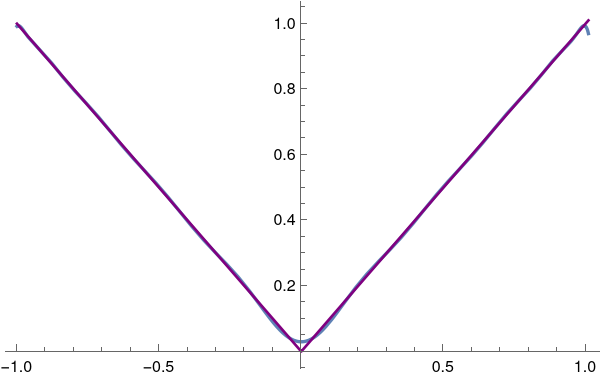
Figure 11.1: Legendre approximation (blue) with 10 terms of |x| (purple). 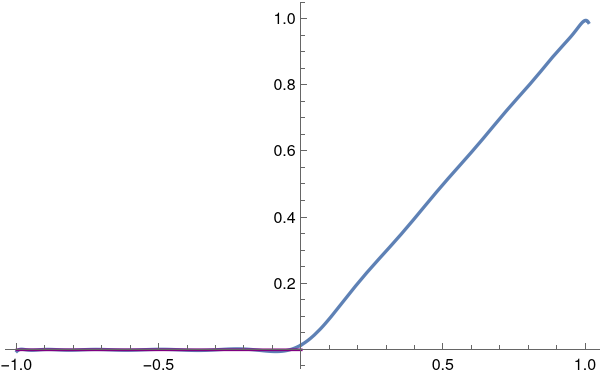
Figure 11.2: Legendre approximation (blue)with 10 terms of g(x) (purple). End of Example 11Example 12: We consider the piecewise differentiable function
\[ f(x) = \begin{cases} x^2 , & \mbox{ when} \quad x \ge 0 , \\ 0, & \mbox{ when} \quad x \le 0 . \end{cases} \tag{12.1} \]Expanding this function into Legendre series, we get\[ f(x) = \sum_{n\ge 0} c_n P_n (x) , \qquad c_n = \left( n + \frac{1}{2} \right) \int_0^1 x^2 P_n (x) \,{\text d} x . \tag{12.2} \]Using formula\[ P'_{n+1} (x) - P'_{n-1} (x) = \left( 2n+1 \right) P_n (x) , \quad n\ge 1 , \tag{12.3} \]we integrate by parts\[ c_n = \frac{1}{2}\, \int_0^1 x^2 \frac{\text d}{{\text d}x} \left( P_{n+1} (x) - P_{n-1} (x) \right) {\text d} x = \frac{1}{2} \left( P_{n+1} (1) - P_{n-1} (1) \right) - \int_0^1 x \left( P_{n+1} (x) - P_{n-1} (x) \right) {\text d} x . \]Since Pn(1) = 1, we get again upon integration by parts,\begin{align*} c_n &= - \frac{1}{2n+3}\,\int_0^1 x\, \frac{\text d}{{\text d}x} \left[ P_{n+2} (x) - P_n (x) \right] {\text d} x + \frac{1}{2n-1}\,\int_0^1 x\, \frac{\text d}{{\text d}x} \left[ P_{n} (x) - P_{n-2} (x) \right] {\text d} x - \\ &= \frac{1}{2n+3}\,\int_0^1 \left[ P_{n+2} (x) - P_n (x) \right] {\text d} x - \frac{1}{2n-1}\,\int_0^1 \left[ P_{n} (x) - P_{n-2} (x) \right] {\text d} x \\ &= -\frac{1}{2n+3}\,\frac{1}{2n+5} \left[ P_{n+3} (0) - P_{n+1} (0) \right] + \frac{1}{2n+3}\,\frac{1}{2n+1} \left[ P_{n+1} (0) - P_{n-1} (0) \right] \\ & \quad + \frac{1}{2n-3}\,\frac{1}{2n-1} \left[ P_{n+1} (0) - P_{n-1} (0) \right] - \frac{1}{2n+1}\,\frac{1}{2n-1} \left[ P_{n-1} (0) - P_{n-3} (0) \right] . \end{align*}The value of a Legendre polynomial Pₙ(x) at x = 0 is 0 if n is odd, and a non-zero value if n is even, specifically \( \displaystyle \quad P_{2k} (0) = (-1)^k \frac{(2k)!}{2^{2k} (k! )^2} \quad \left( \mbox{or} \quad P_{2k} (0) = (-1)^k \frac{(2k-1)!!}{(2k)!!} \right) , \quad \) with common values being P₀(0) = 1, P₂(0) = −½, P₄(0) = ⅜. Legendre polynomials are either even or odd functions, so they only have non-zero values at x = 0 for even n.We check with Mathematica:
Integrate[LegendreP[0, x]*x^2, {x, 0, 1}]1/3Integrate[LegendreP[1, x]*x^2, {x, 0, 1}]1/4Integrate[LegendreP[2, x]*x^2, {x, 0, 1}]2/15Integrate[LegendreP[3, x]*x^2, {x, 0, 1}]1/24Integrate[LegendreP[4, x]*x^2, {x, 0, 1}]0Integrate[LegendreP[5, x]*x^2, {x, 0, 1}]-(1/192)Integrate[LegendreP[6, x]*x^2, {x, 0, 1}]0Therefore, we have \[ f(x) \sim 1 + \frac{x}{4} + \frac{2}{15}\, P_2 (x) + \frac{1}{24}\,P_3 (x) + \sum_{k\ge 2} c_{2k+1} P_{2k+1} (x) , \] where \begin{align*} c_{2k+1} &= \frac{1}{4k+5}\,\frac{1}{4k+3} \left[ P_{2k+2} (0) - P_{3k} (0) \right] - \frac{1}{4k+5}\,\frac{1}{4k+7} \left[ P_{2k+4} (0) - P_{2k+2} (0) \right] \\ & \quad + \frac{1}{4k-1}\,\frac{1}{4k+1} \left[ P_{2k+2} (0) - P_{2k} (0) \right] - \frac{1}{4k+3}\,\frac{1}{4k+1} \left[ P_{2k} (0) - P_{2k-2} (0) \right] . \end{align*}f[x_] = Piecewise[{{0, x < 0}, {x^2, x > 0}}]; c[k_] = (LegendreP[2*k + 2, 0] - LegendreP[2*k, 0])/(4*k + 5)/(4*k + 3) - (LegendreP[4*k + 4, 0] - LegendreP[4*k + 2, 0])/(4*k + 7)/(4*k + 5) + (LegendreP[2*k + 2, 0] - LegendreP[2*k, 0])/(4*k + 1)/(4* k - 1) - (LegendreP[2*k, 0] - LegendreP[2*k - 2, 0])/(4*k + 3)/(4*k + 1); s24 = 1 + x/4 + 2/15 * LegendreP[2, x] + LegendreP[3, x]/24 + Sum[c[k]*LegendreP[2*k + 1, x], {k, 2, 24}]; Plot[{s24, f[x]}, {x, -1.0, 1.01}, PlotStyle -> {Thick, {Blue, Purple}}, PlotRange -> {-1.1, 1.1}]?????????\[ P_{2k+1} (0) = 0, \qquad P_{2k} (0) = (-1)^k \frac{(2k-1)!!}{(2k)!!} , \]■End of Example 12Now we go into complex variable domain and conventionally use
\[ P_n (z) = \sum_{k=0}^{\lfloor n/2 \rfloor} \frac{(-1)^k \left( 2n - 2k \right) !}{2^n k! \, (n-k)!\, (n- 2k)!}\, z^{n-2k} = \frac{1}{2\pi {\bf j}} \oint_C \frac{( t^2 -1 )^n}{2^n \left( t-z \right)^{n+1}}\,{\text d}y , \]where C is a closed contour surrounding the point t = z. This formula was discovered by Ludwig Schläfli (1814--1895).Another linearly independent solution of the Legendre equation \eqref{Eqlegendre.1} is the Legendre functions of the second kind, denoted as
\[ Q_n (z) = P_n (z) \int^z \frac{{\text d}z}{\left( z^2 -1 \right) \left\{ P_n (z) \right\}^2} = \frac{1}{2}\,P_n (z) \ln \frac{z+1}{z-1} - W_{n-1} (z) , \]where Wₙ is a polynomial of degree n, and the path of integration does not cross the cut of logarithm function. Mathematica has a dedicated command for this function: LegendreQ[n, x].Example 13: A German mathematician by the name of Eduard Heine (1821–1881) discovered in 1851 (Theorie der Anziehung eines Ellipsoids, (E. Heine, pp. 70-82), Journal für die reine und angewandte Mathematik, 42 (1851), 70--82) the Legendre expansion of 1/(z − u): \[ \frac{1}{z-u} = \sum_{r\ge 0} a_r P_r (u) , \] where coefficients are given by \[ a_r = \frac{2r +1}{2} \int_{-1}^1 \frac{P_r (u)}{z-u}\,{\text d}u = \left( 2r + 1 \right) Q_r (z) . \] This suggests the formula \[ \frac{1}{z-u} = \sum_{k\ge 0} \left( 2k+1 \right) Q_k (z)\,P_k (u) \tag{22.1} \] The following proof of formula (22.1) is due to Christoffel (Über die Gaußische Quadratur und eine Verallgemeinerung derselben, (E.B. Christoffel, pp. 61-82), Journal für die reine und angewandte Mathematik, 55 (1858), 61--82).
When k ≥ 1, it follows from the recurrence relations \begin{align*} \left( 2k + 1 \right) z\, Q_k (z) &= \left( k+1 \right) Q_{k+1} (z) + k\, Q_{k-1} (z) , \\ \left( 2k + 1 \right) u\, P_k (u) &= \left( k+1 \right) P_{k+1} (u) + k\, P_{k-1} (u) , \end{align*} that \begin{align*} & \left( 2k + 1 \right) \left( z-u \right) Q+k (z)\, P_k (u) \\ & \qquad = \left( k+1 \right) \left\{ Q_{k+1} (z)\,P_k (u) - Q_k (z)\,P_{k+1} (u) \right\} \\ & \qquad \quad -k \left\{ Q_k (z)\,P_{k-1} (u) - Q_{k-1} (z) P_k (u) \right\} . \end{align*} The corresponding formula when k = 0 is \[ \left( z-u \right) Q_0 (z)\, P_0 (u) = \left\{ Q_1 (z)\, P_0 (u) - Q_0 (z)\, P_1 (u) \right\} + 1 . \] From these two formulas, we have by addition \begin{align*} &\sum_{k=0}^n \left( 2k + 1 \right) Q_k (z)\, P_k (u) \\ & \qquad = \frac{1}{z-u} + \frac{n+1}{z-u} \left\{ Q_{n+1} (z)\, P_n (u) - Q_n (z)\, P_{n+1} (u) \right\} . \end{align*} To prove Heine's formula, we have therefore to show that \[ \left( n+1 \right) \left\{ Q_{n+1} (z)\, P_n (u) - Q_n (z)\, P_{n+1} (u) \right\} \] tends to zero as n tends to infinity.
Now, if z = cosh(α + ⅉβ) where α > 0, ⅉ² = −1, and if ϕ is real, we get \begin{align*} &\left\vert z + \left( z^2 -1 \right)^{1/2} \cosh\phi \right\vert = \left\vert \cosh (\alpha + {\bf j}\beta ) + \sinh (\alpha + {\bf j}\beta )\,\cosh\phi \right\vert \\ & \qquad = \left\{ \frac{1}{2} \left( \cosh 2\alpha + \cosh 2\beta \right) + \sinh 2\alpha \,\cosh\phi + \right. \\ & \qquad \quad \left. + \frac{1}{2} \left( \cosh 2\alpha - \cosh 2 \beta \cosh^2 \phi \right) \right\}^{1/2} \\ & \qquad \ge \left\{ \cosh 2\alpha + \sinh 2\alpha\,\cosh\phi \right\} \ge e^{\alpha} . \end{align*} From Heine's integral \[ Q_n (z) = \int_0^{\infty} \left[ z + \left( z^2 -1 \right)^{1/2} \cosh \phi \right]^{-n-1} {\text d}\phi , \] it follows \begin{align*} \left\vert Q_n (z) \right\vert &= \left\vert \int_0^{\infty} \left[ z + \left( z^2 -1 \right)^{1/2} \cosh \phi \right]^{-n-1} {\text d}\phi \right\vert \\ & \leqslant \int_0^{\infty} \left[ \cosh 2\alpha + \sinh 2\alpha\,\cosh\phi \right]^{-(n+1)/2} {\text d}\phi \\ & \leqslant e^{-(n-1)\alpha} \int_0^{\infty} \left[ \cosh 2\alpha + \sinh 2\alpha \,\cosh\phi \right]^{-1} {\text d}\phi \\ & \leqslant e^{-(n-1)\alpha} Q_0 (\cosh 2\alpha ) . \end{align*} Similarly, if u = cosh(γ + jδ), where γ > 0, and if θ is real, we have \begin{align*} &\quad \left\vert u + \left( u^2 -1 \right)^{1/2} \cos\theta \right\vert \\ &= \left\vert \cosh (\gamma + {\bf j}\delta ) + \sinh (\gamma + {\bf j}\delta )\,\cos\theta \right\vert \\ &= \left[ \frac{1}{2} \left( \cosh 2\gamma + \cos 2\delta \right) + \sinh 2\gamma \,\cos\theta + \frac{1}{2} \left( \cosh 2\gamma - \cos 2\delta \right) \cos^2 \theta \right]^{1/2} \\ & \leqslant \left[ \cosh 2\gamma + \sinh 2\gamma \right]^{1/2} = e^{\gamma} , \end{align*} and so, by Laplace's first integral \[ P_n (z) = \frac{1}{\pi} \int_0^{\pi} \left[ z + \left( z^2 -1 \right)^{1/2} \cos\phi \right]^n {\text d}\phi , \] we have \[ \left\vert P_n (u) \right\vert = \frac{1}{\pi} \left\vert \int_0^{\pi} \left[ z + \left( z^2 -1 \right)^{1/2} \cos\phi \right]^n {\text d}\phi \right\vert \leqslant e^{n\gamma} . \] Now suppose that α is fixed and that ϵ is an arbitrary positive number less than α. Then when 0 ≤ γ ≤ &alpha − ϵ, we find that \begin{align*} &\left( n+1 \right) \left\vert Q_{n+1} (z)\, P_n (u) - Q_n (z)\, P_{n+1} (u) \right\vert \\ & \leqslant \left( n+1 \right) \left[ e^{-n\alpha} Q_0 (\cosh 2\alpha ) \, e^{n\gamma} + e^{-(n-1) \alpha} Q_0 (\cosh 2\alpha )\, e^{(n+1)\gamma} \right] \\ &= \left( n+1 \right) Q_0 (\cosh 2\alpha )\, e^{n\left( \gamma - \alpha \right)} \left[ 1 + e^{2\alpha} \right] \\ & < \left( n+1 \right) Q_0 (\cosh 2\alpha )\,e^{-n\epsilon} \left[ 1 + e^{2\alpha} \right] . \end{align*} This last expression does not depend on β, γ, or δ, and tends to zero as n tends to infinity. It follows that the series \[ \sum_{n\ge 0} \left( 2n+1 \right) Q_n (z)\, P_n (u) \] converges uniformly with respect to β, γ, and δ, and has sum 1/(z − u).
The simplest way of stating this result is to use geometrical language. If we keep α fixed and vary β, the point z = cosh(α + jβ) traces out an ellipse with foci at the points of affix ±1 and major axis of length 2 cosh2α. The condition 0 ≤ γ ≤ α − ϵ means that u = cosh(γ + ⅉδ) lies within or on the smaller confocal ellipse of major axis 2 cosh(α − ϵ). This result can be reformulated as follows:
The series \[ \sum_{n\ge 0} \left( 2n + 1 \right) Q_n (z)\, P_n (u) \] converges uniformly with respect to z and u when z lies on a fixed ellipse C with foci at the points of affix ±1 and u lies in any closed domain definitely within C. The sum of the series is 1/(z − u). ■
End of Example 13Example 14: Let us consider the odd, 2π-periodic function \[ f(x) = \begin{cases} \frac{\sin (1/x)}{x\,\ln (1/|x|)} , &\quad 0 < |x| < e^{-2} , \\ 0, &\quad e^{-2} \le |x| \le 1 \end{cases} \] extended by f(0) = 0. We know that \[ |f(x) | \,\sim \, \frac{1}{|x|\, \ln (1/|x|)} \quad (x\to 0), \] and \[ \int_0^{e^{-1}} |f(x)|\,{\text d}x = \int_{e^2}^{\infty} \frac{{\text d}t}{t} = \infty . \] So f ∉ 𝔏¹([−1, 1])
The formal Legendre expression of f is \[ f(x) = \sum_{n\ge 0} a_n P_n (x) , \] with coefficients \[ a_n = \frac{2n+1}{2} \,\int_{-1}^1 f(x)\,P_n (x)\,{\text d}x , \] whenever the integral makes sense. Since f is odd and Pₙ is even for even n and odd for odd n, we have
- 𝑎ₙ = 0 for all even n,
- only odd indices contribute: \[ a_{2k+1} = \frac{4k+ 3}{2} \, \int_{-1}^1 f(x)\,P_{2k+1} (x)\,{\text d}x , \]
Thus, for each fixed n, the improper integral \[ \int_{-1}^1 f(x)\,P_n (x)\,{\text d}x \] converges, and all Legendre coefficients 𝑎ₙ exist (in the same classical, oscillatory sense as the Fourier coefficients).
Define a distribution Tf ∈ 𝒟′(−1, 1) by \[ \left\langle T_f , \varphi \right\rangle = \mbox{V.P.}\,\int_{-1}^1 f(x)\,\varphi (x)\,{\text d}x , \quad \varphi \in ℭ_c^{\infty}(-1,1). \] Here the set of test functions 𝒟 = ℭ∞c consists of all infinitely differentiable functions with compact support in (−1, 1). . Then the Legendre coefficients can be written distributionally as \[ a_n = \frac{2n+1}{2}\, \left\langle T_f , P_n \right\rangle . \] Becayse Pₙ is smooth and bounded, and we just sgowed the corresponding improper integrals converge, this pairing is well defined for every n. The Legendre series \[ \sum_{n\ge 0} a_n P_n (x) \] converges to Tf in the sense of distributions: \[ T_f = \sum_{n\ge 0} a_n P_n (x) \qquad \mbox{in }\ 𝒟'(-1,1) . \] Pointwise, as with Fourier series, the convergence is delicate:
- for x ≠ 0, where f is smooth, the partial sums converge to f(x);
- near x = 0, the singularity and slow decay of 𝑎ₙ prevent any uniform or 𝔏p convergece, but distributional convergence remains valid.
End of Example 14Theorem 22 (K. Neumann): If f(z) is an analytic function regular within and on an ellipse C with foci at the points of affix ±1, it can be expanded as a series of Legendre polynomials \[ f(x) = \sum_{n\ge 0} c_n P_n (z) , \qquad c_n = \frac{2n+1}{2\pi{\bf j}} \oint_C f(u)\,Q_n (u)\,{\text d} u , \] that converges uniformly when z lies within or on a smaller ellipse C₁, confocal with C.For if u is any point within or on C₁, we have \begin{align*} f(u) &= \frac{1}{2\pi{\bf j}} \oint_C f(z)\,\frac{{\text d}z}{z-u} \\ &= \frac{1}{2\pi{\bf j}} \oint_C f(z)\,\sum_{n\ge 0} \left( 2n+1 \right) Q_n (z)\,P_n (u)\,{\text d}z \\ &= \frac{1}{2\pi{\bf j}}\, \sum_{n\ge 0} \oint_C f(z)\,\left( 2n+1 \right) Q_n (z)\,P_n (u)\,{\text d}z , \end{align*} the inversion of the order of integration being valid since the infinite series under the sign of integration is uniformly convergent with respect to z and u when z lies on C. Then it follows that f(u) can be expressed as a uniformly convergent series \[ f(u) = \sum_{n\ge 0} c_n P_n (u) , \] where \[ c_n = \frac{2n+1}{2\pi{\bf j}} \oint_C f(z)\,Q_n (z)\,{\text d} z. \] This completes the proof of Karl Neumann's expansion theorem.Example 15: We choose a function f(z) = 1/(z − 2) that is:
- analytic on and inside a given ellipse with foci at ±1,
- non‑polynomial (so the Legendre series is genuinely infinite),
- easy to compute with.
Confocal ellipses with foci ±1 are described by: \[ z=\cosh \rho \cos \theta + {\bf j}\sinh \rho \sin \theta ,\qquad \rho =\mathrm{constant}. \] Large ellipse (ρ big)
Suppose f(z) is analytic on and inside some ellipse C with foci ±1. That ellipse is the outer boundary of analyticity. Inside it, everything is smooth and holomorphic. Outside it, something goes wrong—there is a singularity somewhere.
Legendre polynomials Pₙ(z) are orthogonal on [-1,1]. But their analytic continuation naturally extends to the entire complex plane. Their growth outside [-1,1] is controlled by the same confocal ellipses: \[ |P_n(z)|\sim (\cosh \rho )^n\quad \mathrm{when\ }z\mathrm{\ lies\ on\ the\ ellipse\ }\rho . \] So the geometry of the ellipses is built into the polynomials themselves.
If f(z) is analytic on a large ellipse C, then its Legendre coefficients decay like: \[ \sim (\cosh \rho _C)^{-n}, \] where ρC is the parameter of the ellipse C. This means:
- The Legendre series converges inside that ellipse.
- But not necessarily up to it.
- And certainly not beyond it.
Clear[ellipse] ellipse[ρ_] := ParametricPlot[ {Cosh[ρ] Cos[θ], Sinh[ρ] Sin[θ]}, {θ, 0, 2 Pi}, PlotRange -> {{-3, 3}, {-2, 2}}, PlotStyle -> Thick ]Show[ {ellipse[0.3], ellipse[0.6], ellipse[1.0], ellipse[1.3]}, Epilog -> { Red, PointSize[Large], Point[{-1, 0}], Point[{1, 0}], Text[Style["-1", 14], {-1, -0.2}], Text[Style["+1", 14], {1, -0.2}] }, Axes -> True, AxesOrigin -> {0, 0}, AspectRatio -> Automatic ]To determine how Pₙ(z) behaves on a confocal ellipse, we pick an ellipse with parameter ρ = 0.8. Evaluate Pₙ(z(θ)) along that ellipse.\[Rho] = 0.8; z[\[Theta]_] := Cosh[\[Rho]] Cos[\[Theta]] + I Sinh[\[Rho]] Sin[\[Theta]]; Plot[Evaluate@ Table[Abs[LegendreP[n, z[\[Theta]]]], {n, 0, 6}], {\[Theta], 0, 2 Pi}, PlotRange -> All, PlotLegends -> Placed[LineLegend[Range[0, 6]], {0.85, 0.75}], AxesLabel -> {"\[Theta]", "|P_n(z(\[Theta]))|"}, PlotLabel -> "Growth of Legendre Polynomials on a Confocal Ellipse"]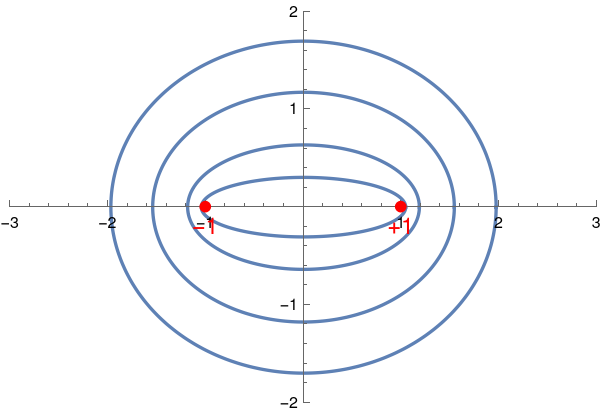
Figure 15.1: Ellipses 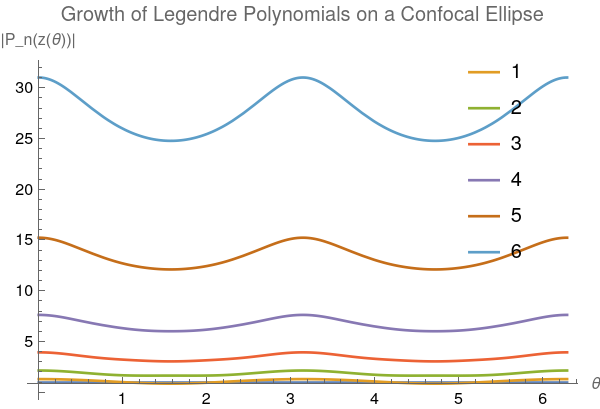
Figure 15.2: Legendre polynomials on ellipse Why “smaller ellipse” and not the whole region? Because the Legendre series behaves like a power series in the variable \[ z=\cosh \rho \cos \theta + {\bf j}\,\sinh \rho \sin \theta \qquad ({\bf j}^2 = -1). \] Just as a Taylor series converges inside the largest circle avoiding singularities, a Legendre series converges inside the largest ellipse avoiding singularities. The ellipse plays the role of the “circle of convergence”.
Neumann’s theorem says: If f(z) is analytic on and inside an ellipse C with foci ±1, then its Legendre expansion converges uniformly on any smaller confocal ellipse C₁.
Geometrically:
- The outer ellipse is the analytic boundary.
- The inner ellipse is the convergence region.
- The Legendre polynomials “feel” the geometry of the ellipse because their growth is controlled by cosh ρ.
- The confocal ellipses are the natural level sets of the analytic continuation of both f and Pₙ.
This picture shows the exponential growth rate ∼ (cosh ρ )ⁿ, which is the geometric heart of Neumann’s theorem. We use the exact Legendre expansion: \[ f(z)=\frac{1}{z-2}=-\sum _{n=0}^{\infty }\frac{2n+1}{2^{n+2}}P_n(z). \] Let’s visualize convergence on an ellipse strictly inside the analytic boundary.
f[z_] := 1/(z - 2); coeff[n_] := -(2 n + 1)/2^(n + 2); partialSum[z_, Nmax_] := Sum[coeff[n] LegendreP[n, z], {n, 0, Nmax}]; ρ = 0.6; z[θ_] := Cosh[ρ] Cos[θ] + I Sinh[ρ] Sin[θ]; Plot[ Evaluate@Table[ Abs[f[z[θ]] - partialSum[z[θ], Nmax]], {Nmax, {2, 4, 6, 8, 10}} ], {θ, 0, 2 Pi}, PlotRange -> All, PlotLegends -> Placed[LineLegend[{2, 4, 6, 8, 10}], {0.85, 0.75}], AxesLabel -> {"θ", "Error"}, PlotLabel -> "Uniform Convergence of Legendre Series on a Confocal Ellipse" ]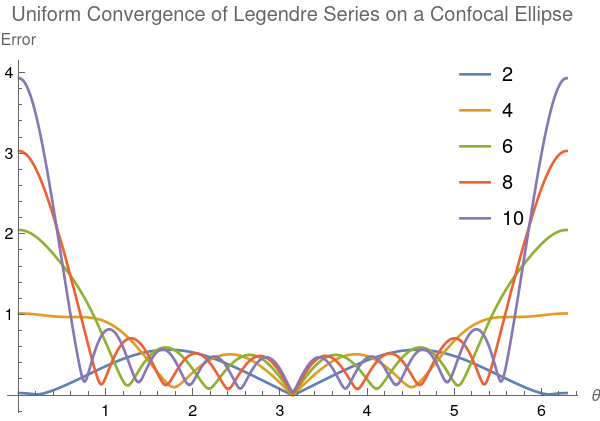
Figure 15.3: Uniform Convergence of Legendre Series The ellipse has semimajor axis 𝑎 = cosh ρ. The singularity of f(z) at z=2 lies on the real axis. The largest ellipse on which f is analytic is the one with cosh ρ₀ = 2. So any ellipse with ρ < &rho₀ is a “smaller confocal ellipse” C₁ where the Legendre series converges uniformly.
For any smaller ellipse C₁ with semimajor axis 𝑎₁ < 2, the series \[ \sum _{n=0}^{\infty }\frac{2n+1}{2^{n+2}}P_n(z) \] converges uniformly on and inside C₁. This is precisely the content of Neumann’s theorem.
Let us consider a numerical illustration example. Take the ellipse with semimajor axis 𝑎 =1.5. This corresponds to the domain inside the analytic region. Then: \[ f(z)=\frac{1}{z-2}\approx -\sum _{n=0}^N\frac{2n+1}{2^{n+2}}P_n(z) \] converges uniformly on that ellipse.
For example, at z = 1.2: \begin{align*} S_0 (f;1.2) &= \frac{1}{1.2-2}=-1.25 , \\ S_1 (f;1.2) &= -0.25 - \frac{3}{8}\,P_1 (1.2) \approx -0.70 , \\ S_2 (f;1.2) &= -0.70 - \frac{5}{16}\,P_2 (1.2) \approx -1.07 , \\ S_3 (f;1.2) &\approx -1.20 , \\ S_4 (f;1.2) &\approx -1.24, \\ S_5 (f;1.2) &\approx -1.249 . \end{align*} The convergence is rapid because the nearest singularity is at distance 2 from the origin. The series converges uniformly on any ellipse with foci ±1 whose semimajor axis is < 2. This is a direct illustration of Neumann’s theorem.
Legendre expansions converge inside confocal ellipses. The entire story takes place in the complex plane, but the geometry is entirely real and visual. Everything begins with the two points ±1. These are the foci of a whole family of confocal ellipses. Every ellipse in this family satisfies: \[ |z-1|+|z+1|=\mathrm{constant}. \] The family of confocal ellipses are indexed by a parameter ρ > 0: \[ z(\theta )=\cosh \rho \cos \theta +i\sinh \rho \sin \theta . \] Semimajor axis: 𝑎 = cosh ρ. Semiminor axis: b = sinh ρ. Foci: ± 1. As ρ increases, the ellipse expands outward:
Animate[ ParametricPlot[ {Cosh[ρ] Cos[θ], Sinh[ρ] Sin[θ]}, {θ, 0, 2 Pi}, PlotRange -> {{-3, 3}, {-2, 2}}, PlotStyle -> Thick, Epilog -> { Red, PointSize[Large], Point[{-1, 0}], Point[{1, 0}] }, Axes -> True, AxesOrigin -> {0, 0}, AspectRatio -> Automatic ], {ρ, 0.1, 1.5} ]This gives a beautiful dynamic visualization of the confocal geometry underlying Legendre expansions. ■End of Example 15There are known also associated Legendre polynomials (or functions):Laplace series
\begin{equation} \label{Eqlegendre.3a} P_n^m (x) = P_{n,m} (x) = (-1)^m \left( 1 - x^2 \right)^{m/2} \frac{{\text d}^m}{{\text d} x^m} \, P_n (x) , \qquad m=0,1,2,\ldots , n, \quad x \in (-1,1) , \end{equation}that are eigenfunction of the singular Sturm--Liouville problem\begin{equation} \label{Eqlegendre.4a} \left( 1-x^2\right) y'' -2x\,y' + \left( \lambda - \frac{m^2}{1-x^2} \right) y =0 , \qquad x \in (-1, 1), \qquad y(\pm 1) < \infty , \qquad \lambda = n(n+1) . \end{equation}It turns out that the associated Legendre's polynomials are orthogonal\begin{equation} \label{Eqlegendre.6a} \int_{-1}^1 P_n^m (x) \, P_k^m (x) \,{\text d} x = \begin{cases} 0 , & \ \mbox{for} \quad n\ne k, \\ \frac{2}{2n+1} \cdot \frac{(n+m)!}{(n-m)!}, & \ \mbox{for} \quad n = k . \end{cases} \end{equation}Also, they satisfy the orthogonality condition for fixed n with weightw = 1/(1 - x²): \begin{equation} \label{Eqlegendre.7a} \int_{-1}^1 \frac{P_n^i (x) \, P_n^m (x)}{1 - x^2} \,{\text d} x = \begin{cases} 0 , & \ \mbox{for} \quad m\ne i, \\ \frac{(n+m)!}{2(n-m)!}, & \ \mbox{for} \quad m = i \ne 0 , \\ \infty , & \ \mbox{for} \quad m = i =0. \end{cases} \end{equation}For any integer m, we can expand a smooth function into series with respect to associated Legendre functions
\begin{equation} \label{Eqlegendre.11} f(x) = \sum_{n\ge m} a_n P_n^m (x) , \qquad a_n = \left( n + \frac{1}{2} \right) \frac{(n-m)!}{(n+m)!} \,\int_{-1}^1 f(x)\,P_n^m (x)\,{\text d}x , \quad n=0,1,2,\ldots . \end{equation}When derivative of f(x) satisfies the condition\[ \int_{-1}^1 \left( f'^2 (x) + \frac{m^2 f^2 (x)}{1-x^2} \right) {\text d}x < \infty , \]then eigenfunction expansion \eqref{Eqlegendre.11} converges uniformly.- Suppose that f(z) is an analytic function regular in an annulus bounded externally by an ellipse C₂ with foci at the points of affix ±1, and internally by a smaller confocal ellipse C₁. Show that f(z) can be expanded as a series of the form \[ f(z) = \sum_{n\ge 0} a_n P_n (z) + \sum_{n\ge 0} b_n Q_n (z) , \] where \begin{align*} a_n &= \frac{2n+1}{2\i{\bf j}} \oint_{C_2} f(z)\,Q_n (z)\,{\text d} z , \\ b_n &= \frac{2n+1}{2\i{\bf j}} \oint_{C_1} f(z)\,P_n (z)\,{\text d} z . \end{align*}
- Abramowitz, M. & Stegun, I. A., Handbook of Mathematical Functions: with Formulas, Graphs, and Mathematical Tables, (Dover Books on Mathematics), 1965.
- Askey, R., Orthogonal Polynomials and Special Functions, AMS, Contemporary Mathematics, Volume: 471; 2008.
- Bera, R.K. and Ghodadra, B.L., Convergence Rate of Fourier–Legendre Series of Functions of Generalized Bounded Variation, Mathematical Notes, 116 (2024), 168–181.
- Bera, R.K. and Ghodadra, B.L., Rate of convergence Rate of Fourier–Legendre Series of Functions of class (nα)BVp[−1, 1], Acta et Commentationes Universitatis Tartuensis de mathematica, Volume 28, Number 2, 2024; Available online at https://ojs.utlib.ee/index.php/ACUTM
- Bojanić, R. and Vuilleumier, M., On the Rate of Convergence of Fourier–Legendre Series of Functions of Bounded Variation, Journal of Approximation Theory, 31 (1981), 67–79.
- Courant, R. and Hilbert, D., Methods of Mathematical Physics, Vol. I, Wiley-VCH, 1989.
- Christoffel, E. B. (1858), "Über die Gaußische Quadratur und eine Verallgemeinerung derselben.", Journal für die Reine und Angewandte Mathematik (in German), 55: 61–82, doi:10.1515/crll.1858.55.61
- Freud, G., Orthogonal Polynomials, Pergamon, 2014.
- Gasper — Positive Kernels and Orthogonal Polynomials,
- Goginava, U., Classes of Functions of Bounded Generalized Variation, arXiv:1210.2511
- Hobson, E.W., The Theory of Spherical and Ellipsoidal Harmonics, Cambridge University Press, 2012.
- Muckenhoupt, B. Mean convergence of orthogonal series. Transactions of the American Mathematical Society, 147 (1970), 419-431. DOI: https://doi.org/10.1090/S0002-9947-1970-99933-9
- Pollard, H., The mean convergence of orthogonal series, Transactions of the American Mathematical Society, Vol. 62, No. 3 (Nov., 1947), pp. 387-403.
- Stein, E.M. and Weiss, G., Introduction to Fourier Analysis on Euclidean Spaces, Princeton University Press, 1971.
- Szegő, G., Orthogonal Polynomials, American Mathematical Society, 1939.
Return to Mathematica page
Return to the main page (APMA0340)
Return to the Part 1 Matrix Algebra
Return to the Part 2 Linear Systems of Ordinary Differential Equations
Return to the Part 3 Non-linear Systems of Ordinary Differential Equations
Return to the Part 4 Numerical Methods
Return to the Part 5 Fourier Series
Return to the Part 6 Partial Differential Equations
Return to the Part 7 Special Functions - Approximate identity: